Step by step
What not to do
- Don't say 'You can't manage this house anymore.' Use 'I' statements like 'I worry about you living alone and would love to have you closer.'
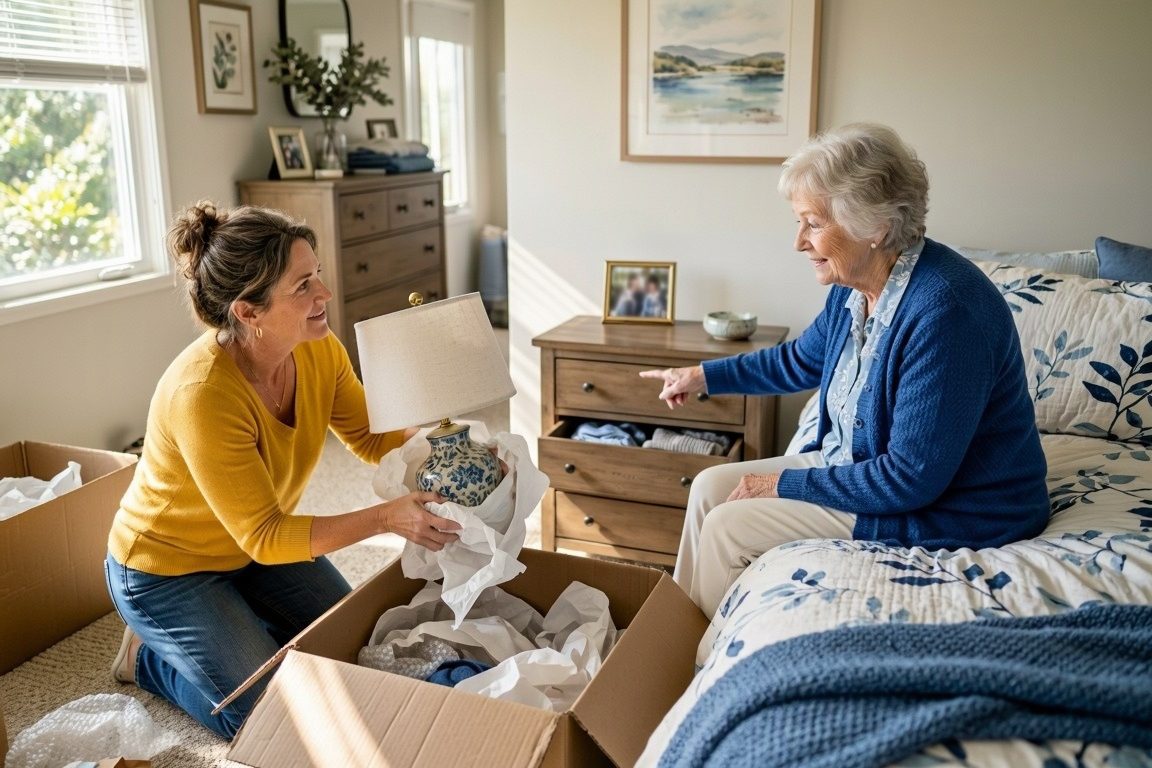
- Don't pack or sort belongings in front of an upset parent. Pack while they're away and offer small positive choices like which photo to hang.
- Don't assume your parent will adjust quickly or feel grateful. Give them time; lean on familiar objects and routines.
- Don't neglect your own boundaries. Set clear expectations about privacy and household rules; protect time for yourself.
- Don't keep financial and legal arrangements informal. A notarized, shared document prevents resentment.
- Don't skip home safety modifications during the move: grab bars in bathroom, secure hazards, add locks or door alarms if wandering is a concern, clear tripping hazards.
Key points
- Hold a family meeting early to discuss logistics, finances, and everyone’s concerns, and include your parent if possible.
- Create a written, notarized legal and financial agreement before the move to prevent future disputes.
- Prepare your parent’s room with familiar furniture and objects to reduce disorientation and anxiety.
- Pack your parent’s belongings when they are not present to avoid repeated questions and distress.
- Use a weekly schedule to communicate your availability and help your parent feel secure.
- Integrate your parent gradually into your daily life, inviting them along on errands rather than forcing activities.
- Plan for your own self-care and respite from the start, you cannot be a good caregiver if you are burned out.
Videos
 When a Grandparent Moves InThis video offers practical advice on how to prepare your home and family for a grandparent moving in, including tips on maintaining routines and addressing children’s feelings.
 SENIOR PARENT FAILS: What To Do When Your Elderly Parent Refuses To MoveThis video addresses the common challenge of a parent who resists moving, offering strategies to approach the conversation without triggering defensiveness.
 DEMENTIA NURSING HOME TRANSITIONWhile focused on nursing home transitions, this video provides valuable tips on packing, timing, and creating a welcoming environment that apply to moving into a family home as well.
 Tips For Moving Someone With DementiaThis video offers specific, actionable tips for moving a person with dementia, including how to handle the emotional and logistical challenges.
2 more videos
 Signs Parents Need Memory CareThis video helps you recognize when a parent’s needs may exceed what you can provide at home, which is important to consider before or after the move.
 Taking your parent with Alzheimer's to the hospitalThis video provides guidance on how to prepare for hospital visits, which may become more frequent after a move, including tips on bringing familiar items and communicating with staff.
Background
Why This Move Is So Stressful for Everyone
Moving is stressful for anyone, but for a person with dementia, it can be deeply disorienting. They may not fully understand why they are leaving their home, and they might feel a loss of control, independence, and identity. The unfamiliar environment can trigger confusion, anxiety, and even resistance. As the source passages note, even a move to a positive new place can be traumatic, especially when the person cannot grasp the reasons behind it. This is why preparation and a gentle approach are so critical.
The Emotional Weight on the Caregiver
As the adult child caregiver, you are likely juggling your own emotions, guilt about uprooting your parent, worry about how this will affect your spouse and children, and fear about whether you can handle the responsibility. Many caregivers also carry unresolved issues from the past, which can surface during this transition. The source passages emphasize that it is normal to feel guilty regardless of the decision you make, and that acknowledging these feelings is the first step to managing them. You are not alone, and there are concrete ways to prepare that will reduce stress for everyone.
The Role of Dementia in the Move
Dementia adds layers of complexity. Your parent may not be able to participate in planning, may forget conversations about the move, or may become more stubborn when told they cannot manage their current home. The source passages warn against statements like 'this house is too much for you' because they can trigger a defensive reaction, making the person want to prove they can still handle things, even through risky behaviors. Instead, you need to approach the conversation with empathy, focusing on safety and your desire to be together, not on their limitations.
Practical tools
6
Family Meeting Agenda Template
A one-page guide with prompts for written questions, plus topics: routines/privacy, remodel needs, expenses, division of tasks.
Private Suite Preparation Checklist
Room-by-room list for bedroom, bathroom, kitchenette; prompts to recreate familiar furniture placement, photos, decor from the old home.
Move-In Day Setup Guide
Timeline:
Weekly Shared Calendar Template
Visual weekly grid with time blocks for caregiver at home/out, appointments, visitors, self-care breaks. Post on fridge or board.
Legal and Financial Agreement Worksheet
Attorney-ready template covering expense categories (housing, medical, personal), property ownership, contribution sources, family signatures.
New Caregiver Welcome Sheet
One-page profile of parent's preferences, routines, comfort items, plus a home tour checklist:
Different situations
Lewy body dementia or Parkinson’s dementia
These conditions often involve visual hallucinations, fluctuating cognition, and movement issues. Make sure the home has clear pathways free of clutter to prevent falls. Use nightlights to reduce shadows that might be misinterpreted. Avoid rearranging furniture after the move, as changes can trigger confusion. If hallucinations occur, do not argue; instead, acknowledge their experience and redirect to a safe activity.
Late-stage dementia (advanced Alzheimer’s, severe memory loss)
Your parent may not be able to participate in any planning or understand the move at all. Focus entirely on creating a calm, safe environment. Use a hospital bed if needed, install bed rails, and consider a floor mattress to prevent falls from bed. Keep the room clutter-free and use familiar objects for comfort. You may need to hire 24/7 care or consider a memory care facility if safety becomes unmanageable at home.
Adult child caregiver vs. spouse caregiver
As an adult child, you may have more authority to make decisions, but you also have your own family to consider. Involve your spouse and children in the planning to avoid resentment. If you are a spouse, the dynamic is different, you are likely already living together, and the move may be from a shared home to a different one. Focus on preserving your couple relationship by setting aside time for just the two of you, even if it is 15 minutes a day.
If your parent is moving from a facility (e.g., assisted living) into your home
This is a reverse transition that can be just as disorienting. Bring familiar items from their facility room, such as a favorite chair or a photo from their old room. The facility may have had structured routines; try to replicate meal times and activity schedules in your home. Be prepared for a period of adjustment as they get used to a less institutional environment.
If your parent has a history of wandering or agitation
Install door alarms or childproof locks on exterior doors. Use a GPS tracker or a wearable device if they are prone to leaving. Create a safe wandering path inside the home, such as a loop through the living room and kitchen, with interesting objects to look at along the way (e.g., a fish tank, a photo wall). Avoid using physical restraints, as they can increase agitation.
Common questions
1
How can I make a new place feel familiar and reassuring after a move?
Place a few of their most cherished items, like a favorite quilt, family photos, or a familiar clock, in their room before they arrive so the space feels instantly recognizable and comforting.
For the doctor
5
- Ask your parent’s doctor: 'Given my parent’s dementia stage, are there any medications or non-drug strategies that could help reduce anxiety during the move?'
- Discuss with a geriatric care manager: 'What home safety modifications should I prioritize for my parent’s specific condition (e.g., fall risk, wandering, incontinence)?'
- Consult with an elder law attorney: 'What legal documents (power of attorney, healthcare proxy, will) need to be updated before the move, and how do I handle my parent’s assets?'
- Ask your parent’s neurologist: 'Are there any changes in medication or behavior management that could ease the transition into a new living environment?'
- If your parent has a history of falls, ask a physical therapist: 'What exercises or home modifications can reduce fall risk in our specific home layout?'