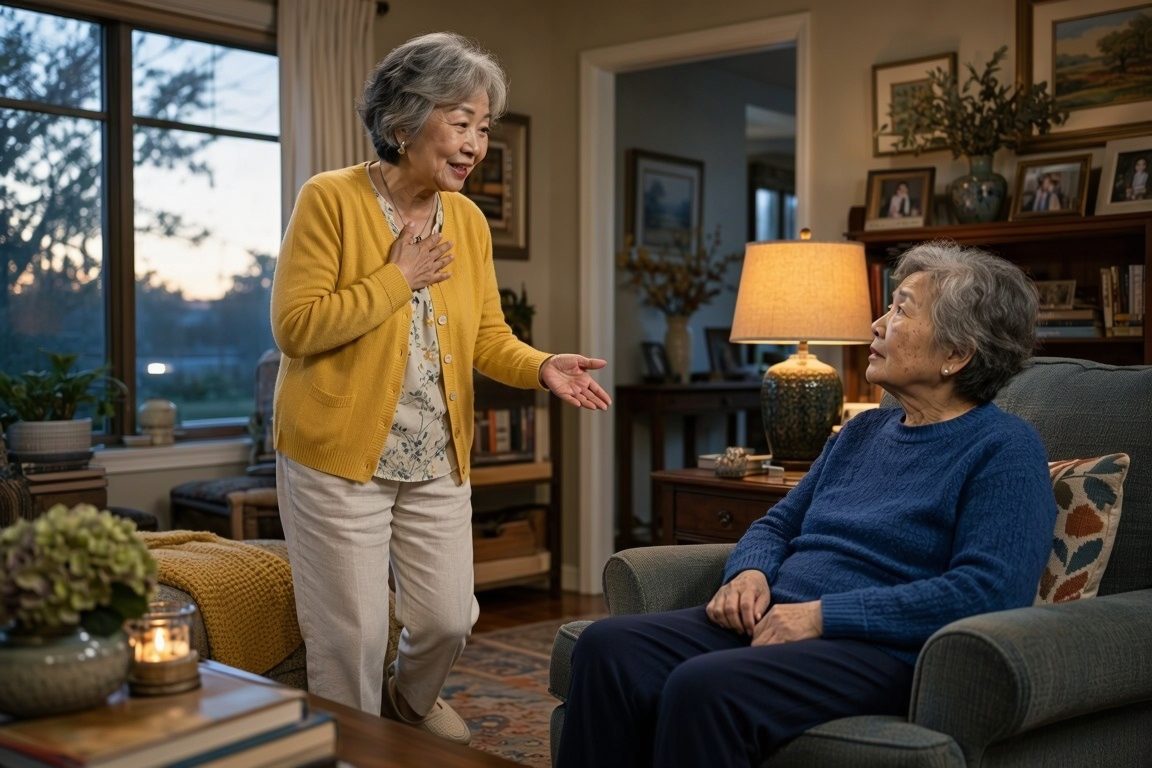
Step by step
What not to do
- Do not approach from behind or the side; always come from the front where they can see you.
- Do not ask 'Do you know who I am?'; this forces a memory test that can trigger shame or withdrawal.
- Do not correct them if they call you by the wrong name or insist they don't recognize you; correcting breaks trust.
- Do not use long, complex sentences or stack multiple questions together; speak in short, simple statements.
- Do not rush, fidget, or show impatience; slow your pace and breathe.
Key points
- Always introduce yourself by name and relationship before expecting a response.
- Approach from the front, make eye contact, and use a gentle touch if comfortable.
- Speak slowly, use short sentences, and avoid open-ended questions.
- Never test their memory by asking 'Do you know who I am?'
- If they don’t recognize you, drop the relationship label and just say your name.
- Focus on making them feel safe and loved, not on getting the facts right.
Videos
 When Someone With Dementia Forgets Who You AreThis video directly addresses the fear and confusion your loved one may feel and shows how to introduce yourself in a way that reduces their distress.
 How to talk to someone with dementia when they are afraid of saying the wrong thingThis video helps you understand the anxiety your loved one may feel about not recognizing you, and offers phrases that put them at ease.
 Supporting a Loved One with DementiaA broader look at how to be supportive, including communication tips that reinforce the introduction strategies in this article.
 Communication & Dementia: Connecting with a Person living with Memory LossThis video demonstrates the importance of non-verbal cues like eye contact and touch, which are key when introducing yourself.
2 more videos
 How To Talk To Someone With DementiaA practical guide to using simple language and avoiding common pitfalls, directly applicable to the introduction process.
 What Are Some Common Behaviors Seen In A Person With Dementia?Helps you recognize behaviors like confusion or agitation that may occur when they don’t recognize you, and how to respond calmly.
Background
Why They Don’t Recognize You: It’s Not Personal
When a person with early-stage dementia doesn’t recognize you, it’s not because they don’t love you or because they’ve forgotten who you are in their heart. Their brain is simply processing visual and auditory information more slowly. Imagine someone you trust suddenly appearing in front of you, but your brain can’t match their face to a name or a memory. That mismatch is disorienting and can feel like a surprise attack. As one expert explains, 'their brain can’t work that fast when they see a person they can’t identify them quickly.' This is why a person with dementia may look confused, startled, or even frightened when you walk into the room. They are not rejecting you; they are struggling to make sense of what their eyes are seeing.
The Emotional Core: Safety Over Facts
At its heart, this moment is about emotion, not facts. Your loved one’s brain may no longer hold the memory of your name or your relationship, but it still feels the emotions you bring. If you approach with tension, frustration, or a hurried tone, they will feel unsafe. If you approach with calm, warmth, and patience, they will feel cared for. As one care expert puts it, 'it’s not always about the facts anymore, it’s about the emotions, how they are feeling in that moment.' Your goal is not to force them to remember you; your goal is to help them feel safe, seen, and loved in this moment. When they feel safe, they are far more likely to respond with calmness and even recognition over time.
The Brain’s Need for Slow, Clear Cues
Dementia changes how the brain processes information. A person may need extra time to understand what they are seeing and hearing. If you rush in with a fast greeting or a complex question, you overload their system. Instead, you need to give their brain simple, step-by-step cues. This means approaching slowly, making eye contact, using a gentle touch, and stating your name and relationship clearly before you expect any response. As one source notes, 'introduce yourself by name' and 'address the person by the name he or she prefers.' This is not about being formal; it’s about giving their brain the one piece of information it needs first: who you are. Once they have that anchor, they can begin to relax and connect.
Practical tools
4
The 'Name First' Script
Memorize and use every time: 'Hello [their name], it's [your name], your [relationship].' Example: 'Hello Dad, it's Sarah, your daughter.' Even if you just stepped out five minutes ago, repeat it, it removes guesswork for their brain and sets a calm, predictable tone.
The Calm Environment Setup
Before you greet them,
A quiet, uncluttered setting helps their brain focus on you instead of competing sensory input.
The 'Inform Others' Checklist
Give visitors a short written note:
Add one or two topics your loved one still enjoys, a grandchild's name, a favorite hymn, gardening, so visitors can steer to familiar ground.
The Familiar Anchor
Bring a small object tied to your shared history, a family photograph, a flower from their garden, a spritz of a familiar perfume on a handkerchief, or a favorite treat. Place it where they can see or hold it as you greet them; it can quietly bridge the recognition gap without forcing them to remember.
Different situations
Early-stage dementia (mild cognitive changes)
In early stages, your loved one may still recognize you most of the time. Use the introduction as a gentle habit, not a necessity. Focus on reducing pressure: avoid testing questions, and let them lead the conversation. Include them in planning for the future, as one source advises: 'be sure to include your parent in the planning, this is their life after all.'
Spouse vs. adult child
If you are the spouse, your loved one may be more likely to recognize you but may also feel more vulnerable about their memory loss. Use a warm, familiar tone: 'Hi honey, it’s me, your wife, Mary.' If you are an adult child, be extra clear about your relationship: 'Hi Mom, it’s your son, David.' Avoid assuming they know you just because you’ve been close.
In a facility or unfamiliar setting
In a new environment, your loved one may be more disoriented. Approach even more slowly. Use the environment to help: 'I’m your daughter, and we’re in the living room of your new home.' Keep your voice low and calm. If they are agitated, give them space and try again in a few minutes.
If they consistently don’t recognize you
If your loved one regularly doesn’t know who you are, stop using the relationship label. Just say your first name: 'I’m Janet.' This avoids the pain of them not remembering that they are a parent or spouse. Focus on the emotional connection: 'I’m here to spend time with you.'
Lewy body dementia or Parkinson’s dementia
These types often involve visual hallucinations or fluctuating alertness. Approach even more gently, and be prepared for them to see you as a stranger or a different person. Use a very calm tone. If they seem frightened, step back and give them space. Do not argue about what they are seeing.
For the doctor
3
- If your loved one becomes consistently agitated or aggressive when you approach, discuss with their doctor whether medication adjustments or a referral to a dementia specialist might help.
- If they are on medications for anxiety, depression, or sleep, ask the clinician if those might be affecting their ability to recognize you or their emotional responses.
- If you are considering using a memory care facility or adult day program, ask the clinician for guidance on how to introduce the idea to your loved one in a way that minimizes distress.