Step by step
What not to do
- Do not assume that because the person has good eyesight, they can see well. Their eyes are fine, but their brain cannot interpret visual information. Saying 'look harder' or 'it's right in front of you' will only frustrate them.Instead, use verbal cues and guide their hand to the object.
- Do not rearrange furniture or move items without warning. A familiar layout becomes a mental map. Changing it can cause disorientation and falls. If you must move something, do it slowly and with the person's input, and label the new location clearly.
- Do not use low-contrast or monochromatic color schemes in any room, especially the bathroom. White-on-white or beige-on-beige makes the room invisible to someone with PCA.Instead, choose high-contrast combinations like dark floor with light walls, or bright accessories against neutral backgrounds.
- Do not leave doors fully closed or partially open. A person with PCA may not be able to judge whether a door is open or closed, leading to collisions. Keep doors either fully open (and secured) or fully closed. Use a contrasting color on the door edge to make it visible.
- Do not rely on the person to tell you what they cannot see. They may not realize they are missing visual information. Watch for signs of hesitation, confusion, or frustration. If they stop at a doorway or stair, assume they cannot see it clearly and offer verbal guidance or a hand.
- Do not use patterned or busy flooring, wallpaper, or countertops. Patterns can be misinterpreted as objects, holes, or movement. Stick to solid, matte finishes that do not create visual noise. This reduces the brain's workload.
Key points
- PCA affects visual processing, not the eyes themselves; home modifications must address brain-based visual-spatial deficits.
- High contrast is your best tool: use bright tape, stickers, and colored accessories to make important objects and edges visible.
- Keep pathways clear and furniture in consistent places to reduce confusion and fall risk.
- Remove clutter and avoid patterned or monochromatic surfaces that the brain cannot interpret.
- Use adaptive tools like audiobooks, text-to-speech, and large-print labels to support reading and daily tasks.
- Involve the person with PCA in decisions about modifications to preserve dignity and reduce resistance.
Videos
 What Are the Symptoms of Posterior Cortical Atrophy Dementia? | TestProvides a clear overview of PCA symptoms, emphasizing visual disturbances that drive the need for home modifications.
 Time with Teepa - Posterior Cortical Atrophy (PCA) or Bensons Disease, what is it?Teepa Snow explains how PCA affects the brain's visual and sensory-motor areas, giving context for why modifications like clear pathways and contrast are essential.
 Posterior Cortical Atrophy Lecture with neurologist Victoria Pelak, of the University of ColoradoA detailed medical lecture that explains the visual processing deficits in PCA, which directly informs the rationale for home modifications.
 What Posterior Cortical Atrophy Really Looks Like | Andrew and Karina ReidFirst-person account of living with PCA, showing real-world challenges like reading, dressing, and navigating space that modifications can address.
2 more videos
 Living With Posterior Cortical Atrophy | Andrew and Karina ReidContinues the personal story, highlighting practical strategies and the emotional impact, reinforcing the need for supportive home environments.
 Posterior Cortical Atrophy An Atypical Form of Alzheimer's DiseaseExplains PCA as an atypical Alzheimer's variant, helping caregivers understand why visual symptoms are primary and why modifications differ from typical dementia care.
Background
What is happening in PCA that makes home modifications unique?
Because PCA often begins in the 50s or 60s, the person may still have insight and frustration. They know something is wrong, but they cannot trust their own eyes. This makes home modifications not just about safety, but about reducing anxiety and preserving dignity. For example, a person with PCA might see a dark area on the floor as a hole or a tunnel, or they might struggle to put on a coat because they cannot organize the armholes in space. Modifications must address these specific visual-spatial deficits, not just general dementia safety.
Why contrast and simplicity matter more than ever
Clutter is especially dangerous for someone with PCA. Because they cannot easily distinguish objects from backgrounds or judge distances, a cluttered room becomes a confusing, even frightening, landscape. Pathways must be clear, and items should be placed in consistent, predictable spots. The goal is to reduce the cognitive load of interpreting the environment so the person can focus on the task at hand, whether walking to the kitchen or finding the bathroom.
Practical tools
6
High-contrast tape and stickers
Use bright red, yellow, or white tape (like gaffer tape or electrical tape) to mark stairs, edges of steps, door frames, light switches, and handles. Red stickers on the back of clothing help with dressing. One caregiver found this simple tool made stair navigation safe and dressing possible.
Motion-sensor nightlights
Place these in the bedroom, hallway, and bathroom. They provide consistent, low-level light that reduces shadows and helps the person see where they are going. Choose lights with a warm, soft glow to avoid glare.
Large-print labels and picture labels
Use a label maker or handwritten cards with bold black text on white or bright yellow paper. Label drawers, cabinets, and doors. For someone who struggles with reading, use simple pictures (e.g., a cup for the cup cabinet).
Grab bars and handrails
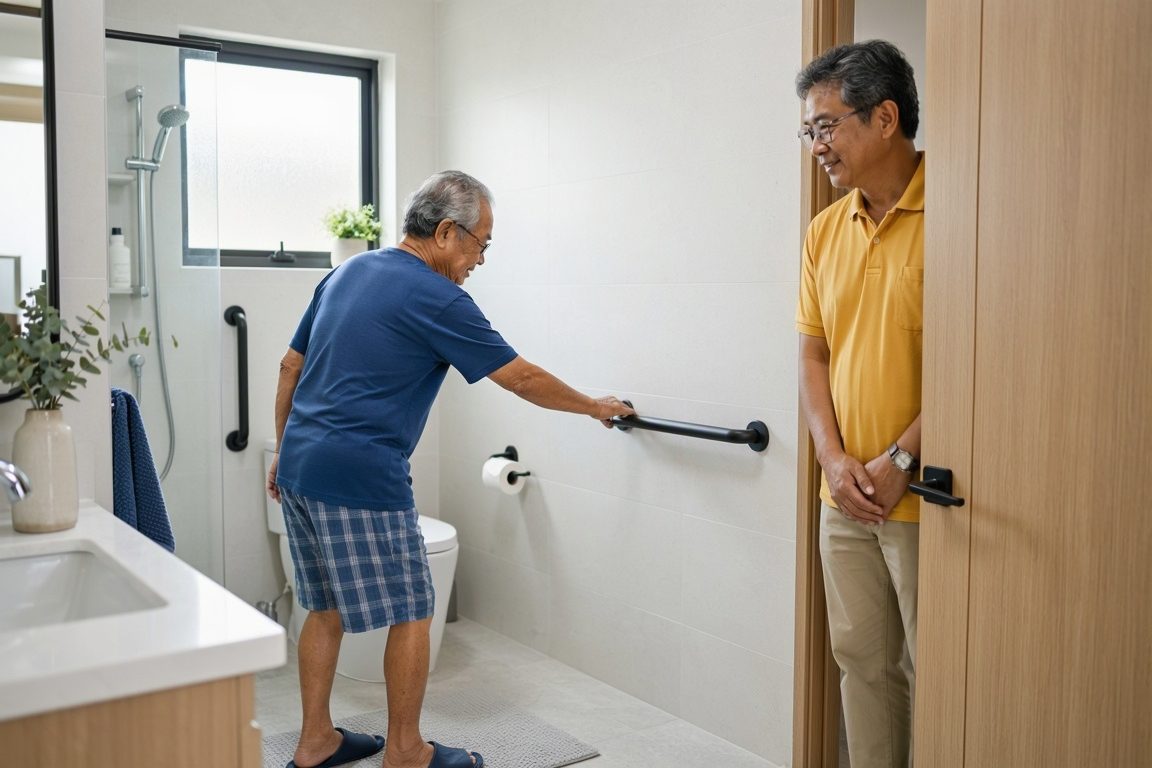
Install grab bars in the shower, next to the toilet, and along long hallways. They provide a physical reference point and support. Choose bars with a contrasting color (e.g., white on a dark wall) so they are visible.
Audiobooks with text highlighting
Use services like Audible or Kindle with 'Whispersync' that highlight the text as it is read aloud. This helps the person follow along despite reading difficulties. One person with PCA said this allowed them to continue 'reading' with their children.
Consistent clothing organization system
Set up a 'uniform' approach:
Keep socks and underwear in a labeled drawer. This reduces decision-making and visual confusion.
Different situations
Late-stage PCA or when the person uses a wheelchair
Focus on clear, wide pathways (at least 36 inches). Remove all rugs. Install ramps at entrances. Lower light switches and grab bars to wheelchair height. Use a contrasting color on the edge of the ramp. Ensure the bathroom door is wide enough (32 inches minimum) and consider a roll-in shower.
Spouse as caregiver vs. adult child
Spouses may need to adjust their own routines and may resist changes that feel like 'giving up.' Frame modifications as helping the person stay independent longer. Adult children may need to gently introduce changes and explain why they help. Both should involve the person with PCA in decisions when possible.
Person with PCA also has Lewy body dementia or Parkinsonism
Add fall prevention measures like padded floors or hip protectors. Visual hallucinations may occur; do not argue about them. Use calm, simple language. Avoid high-contrast patterns that might be misinterpreted. Discuss medication changes with the neurologist.
Living in a facility or assisted living
Work with staff to implement modifications: ask for a room with consistent layout, high-contrast bathroom fixtures, and clear signage. Bring your own high-contrast tape and stickers. Label the person's room door with their name and a familiar photo. Request that staff avoid moving furniture.
Person with PCA has significant reading or writing difficulty
Use text-to-speech software on a tablet or phone. Write instructions in large, printed letters (not cursive). Use audiobooks and podcasts. For writing, provide a keyboard or voice-to-text app. Avoid asking them to sign documents without a clear, high-contrast signature line.
For the doctor
5
- Ask your neurologist or occupational therapist about a home safety evaluation to identify specific fall risks and modification needs.
- Discuss whether the person with PCA might benefit from low-vision rehabilitation services, which can provide specialized tools and training.
- If the person has hallucinations or misperceptions (e.g., seeing holes or tunnels), ask the doctor if these are related to PCA or another condition, and whether any medication adjustments are appropriate.
- Inquire about adaptive driving evaluations if the person still drives; PCA often makes driving unsafe due to depth perception and object recognition issues.
- Ask about financial assistance programs for home modifications, such as through long-term care insurance, Medicaid waivers, or local Area Agencies on Aging.