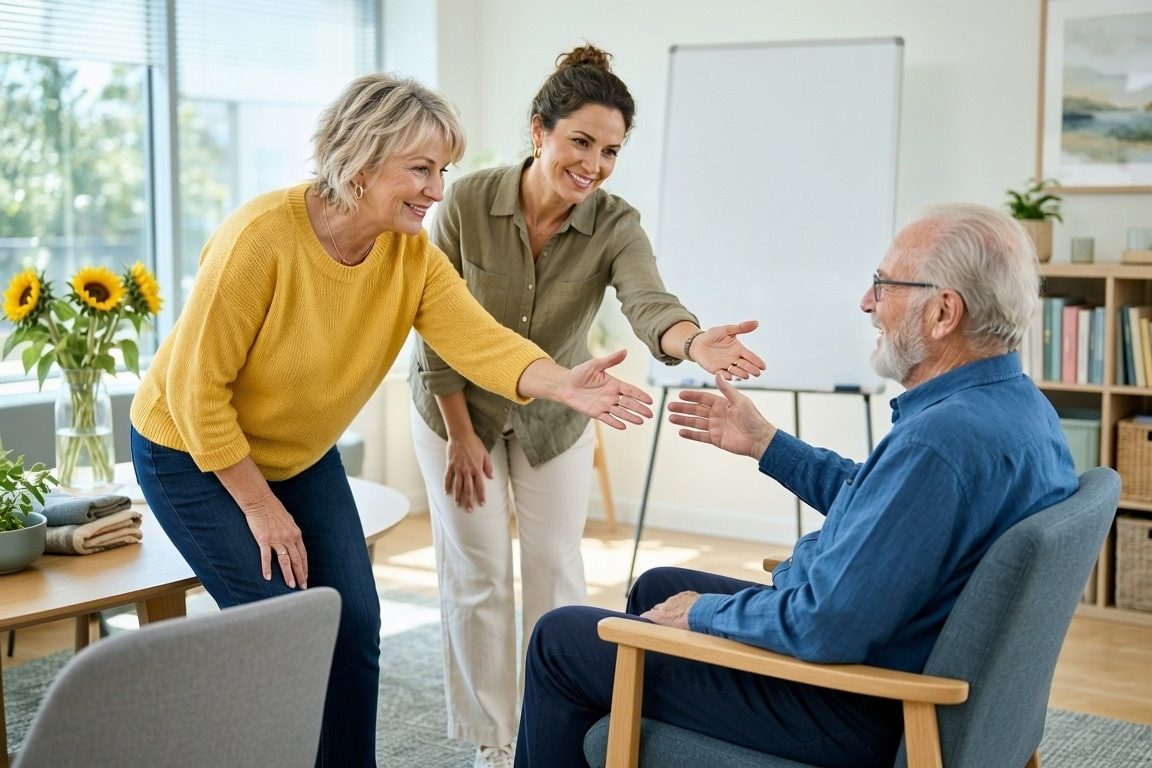
Step by step
What not to do
- Don't try to learn hands-on skills from books and videos alone; under stress your brain will not recall steps you have only read about.
- Don't wait until you are in crisis to seek training; exhaustion sharply reduces your ability to absorb new skills and persist when the first attempt does not work.
- Don't assume one workshop is enough; dementia is progressive and unused skills fade, so plan for refreshers and follow-up coaching.
Key points
- Hands-on training transforms knowledge into real-world skills, reducing caregiver stress and burnout.
- The most effective programs are tailored, flexible, and include practice with feedback.
- Start training early, even before you feel you need it, and treat it as an ongoing process.
- Involve all family members and paid caregivers in the same training for consistency.
- Use simple tools like the hand-under-hand technique, a communication script, and a skills journal to reinforce learning.
- Celebrate small wins and be kind to yourself as you learn new skills.
Videos
 Can Dementia Guidance Help Reduce Caregiver Burnout? | TestThis video explains how structured guidance, including hands-on training, directly reduces emotional exhaustion and helps caregivers recognize burnout early.
 Uniting for Better Dementia Care = Seni + Dementia LiveThis video shows how combining professional training with family involvement creates a unified care approach that benefits everyone.
 SUP! Incremental Changes and Early Results with PAC SkillsThis video demonstrates the Positive Approach to Care (PAC) skills in action, including hand-under-hand, and shows how small changes lead to big improvements.
 How Do I Find a Therapist for Caregiver Burnout?This video guides you on finding professional support that can complement hands-on training by addressing the emotional toll of caregiving.
2 more videos
 Recognizing the Value of Care Planning Paired with Dementia EducationThis video explains how combining care planning with hands-on education leads to better outcomes for both caregiver and care recipient.
 How Do Caregivers Cope With Loss Through Therapy?This video addresses the grief that comes with dementia and how therapy, alongside skills training, helps caregivers process loss and maintain resilience.
Background
Why Hands-On Training Matters More Than Reading or Watching Alone
Caring for someone with dementia is not like following a recipe. Every day brings new challenges, and the person you care for changes over time. Reading articles or watching videos can give you important background knowledge, but they cannot teach your hands and your voice how to respond in the moment. Hands-on training fills that gap. It gives you a chance to practice techniques like 'hand-under-hand' guidance, redirection, and calming communication in a safe setting before you need them in a crisis. As one experienced trainer explains, it is like asking a general practitioner to perform heart surgery without training: you might have the basic degree, but you lack the specialized skills. Hands-on training builds those skills step by step, so you are not guessing when it matters most.
How Training Reduces Burnout and Builds Resilience
One of the biggest sources of caregiver burnout is the feeling of being unprepared. When you do not know how to handle a situation, you feel helpless, frustrated, and isolated. Hands-on training directly addresses this by giving you practical strategies that work. Research shows that caregivers who receive training report lower levels of emotional exhaustion and are better at recognizing early signs of burnout in themselves. They also feel more competent, which reduces the stress that comes from constant uncertainty. Training also connects you with a community of other caregivers and professionals, which fights the loneliness that so many family caregivers experience. When you know you have a skill set to draw on, you can approach each day with more confidence and less fear.
What Effective Hands-On Training Looks Like
Not all training is created equal. The most effective programs are tailored to your specific situation and flexible enough to change as the disease progresses. They consider the needs of both the caregiver and the person living with dementia. Good training teaches you actual skills, not just facts. For example, you might practice how to approach someone from the front, at eye level, using a calm tone and open body language. You might learn the 'hand-under-hand' technique, which allows you to guide a person's hand gently without triggering a defensive reaction. Training that includes role-play, video feedback, and live coaching is especially powerful because it lets you make mistakes and learn in a low-stakes environment. The best programs also involve the whole care team, including family members and even non-clinical staff like dining and housekeeping workers, because everyone who interacts with the person needs basic skills.
Practical tools
3
Hand-Under-Hand Technique
A gentle way to guide a person without triggering a defensive grip. Approach from the front at eye level, slide your hand under theirs palm-up so your hand supports theirs, then guide their hand to the task, holding a spoon or washcloth. The contact feels supportive rather than controlling and preserves dignity.
Simple Daily Communication Script
A pocket card of short phrases you can rely on: 'May I help you with that?' instead of 'Do you want to...'; 'Let's go this way together' instead of 'Come with me'; approach from the front, get to eye level, and pause one beat before speaking.
ABC Behavior Tracker
A one-page chart where you log the Antecedent (what happened just before), the Behavior (what the person did), and the Consequence (what you both did next). Over weeks it reveals triggers and patterns, giving you a concrete map of what to change instead of guessing.
Different situations
For Lewy body dementia (LBD)
People with LBD often have extreme fluctuations in alertness and may experience visual hallucinations. Training should emphasize techniques for validation (not arguing about hallucinations) and for recognizing when the person is in a 'good' versus 'bad' period. Avoid training that focuses only on memory issues; LBD requires skills for managing movement and sleep problems as well.
For late-stage dementia
In late stages, the person may be nonverbal and bedbound. Training should focus on comfort care, pain recognition, and gentle touch techniques. Hand-under-hand may still work for simple tasks like holding a hand or offering a sip of water. Also learn how to position the person safely and how to communicate through facial expressions and tone of voice.
For an adult child caring for a parent
Adult children often struggle with role reversal and guilt. Training should include modules on setting boundaries, managing guilt, and communicating with siblings. Look for programs that address the emotional aspects of caregiving, not just the practical skills. Also consider training that includes how to have difficult conversations about driving, finances, and care decisions.
For a spouse caring for a partner
Spouses often feel a deep sense of loss and may resist training because it feels like admitting defeat. Training should be framed as a way to strengthen the relationship, not as a sign of failure. Look for programs that include couples counseling or support groups for spousal caregivers. Also learn techniques for managing intimacy and companionship as the disease progresses.
For care in a memory care facility
If your loved one is in a facility, you can still benefit from training. Ask the facility if they offer family training sessions. Learn the techniques the staff uses so you can be consistent during visits. Also, training can help you communicate more effectively with staff and advocate for your loved one's needs. Consider becoming a 'dementia champion' in the facility to help other families.
For the doctor
5
- Ask your doctor or a geriatric specialist: 'Are there any local hands-on training programs for family caregivers that you recommend?'
- If you are considering medication to manage agitation or sleep issues, ask: 'Can we try non-drug approaches first, and can you refer me to a trainer who can teach me those techniques?'
- If you are feeling overwhelmed or depressed, ask: 'Can you refer me to a therapist who specializes in caregiver burnout and who can also help me practice coping skills?'
- If your loved one has a history of falls or injuries, ask: 'What specific safety techniques should I learn in a hands-on training program to prevent falls?'
- If you are considering placing your loved one in a facility, ask: 'Can you recommend a facility that provides hands-on dementia training for all staff, including non-clinical workers?'