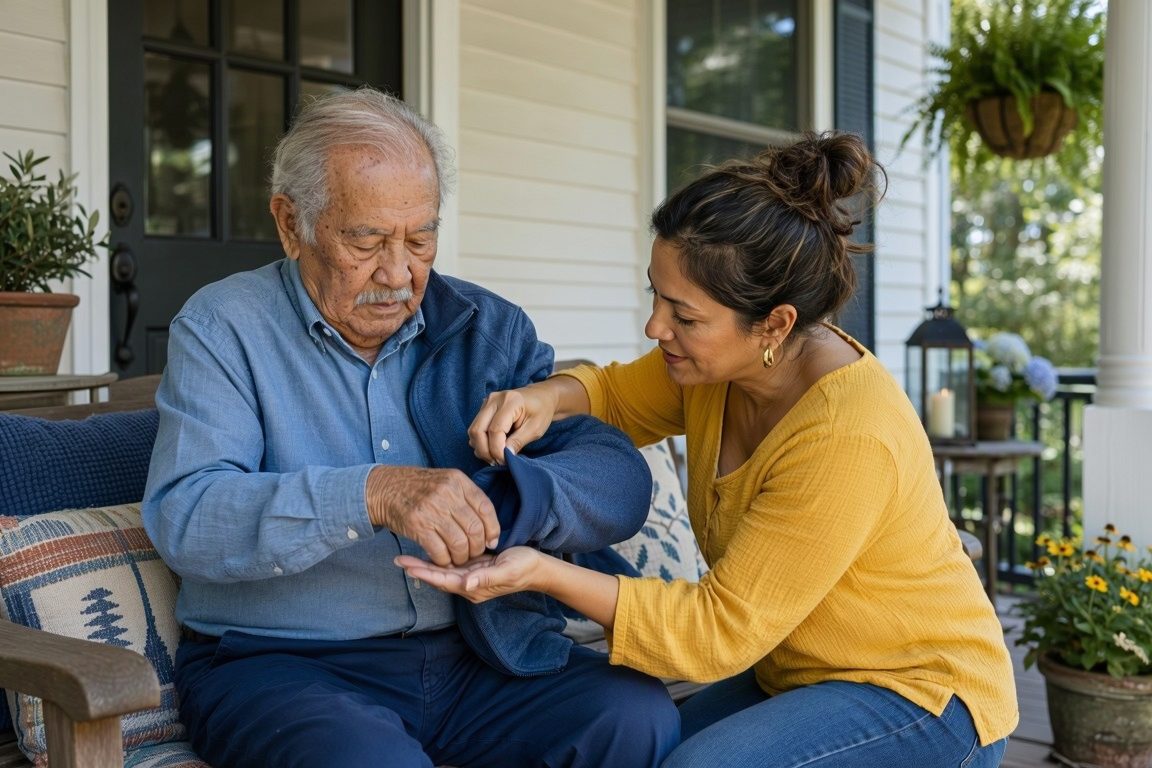
Step by step
What not to do
- Do not give long verbal instructions like 'Now lift your arm and put it through the sleeve.' This overwhelms the aphasic brain.Instead, use hand-under-hand to show the motion without words.
- Do not grab their hand or arm and force it into the sleeve. This feels controlling and can trigger a fight response.Instead, offer your hand under theirs and let them feel the invitation.
- Do not dress them completely without their involvement, even if it is faster. This strips away their sense of agency and can lead to learned helplessness.Instead, use hand-under-hand to keep them an active partner, even if the task takes longer.
- Do not correct them if they put the shirt on backward or miss a button. This can cause shame and resistance.Instead, gently guide with hand-under-hand to adjust, or simply let it be and try again next time.
- Do not assume they understand what you want just because they are looking at the clothes. Aphasia means the connection between seeing the shirt and knowing what to do is broken. Use hand-under-hand to bridge that gap.
Key points
- Hand-under-hand is a non-verbal invitation to participate, not a command or a takeover.
- Place your hand under theirs, palm up, and guide the motion together. You are a helper, not a doer.
- Use single words or short phrases, not full sentences. Point to the garment as you say its name.
- Pause after giving a visual or verbal cue; give the brain time to process before you step in.
- Praise effort, not perfection. The goal is connection and participation, not a perfectly dressed appearance.
- Adaptive clothing can help, but still use hand-under-hand to involve the person in the fastening process.
Videos
 PAC Live @ 5 - Hand Under HandTeepa Snow demonstrates hand-under-hand in real time, showing how to use it for dressing and other tasks. See the exact hand placement and pacing.
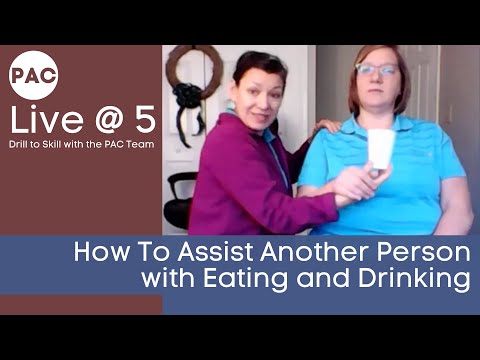 How To Assist Another Person with Eating and DrinkingThough focused on eating, this video shows the same hand-under-hand technique applied to a different activity. The principles of initiation and muscle memory transfer directly to dressing.
 How to Help a Person Living with Dementia to Get Dressed and UndressedA full walkthrough of dressing assistance, including how to use hand-under-hand for shirts, pants, and managing resistance. Practical and step-by-step.
 Assisting with Activities of Daily Living in Dementia CareCovers the broader ADL context, with specific segments on dressing and the importance of doing with, not for. Good for understanding the philosophy behind hand-under-hand.
Background
What is happening when aphasia meets dressing?
Aphasia means the brain's language centers are damaged, making it hard for your loved one to understand what you say (comprehensive aphasia) or to find the words to respond (expressive aphasia). When you say 'lift your arm,' the instruction may not register as a meaningful command. The person may freeze, look confused, or even become agitated because they want to help but cannot decode your words. This is not stubbornness or refusal; it is a brain that has lost the map between hearing a word and performing an action.
Why hand-under-hand works where words fail
Hand-under-hand guidance bypasses the broken language pathway and speaks directly to the body's procedural memory. By placing your hand under theirs and gently guiding the motion, you are not doing the task for them; you are doing it with them. This technique, developed by Teepa Snow, uses the person's own hand to feel the movement of putting on a shirt or pulling up pants. The brain's motor cortex still remembers these sequences, even when the language centers do not. The physical sensation of your hand under theirs provides a clear, non-verbal cue: 'We are doing this together.' It also reduces the person's sense of being controlled, because they are still the one doing the action, with your support. This approach is especially powerful for people in the amber or red gem states, where they can initiate but need help starting or sustaining the task.
Practical tools
6
Hand-under-hand starter phrase
Before you touch, say: 'Let me help you with this. I will put my hand under yours, and we will do it together.' This simple script sets the expectation and gives the person a moment to consent. Practice saying it in a calm, low tone.
The 'pause and point' technique
After laying out the clothes, point to the garment and say just the name: 'Shirt.' Wait 5-10 seconds. Sometimes the visual cue plus the single word is enough to trigger the person's own initiation. If not, proceed to hand-under-hand.
Adaptive clothing with magnetic closures
Shirts and pants with magnets instead of buttons or zippers reduce fine motor demands. Even with adaptive clothing, use hand-under-hand to guide their hand to the magnet closure so they feel the 'snap' and participate in the fastening. Brands like 'Silvert's' or 'Magnetic Me' work well.
The 'two-shirt' system
Have two identical or very similar shirts available. Let the person choose one by pointing or touching. This gives a sense of control without requiring speech. Then use hand-under-hand to put on the chosen shirt. The other shirt can be set aside for another day.
Visual step card for dressing
Create a simple card with 3-4 pictures:
Place it on the bed next to the clothes. Point to the first picture and then to the garment. This provides a visual 'ramp' into the task. Use hand-under-hand to guide the first step, then let them try the next step independently if possible.
Rhythm and song
Hum or sing a simple tune (like 'This is the way we put on our shirt') while using hand-under-hand. The rhythm can help the brain organize the movement sequence. Keep it soft and slow; do not expect them to sing along.
Different situations
Early-stage dementia with mild aphasia
You may only need hand-under-hand for the first step to initiate. After that, they might continue on their own. Use the 'pause and point' tool first, and only step in with hand-under-hand if they freeze. Praise their independence.
Late-stage dementia with severe aphasia and apraxia
Hand-under-hand may be needed for every step. The person may not be able to initiate at all. Use very slow, rhythmic motions. Combine with a soft verbal cue like 'up' or 'in' as you guide. Accept that you are doing most of the work, but keep their hand involved so they feel the movement.
Lewy body dementia with fluctuating cognition
On good days, the person may respond well to hand-under-hand. On bad days, they may be too confused or have visual hallucinations that make dressing frightening. On those days, simplify: use only one garment, keep lighting soft, and use hand-under-hand very gently. If they resist, stop and try later. Never force.
Spouse vs. adult child caregiver
A spouse may find it harder to shift from partner to guide. Practice the hand-under-hand technique on yourself first to feel the difference between guiding and grabbing. An adult child may need to be patient with the slower pace. Both roles benefit from saying 'we' instead of 'I' or 'you'.
In a facility setting
Staff may be rushed. Advocate for hand-under-hand by showing them this article or a short video. Ask that they use the person's name and a single word cue before touching. If possible, have a consistent caregiver who knows the person's preferences.
For the doctor
3
- If the person shows signs of pain when moving their arm or leg during dressing, discuss with a doctor or physical therapist whether gentle range-of-motion exercises before dressing could help.
- If the person consistently refuses all dressing assistance and becomes aggressive, ask the clinician about possible underlying causes like infection, pain, or medication side effects.
- If aphasia suddenly worsens or the person can no longer follow even non-verbal cues like hand-under-hand, seek a medical evaluation to rule out stroke or other acute conditions.