Step by step
What not to do
- Do not correct their rhythm or insist they follow your beat. If they play off-tempo, that is fine. The goal is connection, not performance. Correcting them can cause frustration and withdrawal.Instead, adjust your rhythm to match theirs.
- Do not use music that is too loud, fast, or complex. Avoid songs with many instruments or sudden changes in volume. This can overwhelm a person with dementia and increase anxiety. Stick to simple, familiar melodies with a clear, steady beat.
- Do not force participation. If your loved one is not in the mood, do not push. Simply play or hum quietly yourself. Often, they will join after a few minutes. If they do not, try again later. Forcing can create negative associations with music.
- Do not make it about skill or memory. Avoid asking, 'Do you remember this song?' or 'Can you keep up?' This puts pressure on them and highlights deficits.Instead, focus on the shared experience: 'I love how this feels when we play together.'
- Do not neglect your own breathing. Caregivers often hold their breath when concentrating. During drumming, remind yourself to breathe deeply. This lowers your stress and models calm for your loved one. If you notice you are tense, take a slow breath and let your shoulders drop.
Key points
- Group drumming reduces stress hormones (cortisol) for both caregiver and patient, with benefits lasting months.
- You do not need musical skill, just a willingness to tap, hum, and connect through rhythm.
- The shared activity is a form of self-care that also strengthens your relationship and models calm.
- Start simple: seated, slow, and with one instrument. Adjust tempo to match your loved one's energy.
- Do not correct or force participation, focus on connection, not performance.
- Even 3 minutes daily can make a difference. Consistency matters more than duration.
Videos
 Music and Alzheimer's DiseaseThis video shows how music can reach people with Alzheimer's even when other communication fails, and offers practical ideas for using rhythm and song together.
 Episode 43: Energizing Music - Optimize Wellness Through Evidence-Based Recreational Music MakingThis episode directly addresses recreational music making for wellness, with evidence-based strategies you can use at home, including drumming and group activities.
 How Do Dementia Caregivers Prevent Burnout? - Dementia Help HubThis video discusses caregiver burnout prevention and includes the role of music and self-care, reinforcing why shared music making is a sustainable practice.
 HOW TO REDUCE YOUR RISK OF DEMENTIA (and slow down dementia for your loved one)This video explains how learning a new instrument or engaging in rhythmic activities can reduce your own dementia risk, adding a long-term wellness benefit to music making.
2 more videos
 How Does Dementia Assistance Help Relieve Caregiver Stress? | TestThis video explores various forms of dementia assistance, including music programs, and how they reduce caregiver stress through shared engagement.
 How Can Local Dementia Support Groups Prevent Caregiver Burnout? - Dementia Help HubThis video highlights the value of support groups, which can be a great place to start a caregiver-patient drumming group or find others to share the experience.
Background
Why group drumming works for both of you
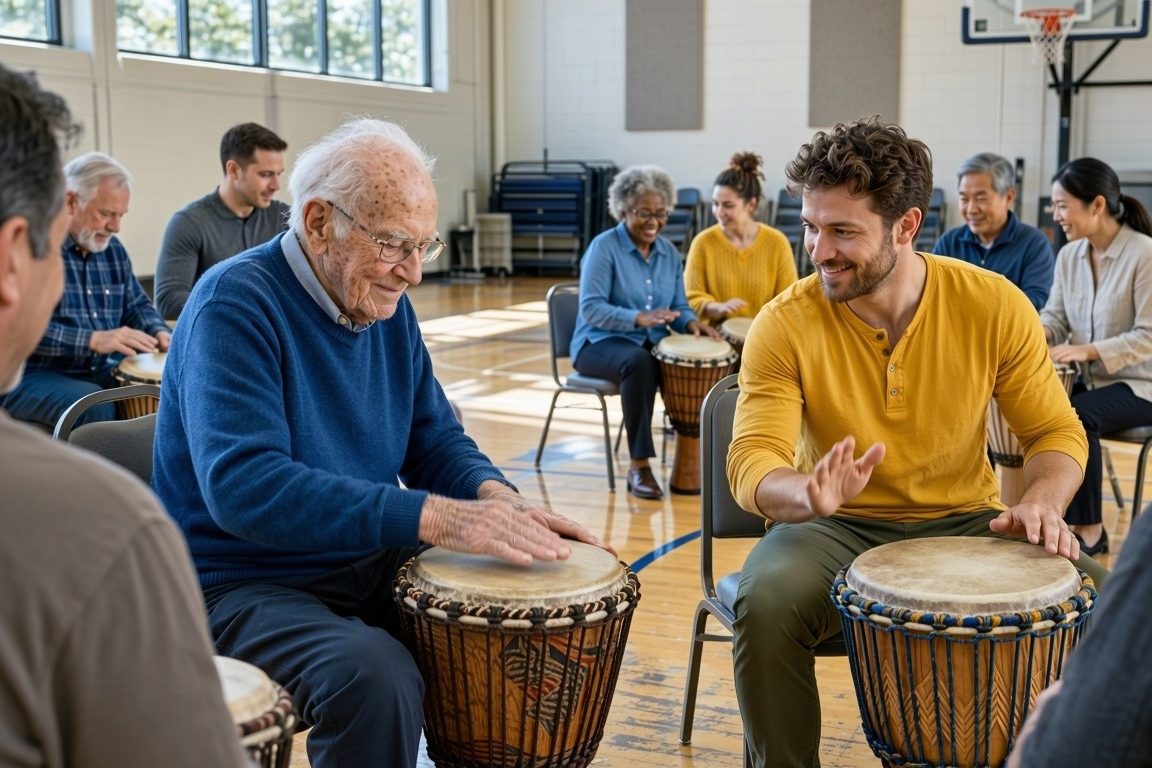
When you and your loved one make music together in a group, something remarkable happens. The shared rhythm activates parts of the brain involved in emotion, social bonding, and motor coordination, areas that remain accessible even as dementia progresses. For your loved one, the predictable beat provides a sense of safety and structure, reducing anxiety and agitation. For you, the act of drumming or clapping along releases tension, lowers cortisol (the stress hormone), and gives your mind a break from constant vigilance. A study of older adults with dementia in care facilities found that those who participated in group music therapy had significantly reduced depression levels and lower cortisol compared to those who did not, and the benefits lasted for months afterward.
Self-care through shared rhythm is not selfish, it is survival
Caregivers often feel guilty taking time for themselves, but recreational music making is different: it is something you do together. This makes it a form of self-care that also strengthens your relationship. When you drum alongside your loved one, you are not neglecting them, you are modeling calm, joy, and presence. The music gives you both a shared language when words fail. As one music therapist noted, 'Self-care is not being selfish. Self-care is for sustainability and for survival, especially for people living with dementia and their care partners.' The rhythmic activity also helps you regulate your own nervous system, lowering your heart rate and breathing, which in turn helps your loved one feel safer and more at ease.
What happens in the brain during group music making
Making music, whether drumming, singing, or clapping, engages multiple brain networks at once. It exercises areas involved in memory, emotion, social interaction, and movement. For a person with dementia, this multi-sensory engagement can temporarily bypass damaged pathways and tap into preserved abilities. For you as a caregiver, the same brain exercise may help reduce your own risk of cognitive decline. Research suggests that learning a new instrument or engaging in rhythmic activities can improve brain health and lower dementia risk. So when you drum together, you are not just having fun, you are actively protecting your own brain while supporting your loved one's remaining strengths.
Practical tools
5
Simple rhythm kit
Gather
Keep them in a basket near where you sit together. You can buy these online or at a music store for under $30. The variety lets you switch instruments if one feels too challenging.
The 'heartbeat' grounding rhythm
Place your hand on your chest and feel your own heartbeat. Then tap that same slow, steady rhythm on a drum or tabletop. Say, 'This is my heart, boom, boom, boom.' Invite your loved one to place a hand on their chest and then tap along. This simple exercise can calm both of you in under a minute.
Familiar song playlist for drumming
Create a short playlist (5–7 songs) of songs your loved one knew well before dementia, old folk songs, hymns, or popular tunes from their young adulthood. Songs with a strong, steady beat work best. Examples: 'This Little Light of Mine,' 'Amazing Grace,' 'Blue Suede Shoes.' Play one song at a time and drum along.
The 'mirror and match' technique
Sit facing your loved one. Drum a simple pattern (e.g., three slow beats, then a pause). Watch them closely. If they tap their foot, tap your foot in the same rhythm. If they hum a note, hum it back. This mirroring builds trust and connection without words. It is especially useful when verbal communication is difficult.
Ending ritual: the gratitude drum
After your music session, take one last drum or shaker. Tap it once and say, 'Thank you for playing with me.' Hand it to your loved one and invite them to tap once. This creates a predictable, positive ending that helps both of you transition to the next activity with a sense of accomplishment.
Different situations
Lewy body dementia or Parkinson's with dementia
These conditions often involve motor symptoms like rigidity or tremors. Use lightweight instruments (shaker eggs, small bells) that are easy to hold. Keep movements small, finger tapping rather than whole-arm drumming. Avoid sudden loud sounds that might startle. Focus on slow, gentle rhythms. If visual hallucinations are present, use instruments with simple shapes and avoid patterns that might be misinterpreted.
Late-stage or very advanced dementia
Your loved one may not be able to hold an instrument or follow a beat. In this case, you can drum gently on their back or shoulder in a slow rhythm while humming. Or place a small drum on the bed/table and gently move their hand to tap it. The goal is sensory stimulation and connection, not active participation. Even a few seconds of shared rhythm can be meaningful.
Spouse caregiver vs. adult child caregiver
Spouses may feel more comfortable with familiar songs from their shared history (e.g., 'their song' from dating years). Adult children might introduce newer, simpler rhythms but should be sensitive to generational preferences. Both roles benefit from the shared activity, but spouses may need extra encouragement to see this as self-care, not just another care task.
In a facility or group setting
In a group, let a trained music therapist or activity leader guide the session if possible. If you are facilitating, keep the group small (4–6 pairs). Use large, easy-to-grip instruments. Seat everyone in a circle so they can see each other. Encourage caregivers to drum alongside their loved ones rather than hovering or correcting. The group energy amplifies the calming effect.
Caregiver with limited time or energy
Even 3 minutes of shared drumming can help. Set a timer if needed. Use a single instrument (like a shaker) that requires no setup. Do it while waiting for a meal or during a commercial break. The key is consistency, not duration. A short daily rhythm practice is more effective than a long weekly session.
For the doctor
4
- If your loved one has a history of seizures, ask the doctor if rhythmic music or drumming could trigger any issues.
- If your loved one has hearing aids or cochlear implants, ask the audiologist about safe volume levels for live music making.
- If your loved one has a pacemaker or other implanted device, ask if the vibrations from drumming could interfere.
- If you have your own health conditions (e.g., arthritis, heart problems), ask your doctor if drumming is safe for you and if there are any movement restrictions.