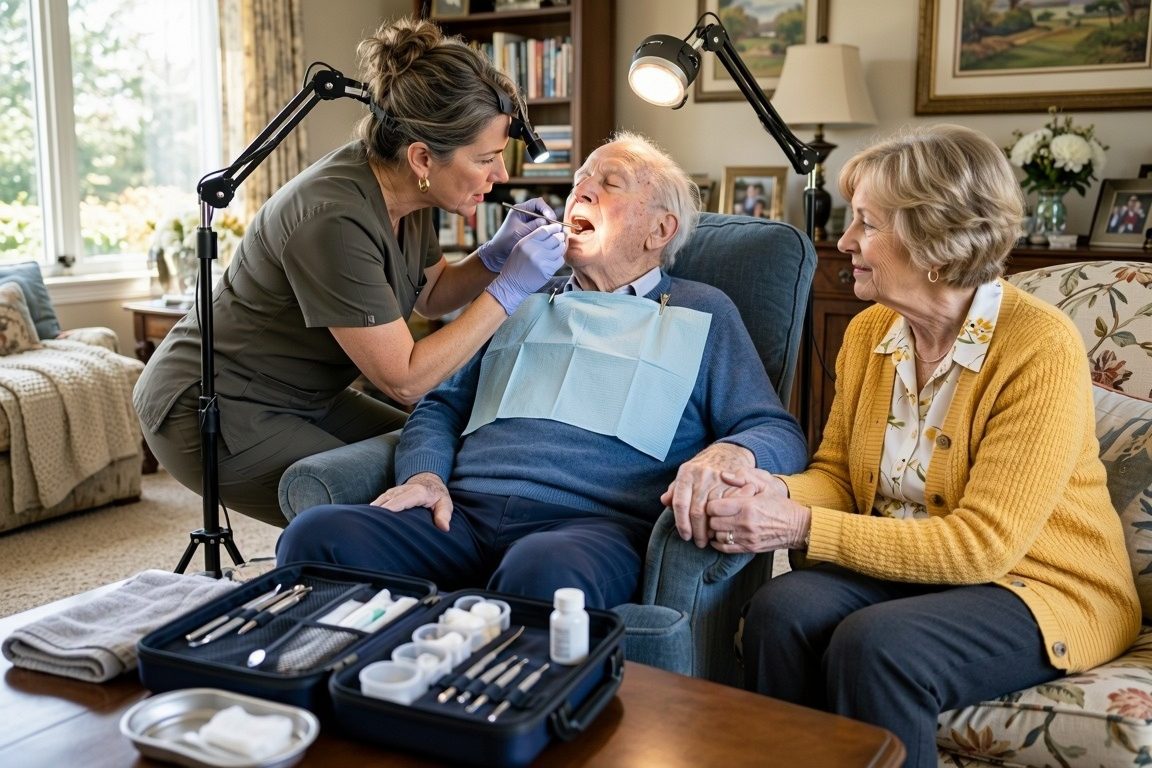
What not to do
- Do not assume a traditional dental office is the only option; for dementia patients leaving their comfort zone often fails.
- Do not pick a provider without confirming they have experience with dementia-related behaviors (e.g., resistance, confusion).
- Do not skip a pre-visit call to explain the patient's specific triggers and communication needs.
Key points
- There are two types of dentists who come to you: house-call (enters your home) and mobile (uses a van). For someone with dementia, house-call is usually the better choice.
- Start your search with the person's doctor, Medicare's Home Health Compare tool, and local memory care communities.
- Interview potential dentists by phone and ask specifically about dementia experience and their approach to anxious or resistant patients.
- Prepare the person and the environment before the visit: calm, familiar, and with a comfort item nearby.
- Do not force a visit if the person is distressed. Reschedule and try a different approach.
- Daily oral care is just as important as professional cleanings. Ask the dentist for product recommendations and techniques.
Videos
 An Interview with Dr. Joy Poskozim on the Importance of Dental Care for SeniorsDr. Poskozim explains the difference between house-call and mobile dentistry, and shares practical tips for finding a dentist who will come to your home. She also discusses how to handle a person with dementia who is resistant to care.
 Hiring a paid dementia caregiver with Laura Smothers-ChuThis video covers how to screen and hire a caregiver, which is directly relevant when you are bringing a professional into your home. The same principles apply to vetting a house-call dentist.
Background
Why traditional dental visits often fail for people with dementia
For someone living with dementia, a trip to the dentist is not just a routine errand. It involves leaving their comfort zone, navigating an unfamiliar environment, and allowing a stranger to touch their mouth. As Dr. Joy Poskozim explains, even a long-trusted dentist can become a stranger when the person is out of their usual routine and out of their home. The brain changes of dementia can make new places feel threatening, and the person may resist or become agitated when asked to sit in a dental chair or open their mouth. This is not stubbornness; it is a neurological response to feeling unsafe.
House-call vs. mobile dentistry: what is the difference?
There are two main types of dentists who provide care outside of a traditional office. A house-call dentist parks their car and brings portable equipment into your home or memory care room. They work with what is available, a kitchen chair, a bed, or a recliner. A mobile dentist operates out of a specially equipped van that can park outside your home or facility. These vans often have two treatment chairs and can perform procedures like root canals and implant surgeries. For someone with dementia who cannot or will not leave their home, the house-call dentist is usually the better choice because the person stays in their familiar environment. As Dr. Poskozim notes, her memory care patients are not going to want to leave the house, so the van model does not work for them.
What a house-call dentist can actually do at home
A house-call dentist can perform the vast majority of what is done in a traditional office. They can do a full oral exam, take X-rays with portable equipment, perform cleanings, place fillings, extract teeth, and treat gum disease. They can also provide guidance on daily oral care routines and recommend products that make brushing and flossing easier for someone with dementia. According to Mayo Clinic research, about 90 to 95 percent of what can be done in a primary care office can be done at home, and the same principle applies to dentistry. The key is finding a provider who is experienced with dementia and willing to adapt to the person's needs.
Practical tools
1
Provider verification checklist
Use a script when calling house-call or mobile dentists:
Different situations
Early-stage dementia (still living at home, able to leave the house with assistance)
You may still be able to use a mobile dentist van parked outside your home. Test the person's tolerance on a good day. Have a familiar item from home in the van. If the person becomes anxious, switch to a house-call dentist. Do not push them into the van if they resist.
Middle-stage dementia (needs supervision, may be anxious in new places)
A house-call dentist is almost always the best option. The person will likely not tolerate a van or office visit. Focus on creating a calm, familiar environment at home. The dentist may only be able to do a brief exam on the first visit. Be patient and celebrate small wins.
Late-stage dementia (bedbound, unable to communicate verbally)
A house-call dentist can still provide care. They can do an oral exam in bed, check for pain or infection, and provide palliative care. Daily oral care becomes critical to prevent pneumonia from aspiration of bacteria. Discuss with the dentist how to safely clean the mouth when the person cannot cooperate.
Lewy body dementia (fluctuating cognition, visual hallucinations, sensitivity to medications)
The person may have good days and bad days. Schedule the dental visit for a time of day when they are typically most alert and calm. Avoid any sedatives or strong painkillers unless discussed with the neurologist, as people with Lewy body dementia can have severe reactions. The dentist should be aware of the diagnosis and adjust their approach.
Spouse caregiver vs. adult child caregiver
As a spouse, you may feel more comfortable being present during the entire visit. As an adult child, you may need to coordinate with the other parent or a sibling to be present. In both cases, have a third person present if possible to help with calming and to observe the visit. The Alzheimer's Association recommends having a third person present to discuss impressions afterward.
Memory care community resident
Coordinate with the facility's staff. They can help prepare the person and the room. Ask if the facility has a designated room for the dentist to use. The staff can also provide a familiar caregiver to sit with the person during the visit. Make sure the dentist has a copy of the person's medical history and medication list.
Medicaid or limited income
House-call dentistry is often private-pay. Ask the dentist about sliding scale fees or payment plans. Some states have Medicaid programs that cover in-home dental care for people who are homebound. Contact your state's Medicaid office and ask about 'homebound dental services.' Also check with local dental schools, which sometimes offer low-cost care.
For the doctor
4
- Ask the person's primary care physician or neurologist: 'Is there any medical reason my loved one should not have a dental procedure at home? For example, if they have a bleeding disorder or take blood thinners, is it safe to have a tooth extraction at home?'
- Ask the dentist: 'What sedation or pain management options are available at home? Are there any medications that should be avoided in someone with dementia?'
- Ask the person's doctor: 'Are there any signs of oral infection or pain that I should watch for, especially if my loved one cannot tell me they are in pain?'
- Ask the dentist: 'If a problem is found that requires a specialist, such as an oral surgeon, what is your protocol for referral? Can that specialist also come to the home?'