Step by step
What not to do
- Do not assume that a normal eye exam means their vision is fine. This is a common trap. The problem is in the brain's processing, not the eyes.Instead, focus on environmental adaptations and observe their actual behavior.
- Do not rearrange furniture or change the layout of rooms frequently. Even small changes can be disorienting and cause anxiety. Keep the environment as consistent as possible. If you must change something, do it gradually and with repeated verbal reminders.
- Do not use monochromatic color schemes in any room, especially the bathroom and kitchen. A beige toilet on a beige floor is invisible to someone with dementia.Instead, use high-contrast colors for key items like toilet seats, plates, and handrails.
- Do not approach your loved one from behind or from the side without announcing yourself. Because of tunnel vision, they may not see you and can become frightened or defensive. Always approach from the front and say their name before touching them.
- Do not leave mirrors uncovered if they cause distress. The person may not recognize their own reflection and may think a stranger is in the room. This can lead to paranoia or agitation. Cover mirrors and see if their mood improves.
- Do not play loud TV or radio in the background. Sudden or overlapping sounds can overwhelm their brain and make it harder to process visual information. Keep the auditory environment calm and predictable.
Key points
- Dementia vision changes are brain-based, not eye-based, a normal eye exam does not rule out visual problems.
- Tunnel vision, depth perception loss, and color contrast issues are common and can be managed with environmental adaptations.
- High contrast (e.g., dark plate on light food) is one of the most effective and simplest tools.
- Reduce clutter and keep the environment predictable to reduce visual overload.
- Use verbal cues to guide attention and reduce startle, always announce yourself.
- Cover mirrors and manage lighting to reduce hallucinations and confusion.
Videos
 How Dementia Changes What They SeeThis video explains the brain-based nature of vision changes, including tunnel vision and motion blindness, and gives practical examples of what the person actually sees.
 Hands on Guide with Understanding the Changing BrainOffers a hands-on demonstration of how to adapt the environment for visual changes, including using contrast and reducing clutter.
 Zinnia Caregiver Support Session: Responding to Dementia-related Changes in the Person You SupportCovers a broad range of dementia-related changes, including vision, and provides a supportive framework for caregivers to respond with empathy and practical strategies.
 What is Sundowning?Explains how visual changes like shadows and reduced light at dusk can trigger sundowning, and offers tips for managing lighting and environment during that time.
2 more videos
 Two Kinds of Vision That All Humans HaveTeepa Snow explains protective vs. discriminatory vision and how dementia affects each, giving you a framework for understanding your loved one's struggles.
 Steady Steps: Practical Strategies for Managing Falls in DementiaFocuses on fall prevention, which is closely tied to vision changes, depth perception loss and tunnel vision are major fall risks. Offers concrete environmental adaptations.
Background
Why Vision Changes in Dementia Go Beyond the Eyes
When someone has dementia, their eyes may still work perfectly, the lenses, retinas, and optic nerves can be healthy. But the brain's visual processing centers are damaged. This means the brain struggles to interpret what the eyes see, like a computer that receives a clear image file but can't open it properly. As one expert explains, the person may have had a recent eye exam that shows 'everything is fine,' yet they still have trouble seeing the environment. That's because the problem isn't in the eyes, it's in the brain's ability to make sense of visual information.
Two key types of vision are affected: protective vision (which helps us detect threats and move toward or away from objects) and discriminatory vision (which lets us identify details like faces, text, or food on a plate). In dementia, both can be impaired. The person may not recognize a shadow as harmless or may fail to see a step as a hazard. They may also lose depth perception, making it hard to judge distances, so reaching for a cup or stepping onto a dark rug becomes risky. Understanding this brain-based change helps you stop blaming the person and start adapting the world around them.
Tunnel Vision, Motion Blindness, and Other Specific Changes
Tunnel vision is a common visual change in dementia. The person may only see what's directly in front of them, missing things to the side. This can make them seem startled when someone approaches from the side, or cause them to bump into furniture they didn't see. Another less common but impactful change is motion blindness, where moving objects (like cars or people) appear to be standing still. This makes crossing the street or navigating a busy room extremely dangerous. There's also a condition called simultaneous agnosia, where the person can only focus on one part of a scene at a time, they might see a cup but not the table it's on, or a face but not the body attached to it.
Color perception also shifts. People with dementia often have trouble distinguishing between similar hues, especially in the same color family. A bathroom where the toilet, floor, walls, and shower are all white or beige becomes an invisible landscape, they literally cannot see where to step. This is why many people with dementia refuse to use the bathroom or become anxious in monochromatic rooms. The brain simply cannot find the boundaries. By understanding these specific changes, you can target your adaptations to the exact problem your loved one is facing.
Practical tools
6
Verbal Cueing Script
Use these exact phrases to guide your loved one: 'I'm coming in from your right side now.' 'Here is your cup: I'm placing it in front of you.' 'There is a step down here, watch your feet.' 'I'm going to touch your arm now so you know I'm here.' These simple statements help their brain connect what they see (or don't see) with reality.
High-Contrast Plate Set
Buy a set of solid-colored plates in bright red, blue, or yellow, and another set in white or black. Use the contrasting plate color against the food color. For example, serve white rice on a red plate, and dark stew on a white plate. This makes the food visible and reduces frustration at mealtime.
Step Edge Tape
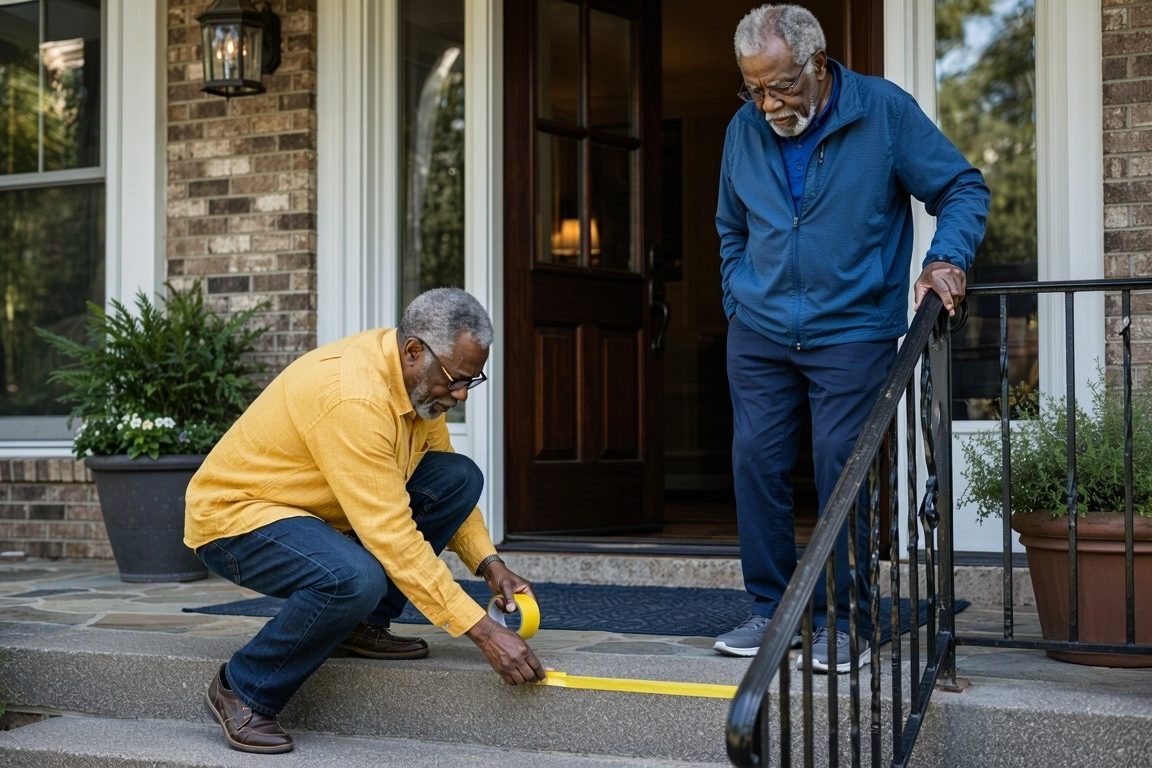
Use brightly colored, non-slip tape (available at hardware stores) to mark the edge of each stair step. Choose a color that contrasts with the step color, yellow on dark wood, black on light carpet. This provides a clear visual cue for depth perception problems.
Nightlight Strategy
Place soft, warm-toned nightlights in hallways, bathrooms, and the bedroom. Avoid blue or cool white lights, which can disrupt sleep. Use motion-sensor lights so they turn on automatically when someone walks by. This reduces falls and confusion during nighttime trips to the bathroom.
Mirror Cover or Removable Film
Use a piece of fabric, a removable mirror cover, or frosted window film to cover mirrors that cause distress. Test it for a day and see if your loved one seems less anxious. If they don't react to the mirror, you may not need to cover it, but if they do, this simple fix can reduce paranoia.
Declutter Checklist
Create a weekly checklist:
A clutter-free environment reduces visual overload and helps the brain focus on what matters.
Different situations
Lewy body dementia (LBD)
People with LBD often have more severe visual hallucinations and fluctuations in vision. They may see people or animals that aren't there. For LBD, avoid covering mirrors if they cause distress, instead, use soft lighting and avoid patterns on walls or floors that could be misinterpreted (like floral wallpaper that looks like faces). Also, be extra cautious with motion blindness; they may not see moving cars or people. Always hold their arm when crossing streets or navigating busy areas.
Late-stage dementia
In late stages, the person may have very limited vision or be nearly blind. Focus on other senses: use touch (a gentle hand on the arm), smell (familiar scents like lavender), and sound (soft music or a familiar voice). Keep the environment extremely simple, one or two pieces of furniture, no patterns, and very high contrast. Use verbal cues constantly, as they may not see you at all.
Spouse vs. adult child caregiver
As a spouse, you may be more familiar with their lifelong habits and preferences. Use that knowledge: if they always liked a certain color, incorporate it as a contrast accent. If they were tidy, keep things neat. As an adult child, you may need to be more assertive about making changes, especially if the parent resists. Explain that these changes are to help them stay safe and independent, not to take away their control. Involve them in choosing colors or placement when possible.
In a facility (nursing home or assisted living)
You may not be able to change the room's paint or furniture. Focus on portable adaptations: bring high-contrast plates and cups, add a bright-colored towel over the bathroom door handle, place a nightlight near the bed. Talk to staff about the vision changes and ask them to use verbal cues when approaching. Label drawers and closets with large, high-contrast pictures (e.g., a photo of a shirt on the shirt drawer).
Medicaid or low-income setting
Many adaptations cost little or nothing. Use items you already own: a dark towel on a light floor, a bright pillowcase on a neutral bedspread. Use painter's tape (cheap and removable) to mark step edges. Repurpose a dark-colored cutting board as a plate for light foods. Use a free app on a tablet to display single-line text for reading. The key is creativity, not expense.
For the doctor
4
- If your loved one suddenly develops new visual symptoms (like seeing things that aren't there, or losing vision in one eye), discuss with their doctor immediately, this could be a sign of a stroke or other medical issue, not just dementia.
- If they have a history of falls and you are considering using a gait belt or other mobility aid, ask their doctor or physical therapist for guidance on proper use and fit.
- If they are on medications that affect vision (like anticholinergics or certain antidepressants), ask the doctor if alternatives are available that might have fewer visual side effects.
- If you are unsure whether their vision changes are due to dementia or an eye condition (like cataracts or glaucoma), request a comprehensive eye exam by a geriatric optometrist or ophthalmologist.