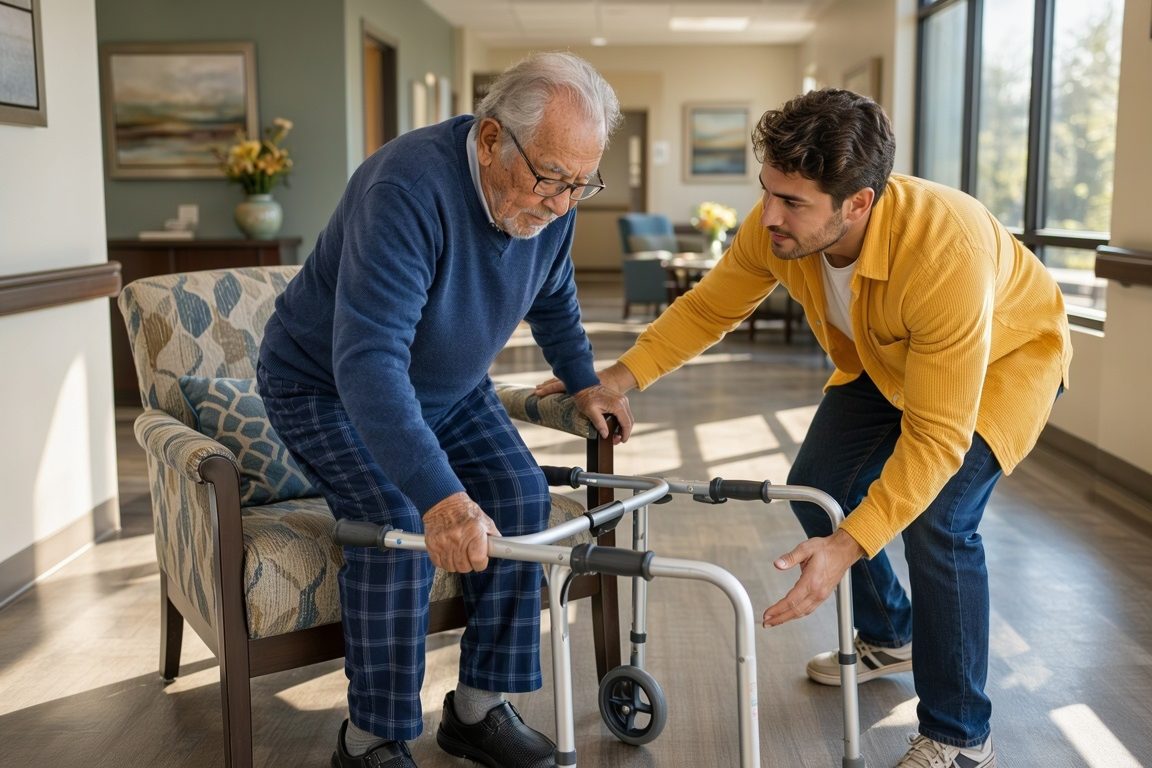
Step by step
What not to do
- Do not scold or argue with the resident about using the walker. Saying 'you need to use your walker' or 'why aren't you using it?' will only cause frustration and agitation. The resident cannot remember why they need it, and they may feel shamed.Instead, use a neutral, supportive tone: 'Let's walk together. I'll help you.'
- Do not leave the walker in the middle of the room or in a walking path. This is a trip hazard for the resident and for other residents. Always store the walker against a wall or in a designated spot when not in use. If the resident pushes it away, pick it up and move it out of the way without comment.
- Do not assume a wheelchair is the answer for every resident. Some residents will fight being placed in a wheelchair because they still have the urge to walk. Forcing them into a chair can increase agitation and lead to attempts to get up unsafely. Always try the spotting and environmental modifications first. Only use a wheelchair if the resident accepts it or if the care team determines it is medically necessary.
- Do not ignore the emotional need behind the walking. A resident who paces or tries to leave may be bored, lonely, or looking for something familiar. Simply blocking them or redirecting without addressing the need will not work. Offer a meaningful activity, a snack, or a one-on-one conversation. As one expert says, 'if they want to get up go to the door, I should still be saying come on, let's head on out', not quizzing them on why (Source 17).
- Do not rely solely on alarms or devices to keep the resident safe. Alarms are a tool, not a solution. They can alert you, but they cannot prevent a fall. The most effective fall prevention is a combination of environmental safety, staff presence, and understanding the resident's patterns. As one source warns, even with alarms, a determined resident can still exit (Source 5, 6).
Key points
- A resident who refuses a walker is not being difficult; their brain cannot form the memory that they need it. Do not argue or scold.
- Replace wheeled walkers with classic, non-wheeled walkers (with tennis balls) to eliminate the brake hazard.
- If the resident refuses any walker, use spotting, a gait belt, or hand-under-hand support instead.
- Create a clear, obstacle-free path for walking, and use nightlights to guide the way at night.
- Implement a scheduled toileting routine to reduce urgent, unsafe trips to the bathroom.
- Use purposeful activities (like carrying a basket) to channel the urge to walk into safe, meaningful movement.
- Document every fall or near-fall and communicate with the care team to adjust the plan.
- When in doubt, prioritize safety over device use. A safe walk without a walker is better than a fall with one.
Videos
 095. How to create a safe home for Dementia family membersThis video covers environmental modifications that reduce fall risk, such as removing clutter and improving lighting, which are directly applicable to a memory care unit.
 123. Replay: How to create a safe home for Dementia family membersA replay of the above, offering additional tips on creating safe walking paths and using visual cues to prevent wandering.
 095. How to create a safe home for Dementia family membersAnother version of the same topic, reinforcing the importance of a clutter-free environment and the use of alarms.
 What Level Of Care Does A Dementia Patient Need?Helps staff and families understand when a resident may need a higher level of care, such as a skilled nursing facility, if mobility and safety cannot be managed in memory care.
2 more videos
 How Do You Know When It's Time To Put A Loved One In A Nursing Home?Discusses the difficult decision of moving a resident to a nursing home when safety concerns (like falls) become unmanageable in a memory care setting.
 Top 3 Signs Your Loved One Needs Nursing Home CareHighlights key indicators, including frequent falls and inability to use mobility aids, which are directly relevant to this topic.
Background
Why the Walker Becomes a Problem in Middle-to-Late Stage Dementia
In middle-to-late stage dementia, the hippocampus, the brain's memory center , is significantly damaged. This means the resident cannot form new memories, including the memory that they need a walker to stand or walk safely. As one expert explains, 'if there's that hippocampal damage to their brain that's not letting them input new memories, they're not going to be able to learn it' (Source 15). Even if they used a walker correctly for years, the part of the brain that says 'I need this device' is gone. When they look down, they see a strange metal object in their way, and their instinct is to push it aside or try to walk without it. This is not stubbornness; it is a neurological reality.
Furthermore, many popular walkers , especially those with wheels and a basket , introduce a hidden danger. A resident may forget to lock the brakes before sitting down or standing up, causing the walker to roll forward and them to fall (Source 1, 2, 3). The very device meant to prevent falls becomes a fall hazard. This is especially true in a memory care facility where staffing ratios mean you cannot be at every resident's side every second. The goal must shift from 'enforcing walker use' to 'creating a safe movement environment that works with the resident's current abilities.'
The Real Risks: Falling, Wandering, and Agitation
When a resident cannot use a walker safely, the risks multiply. First, the obvious: falls. A resident who tries to walk without support may have poor balance, muscle weakness, and a shuffling gait, all of which increase fall risk. Second, the walker itself can cause injury if it is left in a pathway or if the resident trips over it. Third, the frustration of being told to use something they do not understand can trigger agitation, which may lead to wandering or attempts to leave the facility. As one source notes, residents who are agitated may 'remove a necessary medical device', including a walker , because they do not understand why it is there (Source 15). This agitation can also spread to other residents, disrupting the entire unit (Source 9).
Finally, there is the risk of elopement. A resident who is mobile but confused may try to walk out the door. Memory care units are locked for this reason, but if a resident is determined and the walker is not the issue, they may still attempt to leave. The key is to recognize that the walker problem is a symptom of a larger need: the resident needs to move, but their brain cannot coordinate the use of a tool. Your job is to provide the safety they cannot provide for themselves.
Practical tools
6
The 'Classic' Walker with Tennis Balls
Replace any wheeled walker with a standard, non-wheeled walker. Put tennis balls on the back legs to reduce friction and noise. This walker cannot roll forward, so there is no brake to forget. It stays close to the resident and provides stable support. If the resident refuses it, do not force it; simply remove it and use spotting instead.
Gait Belt (Transfer Belt)
A padded belt that goes around the resident's waist, with handles you can hold. This gives you a secure grip to support them while walking, without grabbing their arm or clothing. Always get training from a nurse or therapist on proper use. Never use it to lift the resident; only to guide and steady them.
Rope Lighting or Nightlights for Path Creation
Use battery-operated rope lighting or plug-in nightlights to create a visible path from the bed to the bathroom, or along the hallway. This helps the resident orient themselves at night and reduces the chance of wandering into unsafe areas. Choose warm, soft light to avoid glare (Source 19).
The 'Let's Walk Together' Script
When the resident stands up without their walker, do not say 'where is your walker?' Instead, approach calmly, offer your arm, and say: 'I see you're ready to go. Let's walk together. I'll go with you.' This validates their desire to move and provides the support they need without confrontation. If they resist, step back and try again in a minute.
Purposeful Walking Cart or Laundry Basket
Give the resident a lightweight cart (like a small shopping cart) or a laundry basket with a few soft items (like towels or socks) to carry while walking. This gives their hands something to do and their movement a purpose. It can reduce pacing and wandering because they feel they are 'doing something.' Ensure the cart is stable and cannot tip.
Toileting Schedule Chart
Create a simple chart that lists the times for toileting (e.g., 7am, 9am, 11am, 1pm, 3pm, 5pm, 7pm, bedtime). Post it in the resident's room and in the staff break room. Check off each time it is done. This reduces the number of urgent, unsafe trips to the bathroom and helps prevent falls (Source 23).
Different situations
Resident has Lewy body dementia (LBD)
LBD often causes significant fluctuations in mobility and alertness. A resident may walk well one hour and be unable to stand the next. Do not assume they can always use the same device. Be prepared to switch between spotting, wheelchair, and walker throughout the day. Also, LBD can cause visual hallucinations, so the walker may look like a threatening object. If the resident seems scared of the walker, remove it immediately and use spotting. Discuss all mobility changes with the doctor, as LBD can also cause rigidity and falls.
Resident is in late-stage dementia and non-verbal
In late stages, the resident may be unable to walk at all or may only take a few shuffling steps. A walker is almost never appropriate. Use a wheelchair with a pressure-relieving cushion and a lap belt (with doctor's order) for safety. Focus on gentle range-of-motion exercises in bed or in a chair to prevent contractures. The goal is comfort and dignity, not mobility. Always use a two-person transfer if the resident is heavy or unsteady.
Staff-to-resident ratio is low (e.g., 1:12 or worse)
When you cannot be with the resident constantly, environmental safety becomes critical. Remove all clutter, lock doors to unsafe areas, and use alarms on the resident's bed and door. Consider grouping residents who pace together in a safe, enclosed area. Use a 'walking loop' in the hallway that is clearly marked. If possible, assign one staff member to do a 'safety check' every 15 minutes for high-risk residents. Document every fall or near-fall to build a case for more staff or a different level of care.
Resident is a 'wanderer' who tries to exit the unit
If the resident is determined to leave, the walker is not the primary issue; the wandering is. Use the strategies from the wandering article: secure all exits with high locks, door alarms, and visual barriers (e.g., a curtain or a painted mural over the door). Provide a safe outdoor space if possible. Engage the resident in a high-interest activity (e.g., folding laundry, sorting silverware) to redirect their focus. Never leave them unattended near an exit. If wandering is severe, the facility may need to consider a higher level of supervision or a locked unit within the memory care unit (Source 5, 6).
Resident has had a recent fall or hip fracture
After a fall, the resident may be fearful of walking or may have new mobility limitations. A walker may be medically necessary, but the resident may resist due to pain or fear. Work with physical therapy to find a device that is comfortable and safe. A front-wheeled walker with a seat may be an option, but only if the resident can be taught to use it (which may be impossible). In many cases, a wheelchair is the safest option until the resident heals. Always follow the doctor's and therapist's orders. Do not force the resident to walk if they are in pain.
For the doctor
5
- Ask the resident's doctor or physical therapist: 'Is a wheelchair or transport chair medically necessary for this resident, or can we continue with spotting and environmental modifications?'
- Discuss with the facility's nursing director: 'What is the protocol for using a gait belt with a resident who refuses a walker? Do we need a doctor's order?'
- If the resident has frequent falls, ask the doctor: 'Should we consider a hip protector or a helmet to reduce injury risk?'
- For residents with severe wandering and fall risk, ask the doctor: 'Is this resident appropriate for a locked memory care unit, or do they need a higher level of supervision, such as a one-on-one aide?'
- If the resident is on medications that cause dizziness or low blood pressure (orthostatic hypotension), ask the pharmacist or doctor: 'Can we adjust the timing or dosage to reduce fall risk?'