Step by step
What not to do
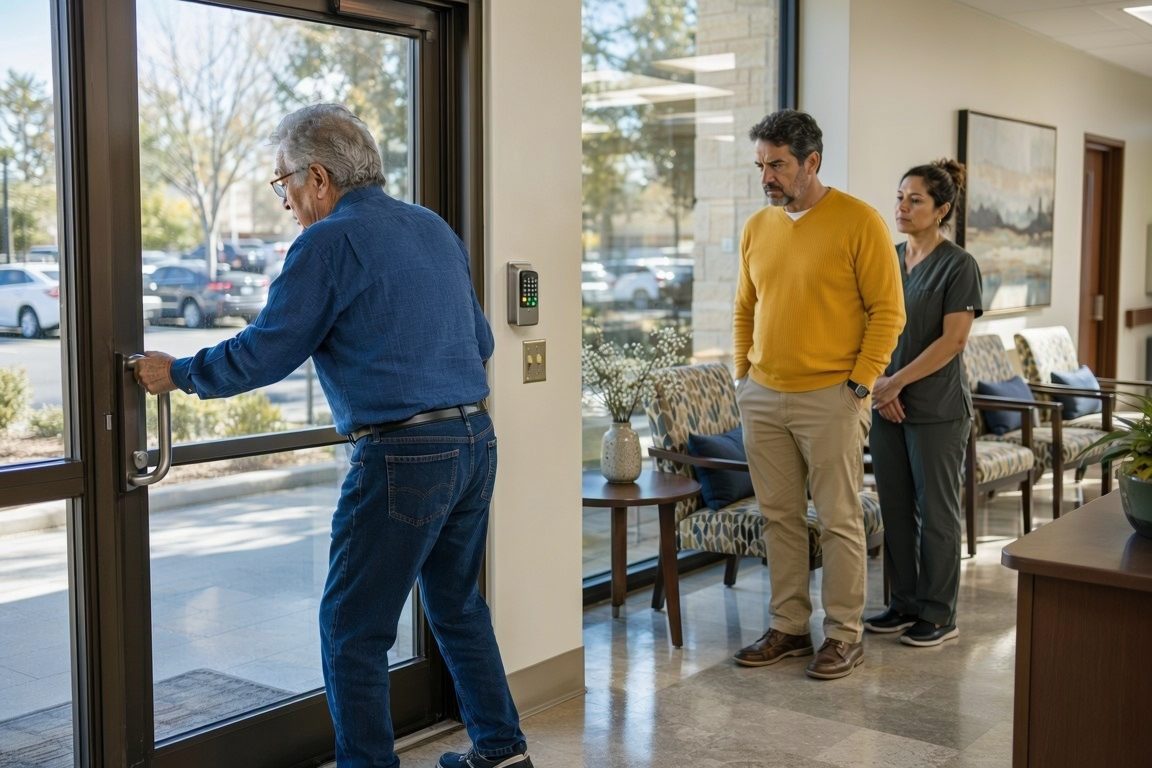
- Do not physically block the door or grab the resident. This can trigger a fight-or-flight response, leading to aggression or falls.Instead, step to the side and use verbal redirection with a calm tone.
- Do not argue or try to reason with the resident. Saying 'This is your home now' will likely increase their confusion and distress.Instead, validate their feeling: 'I know you want to go home. Tell me about your home.' Then redirect to a positive activity.
- Do not remove a purse or coat without offering a replacement. If a woman is attached to her purse, removing it can cause panic and accusations of theft.Instead, offer a decoy purse or a 'job' that involves carrying something (like a bag of snacks) to redirect the exit urge.
- Do not use alarms or locks that are obvious or frightening. A loud alarm can startle the resident and increase agitation. Use discreet alarms (like a chime) that alert staff without alarming the resident. Locks should be placed high or low, out of the resident's line of sight, and painted to match the door.
- Do not leave the resident alone at the exit. If they are fixated on the door, stay with them, engage them in conversation, and slowly guide them away. If you must step away, have another staff member take over. A resident left at a door may eventually figure out how to open it.
- Do not assume that 'memory care' means the facility can handle all behaviors. Some facilities have limits on what they can manage. If exit-seeking becomes dangerous or frequent, discuss with the clinical team whether a higher level of care (e.g., a specialized dementia unit) is needed. As one source notes, families are sometimes told, 'If this keeps up, we can't keep her here.'
Key points
- Exit-seeking is driven by unmet needs, confusion, or boredom, not by a desire to 'escape.' Validate the feeling, then redirect.
- Camouflage the exit door with a poster, plant, or furniture to make it less visually obvious. A dark rug in front can create a natural hesitation.
- Remove or replace trigger items like purses, coats, and keys near the exit. Offer a decoy or a purposeful task instead.
- Create a safe walking loop with clear signage to meet the need to move without leading to an exit.
- Use a calm, non-confrontational approach: ask where they are going, then redirect to an activity or a snack.
- Document patterns and share them across shifts. Preempt exit-seeking with engaging activities during peak times.
Videos
 Why Do Dementia Patients Keep Saying They Want To Go Home?This video explains the emotional need behind 'I want to go home,' which is often the driver of exit-seeking. It offers validation techniques that can be used at the door.
 What Do You Do When A Dementia Patient Starts Wandering?Provides practical, step-by-step redirection strategies for the moment a resident begins to wander toward an exit, including how to use their own language to guide them back.
 Why Does My Mom With Dementia Keep Asking To Go Home?Focuses on the emotional validation needed when a resident repeatedly asks to leave. Useful for training staff on compassionate responses.
 How to Safely Secure Doors for Dementia Patients?Demonstrates environmental modifications like door camouflage, high/low locks, and alarms that are specifically designed for secured units.
2 more videos
 Caregiver Training: Wandering | UCLA Alzheimer's and Dementia Care ProgramA professional training video that covers the triggers for wandering (including exit-seeking) and the correct way to approach and redirect a resident at the door.
 Memory and dementia: Moving a mom with dementiaWhile about moving to a facility, this video helps staff understand the resident's perspective of being in a new, unfamiliar place, which can drive exit-seeking.
Background
Why Residents Try to Leave a Secured Unit
Exit-seeking in a memory care unit is almost never about a desire to 'escape' in the way we might think. Instead, it's often a response to an unmet need: the person may feel bored, anxious, thirsty, or need to use the bathroom. They might be reliving an old memory, believing they need to go to work, pick up children, or 'go home' to a house they lived in decades ago. The locked door itself can feel like a prison, triggering a fight-or-flight response. As one expert notes, wandering can be triggered by seeing things that signal leaving, such as the front door, purses, keys, or coats. In a secured unit, the very presence of an exit door can become an irresistible magnet.
The Emotional and Cognitive Drivers
For a person with middle to late stage dementia, the world is increasingly confusing and unfamiliar. They may not recognize the facility as their home, and every time they see a door, their brain signals 'this is how I get out of here.' This is not a logical decision; it's a deeply felt need. The person may also be experiencing 'sundowning', increased agitation in the late afternoon or evening , which can amplify the urge to leave. As a caregiver, understanding that this is a symptom of the disease, not a personal choice, is the first step to responding with patience and skill. The goal is not to stop the person from wanting to leave, but to meet the underlying need in a way that keeps them safe and calm.
Why Standard 'No' or 'Stop' Doesn't Work
Telling a person with dementia 'No, you can't go out' or physically blocking them often escalates the situation. The person may feel frustrated, frightened, or even more determined to leave. They have a reduced ability to process language and reason, so a direct command can feel like a threat. Instead, the most effective approach is to validate their feeling, redirect their attention, and modify the environment so the exit is less tempting. As one source puts it, 'A person can't leave if they can't find the door.' This is the core principle of environmental modification in a secured unit.
Practical tools
6
Door Camouflage Poster or Cover
A large, realistic poster that makes the door look like a bookshelf, a window with a garden view, or a scenic landscape. These are available online or can be custom-made. Place it at eye level on the door. The resident's brain will process the image as a non-exit, reducing the urge to open it. Ensure the poster is securely attached and does not create a tripping hazard.
Decoy Purse or 'Job' Bag
For residents who fixate on carrying a purse or bag, provide a decoy bag filled with safe, interesting items (e.g., soft fabric squares, a small photo album, a fidget toy). When they approach the exit, hand them the bag and say, 'Oh, I was just looking for you! Can you help me carry this to the activity room?' This redirects the exit urge into a purposeful task.
Safe Walking Loop with Floor Markers
Create a clearly marked walking path inside the unit using colored tape or decals on the floor. The path should form a loop that passes by engaging areas (e.g., a fish tank, a snack station, a cozy chair) and avoids the exit. Residents who need to pace can follow the path safely. Label key rooms (bathroom, dining room) with large, simple signs and pictures.
Redirection Script: 'The Three Questions'
When a resident approaches the exit, use this script: (1) 'Where are you headed today?' (2) 'Who are you going to see?' (3) 'What time do you need to be there?' This gives you clues to their unmet need. Then redirect: 'Oh, your appointment isn't until later. Let's get a snack first.' Practice this script with all staff so responses are consistent.
Pressure-Sensitive Mat or Door Sensor
Place a pressure-sensitive mat in front of the exit door, or install a wireless door sensor that chimes softly at the nurses' station when the door is opened. This alerts staff without alarming the resident. Choose a chime that is pleasant (like a bird sound) rather than a loud alarm. Test the system weekly to ensure it works.
Activity Cart or 'Wandering Kit'
Prepare a portable cart or basket with simple, engaging items:
When a resident starts exit-seeking, bring the cart to them and invite them to 'help' with a task. This provides immediate distraction and a sense of purpose.
Different situations
Lewy Body Dementia (LBD) or Parkinson's Disease Dementia
Residents with LBD may have visual hallucinations and fluctuating cognition. The exit-seeking may be triggered by seeing something that isn't there (e.g., a person calling them from outside). Use validation: 'I see you're looking at something. What do you see?' Then redirect to a safe, familiar activity. Avoid using dark rugs or patterns that could be misinterpreted as threatening. Also, be aware that these residents may have sudden changes in ability; what works one hour may not work the next.
Late Stage Dementia (Bedbound or Wheelchair-bound)
Exit-seeking may manifest as repetitive vocalizations ('I want to go home') or attempts to wheel themselves toward the door. Use a wheelchair with a lap belt (with clinician approval) to prevent falls. Place a familiar object (like a favorite blanket) on their lap to provide comfort. Use a 'talking' photo album or a music player with headphones to redirect their attention. The goal is to meet the emotional need for safety, not physical movement.
Activities Director vs. Direct Care Staff Role
As an activities director, your focus is on preventing exit-seeking through meaningful engagement. Schedule high-interest activities (music, gardening, pet therapy) during peak exit-seeking times (often late afternoon). Train direct care staff to use redirection scripts and to document triggers. As direct care staff, your role is to respond in the moment with calm, consistent redirection. Communicate with the activities director about what works and what doesn't so the activity schedule can be adjusted.
Resident with a History of Elopement (Leaving and Getting Lost)
For a resident who has successfully left the unit before, use a higher level of monitoring. Consider a wearable GPS tracker (with clinician and family approval) that alerts staff if the resident leaves a designated area. Ensure the facility has a 'wandering response' plan that includes notifying local police and having a recent photo on file. The Alzheimer's Association's Safe Return program can also be helpful. Discuss with the clinical team whether a different unit or facility is needed for safety.
Resident Who Becomes Aggressive When Redirected
If the resident responds to redirection with hitting, yelling, or biting, prioritize safety for everyone. Do not get within arm's reach. Use a calm, low voice and give them space. Say, 'I can see you're upset. I'll step back and give you a moment.' Then call for backup from a trained staff member. Consider a referral to a behavioral health specialist or a geriatric psychiatrist. Discuss with the clinician whether medication adjustments might help reduce agitation, but never suggest medication changes yourself.
For the doctor
4
- If the resident's exit-seeking is accompanied by new or worsening aggression, discuss with the clinician whether a medication review or adjustment is needed. Never suggest specific medications yourself.
- If the resident has a history of falls and is exit-seeking, ask the clinician about the safest way to use mobility aids (e.g., a wheelchair with a lap belt) to prevent injury.
- If the resident is on medications for dementia or other conditions, ask the clinician whether any of them could be contributing to increased agitation or confusion (e.g., anticholinergics, benzodiazepines).
- If the resident has a sudden change in exit-seeking behavior (e.g., from never trying to suddenly trying multiple times a day), discuss with the clinician whether a urinary tract infection (UTI) or other medical issue could be the cause.