Step by step
What not to do
- Do not simulate for more than 20 minutes at a time. Prolonged simulation can be genuinely distressing and may leave you feeling overwhelmed, not empowered. Keep it short and debrief afterward.
- Do not simulate in front of your loved one if they are easily confused or anxious. They may think you are playing a game or, worse, that you are mocking them. Do it privately or with a supportive friend.
- Do not assume your simulation is exactly what your loved one experiences. Every person's dementia is unique, and their brain changes are different from a temporary simulation. Use it as a rough guide, not a perfect replica.
- Do not use simulation to 'prove' that your loved one is wrong or that their behavior is unreasonable. The goal is to build compassion, not to win an argument. If you feel anger rising, stop and take a break.
- Do not skip the debrief. The most valuable part of simulation is reflecting on what you felt. Without that reflection, you may just feel frustrated or dismissive. Write down your insights.
Key points
- Simulation helps you move from intellectual understanding to emotional empathy, you feel what your loved one might feel.
- Use simple, safe simulations: goggles for vision, gloves for touch, noise for hearing. Never simulate for more than 20 minutes.
- Always debrief after simulation: write down what you felt and one change you can make.
- Simulation is a tool for compassion, not for proving a point. It's about you, not about 'fixing' your loved one.
- Personalize your simulation based on your loved one's dementia type, stage, and environment.
- Share your simulation insights with other caregivers, it builds community and reduces isolation.
Videos
 Time with Teepa - Dementia SimulationsTeepa Snow demonstrates simulation techniques and explains why experiencing sensory changes firsthand changes your care approach.
 Dementia Careblazer Interview: How the 5 senses can impact behaviorThis interview covers how to observe which senses are affecting your loved one's behavior and gives practical tips for starting the process.
 What to Say When Friends & Family Don't Understand Dementia CaregivingDr. Camille Sinclair teaches how to use short, emotionally anchored stories to help others understand, a skill that simulation builds.
 Time with Teepa - Seeking Sensory Input, or Is It About Sexual Touch? Section 3Teepa explores how sensory seeking can be misinterpreted, and how simulation helps you tell the difference between a need for touch and a sexual behavior.
2 more videos
 SUP! How PAC Certified Consultants Think About Solving Dementia ProblemsThis video shows how professionals use simulation thinking to solve real-world dementia challenges in the moment.
 Hallucinations and DementiaExplains how sensory changes can lead to hallucinations and how simulation can help you respond with validation rather than correction.
Background
Why Simulation Matters: From Head-Knowing to Heart-Knowing
You may have read that dementia changes vision, touch, and hearing, but knowing this in your head is different from feeling it in your body. When you simulate sensory loss, you move from sympathy to empathy, you don't just feel sorry for your loved one; you begin to appreciate what their daily reality might be like. As Teepa Snow explains, simply simulating that experience and processing it can show you 'how your life's going to be when you get dementia'. This isn't about scaring yourself, but about understanding that your loved one is living with something profoundly different, in ways you 'really frankly can't even begin to imagine', until you try.
What Simulation Reveals: The Hidden World of Sensory Changes
In dementia, the brain's ability to process sensory information is altered. Vision may narrow, making peripheral cues invisible. Touch may become less sensitive or overly sensitive. Hearing may distort sounds, making a friendly voice seem harsh. When you simulate these changes, for example, by wearing goggles that block peripheral vision or gloves that dull touch, you suddenly understand why your loved one might startle when you approach from the side, or why they might fidget with their clothing. As the Dementia Careblazers note, you can 'kind of see if your loved one is startled and easy when you're approaching them from different angles'. Simulation gives you a direct, personal reference for their behavior.
The Emotional Impact: Why Simulation Changes Your Response
When you experience even a few minutes of sensory confusion, you feel vulnerable, anxious, and disoriented. That feeling is a gift, it helps you stop blaming your loved one for 'acting out' and start problem-solving with compassion. As one expert puts it, 'it's harder to actually believe in what we're being told if we can't feel what it would mean to us'. Simulation lets you 'feel what it would mean' to live with these changes. Then, when your loved one resists help or seems agitated, you're more likely to ask, 'What can I do to make this easier?' rather than 'Why are they doing this to me?'
Practical tools
4
The 'Dementia Live' Simulation Kit (or DIY version)
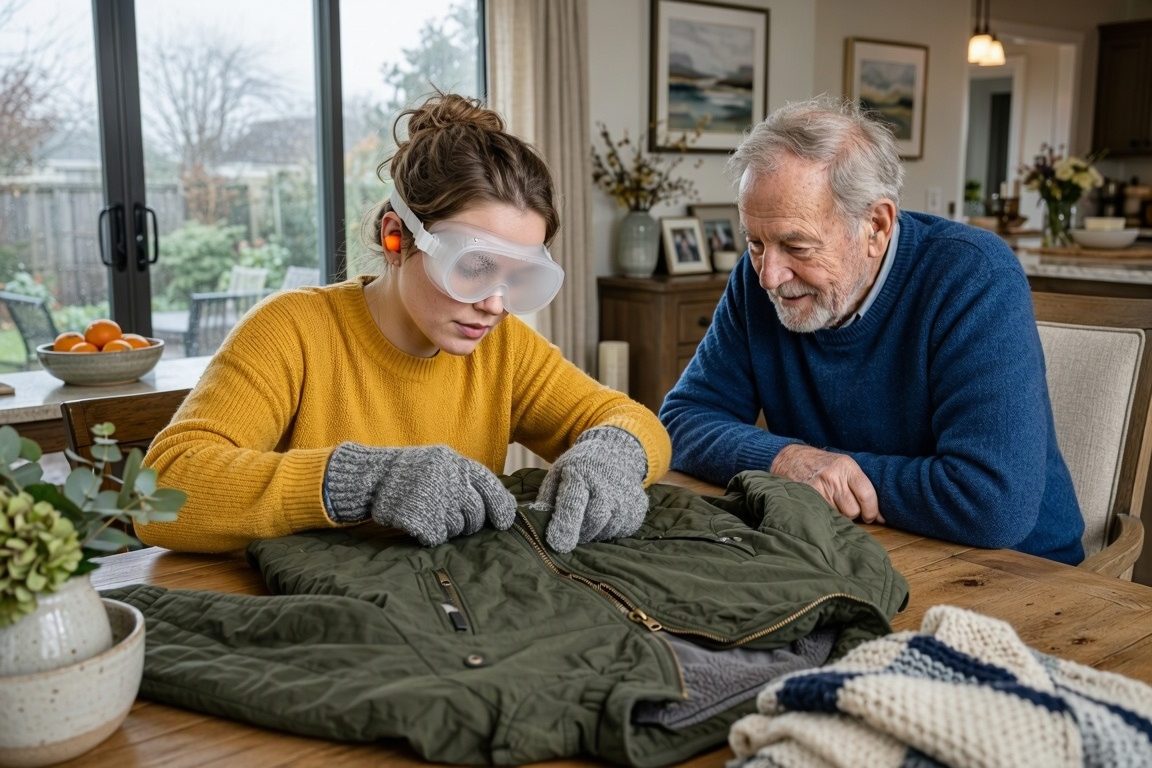
Formal programs like Dementia Live use goggles, gloves, and audio to simulate sensory loss. You can create a DIY version:
Use this kit for a 10-minute weekly practice.
The 'Sensory Journal' Prompt
After each simulation, write answers to three questions:
This turns feeling into action.
The 'Approach from the Front' Reminder Card
Print a small card that says 'Always approach from the front, speak first, and wait 5 seconds before touching.' Tape it to your bathroom mirror or kitchen cabinet. This is a direct application of what you learn from simulating peripheral vision loss.
The 'Texture and Temperature' Check
After simulating touch loss, create a small basket of items with different textures (soft fleece, rough sponge, smooth stone, cool metal). Before helping your loved one with dressing or eating, touch each item to remind yourself how different textures feel when your sense of touch is dulled.
Different situations
Lewy body dementia (LBD)
In LBD, visual hallucinations and fluctuating attention are common. Simulation should include more extreme visual distortion (e.g., goggles with smudged lenses) and sudden changes in lighting. Focus on how disorienting it is when a 'stranger' appears in a mirror, this can help you understand why covering mirrors may reduce distress.
Late-stage dementia (non-verbal)
Simulation becomes less about understanding specific behaviors and more about appreciating profound sensory deprivation. Use the simulation to feel what it's like to have very limited vision and hearing, and then practice using gentle touch and simple, rhythmic sounds (like humming) to connect. Your goal is to learn to 'speak' through the senses that remain.
Spouse vs. adult child caregiver
If you are a spouse, simulation may stir grief as you feel the loss of the person you knew. Allow yourself to feel that. If you are an adult child, simulation may help you shift from a 'fix it' mindset to a 'be with' mindset. In both cases, share your simulation experience with a support group, it can help others feel less alone.
In a facility setting
If your loved one is in a facility, use simulation to evaluate the environment. Put on the goggles and gloves and walk the hallway: is the lighting too bright? Are there confusing shadows? Is the noise level overwhelming? Share your findings with the care team as a collaborative tool, not a criticism.
Medicaid or limited resources
You don't need expensive kits. Use items you already have: a pair of sunglasses with the lenses scratched, old winter gloves, a radio tuned to static. The key is the intention and the reflection, not the equipment. Even 5 minutes with a single sense can be powerful.
For the doctor
3
- If your simulation reveals that your loved one seems to be in constant pain or distress, discuss with their doctor whether an undiagnosed medical condition (like a urinary tract infection, vision problem, or hearing loss) might be contributing.
- If your loved one is experiencing tactile hallucinations (feeling bugs on their skin), always rule out medication side effects with their doctor before assuming it's purely sensory.
- If you find yourself feeling persistently depressed or anxious after simulation exercises, talk to your own healthcare provider. Caregiver burnout is real, and your emotional health matters.