Step by step
What not to do
- Do not use the simulation as a one-time 'shock and awe' event without follow-up. Without a debrief and action plan, the experience can leave staff feeling overwhelmed or defensive rather than empowered.Instead, always pair the simulation with facilitated discussion and concrete next steps.
- Do not force someone who is currently experiencing dementia symptoms or who is highly anxious to participate. The simulation is designed for caregivers and professionals, not for people living with dementia. It can be distressing for someone who is already struggling with cognitive changes.
- Do not treat the simulation as a perfect replica of dementia. It is a tool for building empathy, not a diagnostic or training substitute for real clinical knowledge. Avoid saying 'Now you know exactly what it's like.' Instead, say 'This gives us a small taste of the challenges our residents face every day.'
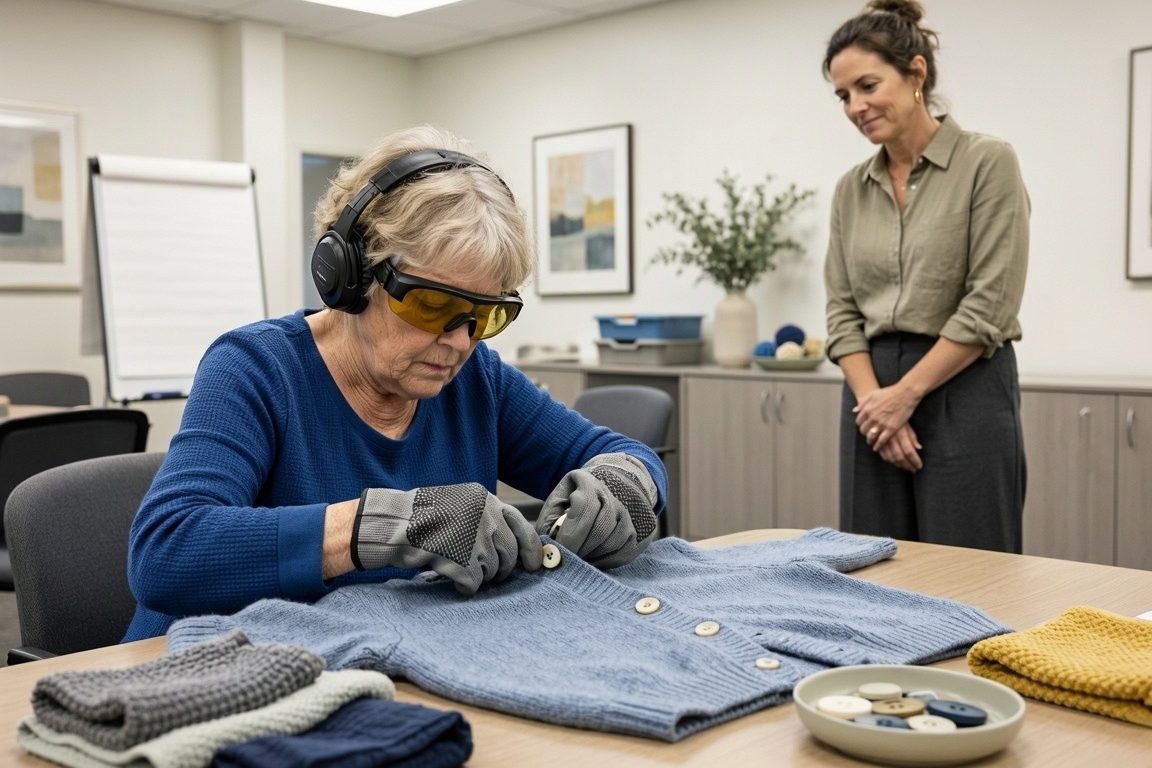
- Do not skip the sensory equipment or try to 'cheat' by removing gloves or goggles. The discomfort is the point. If you make it too easy, you lose the emotional impact that drives behavior change.
- Do not use the simulation to blame or shame staff for past interactions. Frame it as a learning opportunity: 'We all do the best we can with what we know. Now we know more, so we can do better.'
Key points
- Dementia Live is a sensory simulation that gives caregivers a brief, visceral experience of the confusion and frustration of living with dementia.
- The real value comes from the structured debrief after the simulation, where staff connect their feelings to resident behaviors and brainstorm new approaches.
- This training builds empathy, patience, and a needs-based approach to care, reducing staff burnout and improving resident outcomes.
- It is not a diagnostic tool and should not be used with people who are themselves experiencing dementia symptoms.
- Administrators can measure the impact by tracking reductions in behavioral incidents, staff turnover, and family complaints.
- The simulation can be adapted for family members to improve understanding and reduce conflict at care plan meetings.
Videos
 Uniting for Better Dementia Care = Seni + Dementia LiveThis video shows a real partnership between a senior living provider and the Dementia Live program, giving you a concrete example of how the training is implemented in a community setting.
 The 'Dementia LIVE' Experience with AGE-u-cateWatch an actual simulation in action, including the setup of the sensory equipment and a participant's reaction. This is the best way to understand what the experience feels like before you schedule it.
 5 Shocking Facts About Dementia I Wish Everyone KnewThis video provides important background on the sensory and emotional realities of dementia that the simulation aims to teach. It helps frame why empathy training is so critical.
 How To Find Local Dementia Caregiver Support Groups? - TestAfter the simulation, caregivers may need additional emotional support. This video shows how to find local support groups, which can be a valuable follow-up resource for staff or family members.
2 more videos
 What Communication Skills Help With Repetitive Questions In Dementia Care? - TestThe simulation often highlights the frustration of not being understood. This video offers practical communication strategies that staff can use immediately after the training.
 Convincing someone with dementia to go to higher level of careFor administrators and family caregivers, this video addresses a common challenge that the simulation's empathy-building can help with: understanding why a resident may resist a move and how to approach it with compassion.
Background
What Dementia Live Actually Is (And Isn't)
Dementia Live is a simulation experience designed by AGE-u-cate that uses special sensory equipment, goggles that block peripheral vision, gloves that reduce fine motor skills, and headphones that play distracting noise, to mimic some of the sensory and cognitive challenges of dementia. You are then asked to complete simple tasks, like folding a towel or sorting coins, while wearing this gear. The goal is not to perfectly replicate dementia (no simulation can do that), but to give you a visceral, emotional glimpse into the daily reality of someone living with the condition. As one trainer explains, it helps you 'feel more so what it's like to truly live with dementia.' This is a training for empathy, not a diagnostic tool. In fact, experts caution that people who are themselves experiencing dementia symptoms should not go through the simulation, as it could be distressing or confusing.
Why This Matters for Senior Living Caregivers and Administrators
In a senior living community, staff often see behaviors, wandering, agitation, refusal to bathe, as problems to be solved or managed. But these behaviors are usually the person's best attempt to communicate distress or confusion. Dementia Live shifts the focus from 'fixing the behavior' to 'understanding the person.' After the simulation, caregivers report a profound increase in patience and a new appreciation for the subtle cues residents give. One provider notes that the training teaches caregivers to recognize 'the subtle cues of the residents' and to approach care from a 'needs-based' perspective. For administrators, this translates into fewer behavioral incidents, lower staff burnout, and a culture where person-centered care is not just a slogan but a daily practice. The simulation also opens the door for deeper conversations: after the experience, you can talk with staff about what they struggled with and brainstorm new approaches that increase quality of life for both residents and caregivers.
The Ripple Effect: From Simulation to Better Outcomes
The real power of Dementia Live is not the 10-minute simulation itself, but the conversation that follows. When a caregiver has felt the frustration of not being able to complete a simple task, they are far more likely to respond with patience when a resident struggles to button a shirt or find the dining room. This shift in perspective can reduce the use of antipsychotic medications, decrease resident agitation, and improve the overall emotional climate of the community. As one advocate puts it, the training helps 'people that genuinely heart and soul want to help older adults have better outcomes.' For administrators, this is a measurable return on investment: better staff retention, higher family satisfaction scores, and a reputation for truly compassionate care. The simulation is often paired with other training, like 'Compassionate Touch,' to build a comprehensive approach to dementia care.
Practical tools
6
The Debrief Conversation Starter
After the simulation, use these exact phrases to guide discussion:
The 'One Change' Commitment Card
Create a simple index card for each staff member. After the debrief, have them write one specific behavior change they will commit to, such as 'I will wait 10 seconds before repeating a question' or 'I will use a calm, low voice when a resident is upset.' Post the cards in a staff area as a visual reminder.
The 'Sensory Overload' Checklist for Caregivers
Print a checklist that helps staff identify potential sensory triggers in the environment. Items include:
Use this checklist during shift changes to proactively adjust the environment for residents who are agitated.
The 'Slow Down' Script for Difficult Moments
When a resident is upset or refusing care, use this script: 'I can see this is hard for you. Let's take a breath together.' (Pause and breathe slowly.) 'I'm here to help. Would you like to sit down for a moment?' (Offer a choice.) 'Okay, let's try this one step at a time.' (Use simple, one-step instructions.) This script is based on the understanding that the person is doing the best they can.
The 'Dementia Live' Follow-Up Survey
Create a short, anonymous survey to administer 30 days after the training. Ask:
Use the results to plan additional training or support.
The 'Family Member' Simulation Invitation
For administrators: host a special 'Family Night' where family members can experience a shortened version of Dementia Live. Use this as a bridge to better communication. After the simulation, facilitate a discussion about what family members can do to support their loved one and the care team. This can reduce family complaints and increase trust.
Different situations
For a senior living community with a high proportion of residents with Lewy body dementia
Emphasize the visual hallucinations and fluctuating cognition that are common in Lewy body. During the debrief, ask staff to consider: 'What if the person is seeing something that isn't there? How would you respond?' Add a module on validating the person's reality without arguing. The simulation's sensory overload can be particularly effective in helping staff understand the extreme sensitivity to noise and visual stimuli in Lewy body.
For an administrator implementing this in a memory care unit (late-stage dementia)
Focus the debrief on non-verbal communication and the importance of touch and tone. In late-stage dementia, residents may not be able to speak, but they can still feel your approach and attitude. Use the simulation to highlight how even simple tasks (like being fed or bathed) can feel invasive or confusing. Pair the simulation with training on 'Compassionate Touch' techniques.
For a caregiver who is an adult child of a parent with early-stage dementia (not in a facility)
While Dementia Live is typically used in professional settings, you can adapt the principles at home. For example, have the adult child wear oven mitts and try to button a shirt while listening to loud radio static. Then discuss: 'When Mom struggles to get dressed, this is a tiny glimpse of what she might feel.' Use this to build patience and reduce arguments. Focus on the emotional takeaway, not the exact simulation.
For a caregiver in a facility who is a certified nursing assistant (CNA) with high stress
The simulation can be a powerful tool for reducing burnout by reframing 'difficult' behaviors as expressions of need. After the simulation, ask CNAs to share one resident they find challenging and brainstorm a new approach together. Emphasize that the training is not about adding more work, but about working smarter with more understanding. Offer follow-up coaching sessions for the most challenging cases.
For a facility serving residents with mixed dementia (e.g., Alzheimer's and vascular dementia)
During the debrief, discuss how different types of dementia can present differently. For example, vascular dementia may cause more mood swings and difficulty with planning, while Alzheimer's may affect memory more prominently. The simulation is a general tool, but the debrief should be tailored to the specific population you serve. Use it as a springboard for ongoing education about the different dementia types.
For the doctor
3
- If a staff member or family caregiver experiences significant emotional distress during or after the simulation (e.g., feelings of panic, anxiety, or depression), discuss with a mental health professional or employee assistance program.
- If you are considering using the simulation as a tool to help a family member decide whether to move a loved one to a higher level of care, discuss this approach with the loved one's primary care physician or a geriatric care manager first to ensure it is appropriate and not distressing.
- For residents who are already showing signs of agitation or psychosis, do not use the simulation on them or in their presence. Discuss with the facility's medical director or psychiatric consultant about alternative training approaches for staff.