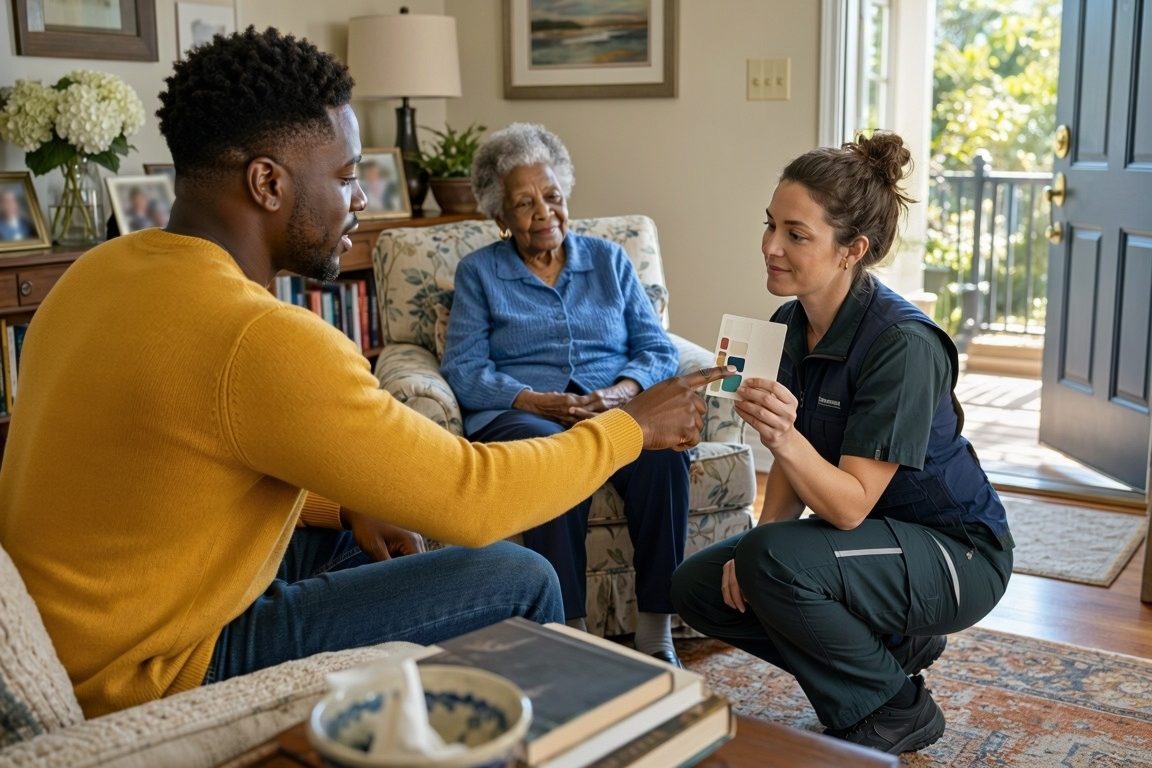
Step by step
What not to do
- Do NOT assume the responder knows anything about dementia. Many have zero training. If you say ‘she has Alzheimer’s,’ they may not know what that means for communication.Instead, use the GEMS state, it is a concrete, visual label they can act on.
- Do NOT shout or speak over your loved one to explain their behavior to the responder. This can escalate fear and confusion.Instead, speak calmly to the responder while your loved one is in another room or behind a door, or use a quiet tone that your loved one cannot hear.
- Do NOT hand the responder a long document or a medical history. They will not read it in the moment. The GEMS tool is designed to be a quick reference, one page, color-coded, with bullet points. Keep it short.
- Do NOT try to ‘translate’ everything your loved one says. If they say something confused, just say to the responder: ‘That is part of their dementia. They are in the Amber state right now, so they may not be oriented to time. Please just go with it and focus on the medical need.’
- Do NOT forget to update the GEMS state if your loved one’s condition changes during the call. For example, if they start out calm (Sapphire) but become agitated (Amber) when the stretcher arrives, tell the responder: ‘They just shifted to Amber, please slow down and give them a moment.’
- Do NOT leave the GEMS tool at home. Keep a copy in your car, in your phone (as a screenshot), and in an emergency bag. You can also put a small laminated card in your loved one’s wallet or purse.
Key points
- The GEMS State Tool gives first responders a quick, visual way to understand your loved one’s cognitive state, use it to replace confusion with clarity.
- Prepare ahead: fill out a one-page info sheet with the GEMS state, three do’s, and three don’ts. Keep copies by the door, in your car, and in your phone.
- When calling 911, tell the dispatcher the GEMS state so responders are primed before they arrive.
- Hand the tool or card to the lead responder immediately, do not assume they know about dementia.
- Update the GEMS state if your loved one’s condition changes during the emergency, it is okay to say ‘they just shifted to Amber.’
- Practice the script and keep the tool accessible. This small preparation can turn a scary, chaotic moment into a calm, human interaction.
Videos
 SUP! How Crisis Intervention Teams and Law Enforcement Use PAC SkillsThis video shows exactly how first responders (police, EMTs) are trained to use Positive Approach to Care skills, including the GEMS tool. Watch it to see how responders are taught to slow down and adapt, it will give you confidence that your card will be understood.
 SUP! PAC Family Edition - Teaching, Learning, and Using PAC Skills at Every AgeThis video demonstrates how families can learn and use PAC skills, including the GEMS tool, in everyday life. It will help you practice identifying states and using the language before an emergency.
 GAME CHANGING Ways to Manage Dementia Behaviors with GRACEThis video offers practical techniques for de-escalating agitation, skills that are directly applicable when first responders arrive and your loved one is upset. Use these techniques alongside the GEMS tool.
 How To Tell If A Dementia Patient Is In Pain?Pain can shift a person’s GEMS state dramatically. This video teaches you how to recognize pain in a non-verbal person, critical information to share with responders so they do not miss a medical issue.
Background
Why First Responders Need the GEMS State Tool
First responders are trained to act fast, assess danger, and treat physical injuries. But when the person they are helping has dementia, the usual script, asking questions, expecting quick answers, moving quickly , can trigger fear, confusion, or even aggression. The person may not be able to say their name, follow a command, or explain what hurts. Without context, a responder might misinterpret confusion as intoxication, stubbornness, or hostility. The GEMS State Tool bridges that gap by giving you a shared language to describe your loved one’s cognitive state in a way that is immediate and actionable.
What the GEMS State Tool Is and How It Works
The GEMS State Tool is a physical booklet or digital resource developed by Teepa Snow’s Positive Approach to Care team. It is color-coded and designed to be durable, it can go in the back of a first responder’s rucksack. Each ‘gem’ represents a different state of brain change: Sapphire (early, mostly independent), Emerald (mild cognitive changes, needs cues), Amber (moderate, needs hands-on help and redirection), Ruby (advanced, needs total assistance), and Diamond (late stage, often non-verbal). The tool helps you quickly identify which gem best describes your loved one right now , because their state can fluctuate hour to hour. It also gives first responders specific communication and care tips for that gem. This turns a potentially chaotic interaction into a guided, compassionate exchange.
The Tool Is Not Just for Emergencies: It’s for Preparation
The best time to learn the GEMS State Tool is long before an ambulance arrives. When you practice identifying your loved one’s typical state and their common fluctuations, you can fill out a simple card or note that you keep in your wallet, on the fridge, or in a phone case. That way, when stress is high, you are not trying to remember everything, you just hand the card to the responder. The tool also helps you anticipate what might trigger a shift (like pain, hunger, or a loud noise) so you can warn responders before they even walk in the door.
Practical tools
6
GEMS State Tool Booklet (Physical or Digital)
Order the official booklet from the Positive Approach to Care website. It is durable, color-coded, and small enough to fit in a glove box. The digital version can be saved to your phone’s home screen for quick access. Use it to show responders the exact gem your loved one is in.
First Responder Info Sheet Template
Create a half-page sheet with:
Print 10 copies and keep them in a ziplock bag on the fridge.
‘I Have Dementia’ Wallet Card
Many organizations (like the Alzheimer’s Association) offer free wallet cards that say ‘I have a cognitive impairment, please be patient.’ Pair this with a small sticker on the back that says ‘GEMS: Amber’ or whatever state applies. Hand this to the responder along with your info sheet.
Phone Lock Screen with GEMS Info
Take a photo of the GEMS state description for your loved one’s current state and set it as your phone’s lock screen. When you hand your phone to a responder, they see the info immediately without you having to unlock it.
Emergency Bag with GEMS Card
Pack a small bag with
Keep it by the door. In a crisis, grab the bag and hand the card to the first responder as you walk out.
Practice Script for 911 Calls
Write out a short script and keep it by the phone: ‘I am calling about [name], who has dementia. Their current GEMS state is [color]. They may not answer your questions. Please tell responders to approach slowly and speak calmly. I have a card ready for them.’ Practice saying it aloud once a month.
Different situations
Lewy Body Dementia (LBD) or Parkinson’s Dementia
These conditions cause extreme fluctuations in alertness and cognition, a person may be lucid one minute and confused the next. Use the GEMS tool to note that the state can change rapidly. Tell responders: ‘They have Lewy body dementia, so their state can shift from Emerald to Amber in minutes. If they seem suddenly confused, it is not a stroke , it is their condition. Please reorient them slowly.’
Late Stage (Ruby or Diamond)
In these states, the person may be non-verbal, unable to move, or unable to follow any commands. The GEMS tool for Ruby/Diamond emphasizes touch, slow movements, and verbal reassurance. Tell responders: ‘They cannot speak or move on their own. Please tell them everything you are going to do before you do it. Use a soft voice and gentle touch. They can still hear you.’
Adult Child vs. Spouse Caregiver
If you are an adult child, you may feel less authority with responders. Practice saying: ‘I am their power of attorney for healthcare. Here is the GEMS card. Please follow it.’ If you are a spouse, you may be more emotional, it is okay to say: ‘I am overwhelmed. Please read this card , it tells you what my husband needs.’ Both roles can use the tool to hand off responsibility.
In a Facility (Nursing Home or Assisted Living)
If your loved one is in a facility, the staff should already have a GEMS state on file. But if they do not, you can advocate by bringing the tool to the care plan meeting. For emergencies, tell the facility staff: ‘Please put a GEMS card on the front of Mom’s chart so that if EMS is called, they see it immediately.’
Medicaid or Limited Resources
The GEMS tool is free to download as a PDF from the Positive Approach to Care website. You do not need to buy the booklet. Print it on regular paper and laminate it with packing tape. You can also write the GEMS state on a sticky note and put it on the inside of your front door, no cost, big impact.
For the doctor
4
- Ask your loved one’s doctor or neurologist: ‘What GEMS state is my loved one typically in? Can you help me fill out the first responder info sheet so it is accurate?’
- If your loved one has a history of falls or seizures, ask: ‘Should I include a specific warning on the GEMS card about how to handle a fall or a seizure?’
- If your loved one takes medications that affect alertness (like antipsychotics or sedatives), ask: ‘How do these meds change their GEMS state? Should I note that on the card?’
- Ask the doctor: ‘Is there a specific protocol for EMTs to follow if my loved one is in the Ruby state and cannot communicate pain?’