Step by step
What not to do
- Do not treat the life history as a quiz or test. If you ask 'What year did you graduate?' and they cannot answer, do not correct them.Instead, say, 'That's okay, tell me about your favorite class.' The goal is connection, not accuracy.
- Do not ignore trauma history. If you know your person experienced sexual assault, do not rush through personal care without warning.Instead, say, 'I'm going to help you wash your arm now. Is that okay?' and move slowly. Ignoring trauma can trigger a violent reaction.
- Do not assume a behavior is 'just dementia' without checking the life history. A person who paces at 3 p.m. may be reliving the habit of picking up children from school. Redirect them by offering a 'school pickup' task, like folding laundry or walking to a door.
- Do not use the life history to argue or correct. If they say 'I was a doctor' and they were a nurse, do not say 'No, you were a nurse.' Instead, say, 'You helped so many people. Tell me about your favorite patient.' Validation preserves dignity.
- Do not keep the life history to yourself. If you are the only one who knows that Mom was a teacher who loved reading aloud, and the facility aide does not know, they may miss a perfect calming activity. Share the story widely.
- Do not stop gathering history once the form is filled. As the disease progresses, new fragments of memory may surface. Keep a running notebook of any new stories or phrases they repeat, these are clues to current needs.
Key points
- A person with dementia can often remember their distant past even when they cannot remember recent events. Use this preserved memory as a bridge to understand and redirect behavior.
- The GATHER life history form is a free, structured tool that guides you through collecting key details about your person's life, childhood, work, relationships, and trauma.
- When a behavior occurs, ask: 'Does this connect to something in their past?' A behavior that looks like 'agitation' may be a trauma response, a lifelong habit, or an unmet need rooted in their history.
- Share the life history with all caregivers, family, aides, facility staff. Consistent knowledge leads to consistent, compassionate responses.
- Do not use the life history to quiz or correct. The goal is connection and understanding, not accuracy. Validate their memories, even if they are not factually correct.
- Revisit and update the life history every few months as the disease progresses. New behaviors may reveal new connections to the past.
Videos
 HOW TO Do a LIFE History on Your Person w/Dementia & WHY It MATTERS!This video directly demonstrates how to use the GATHER life history form step by step. It shows exactly what questions to ask and why each detail matters for behavior management.
 GRACE Dementia Behavior Management Plan || Strategies to Help Beginners CopeThis video introduces the full GRACE system, of which GATHER is the first step. It explains how life history fits into a broader behavior management framework.
 The Threatening and Violent Dementia PatientThis video addresses how to handle aggression, including the critical role of trauma history. It gives concrete examples of how knowing a person's past can prevent violent outbursts.
 What Happens When Someone Who Has a Developmental Disability Also Develops Dementia?This video explains how to adapt life history gathering for people with intellectual/developmental disabilities. It emphasizes looking for changes that are 'not consistent with them historically.'
2 more videos
 Hoarding Behaviors Insights and InnovationsThis video explores hoarding behaviors in dementia, which are often rooted in past scarcity or trauma. It offers strategies for using life history to respond compassionately.
 What Do I Do When VISITING a Person with Dementia? ABCs of Dementia FAQs: VThis video provides tips for engaging a person with dementia during visits, including using life history topics to spark positive conversation and reduce anxiety.
Background
Why the Past Holds the Key to the Present
Dementia gradually damages the parts of the brain that handle recent memory, language, and reasoning. But the deep, long-term memories, childhood, young adulthood, career, first love, often remain intact for much longer. This means your person can still access and talk about who they were long before dementia, even when they cannot tell you what they ate for lunch. That preserved history is not just a nice story; it is a practical tool. When a behavior like yelling, pacing, or refusing care appears, it is almost never random. It is a response to something in the present that feels threatening, confusing, or uncomfortable. And the trigger often connects to a past experience, a trauma, a lifelong routine, a cherished role, or a deep fear.
How Life History Reveals Hidden Triggers
Consider a man who yells 'I'm a bad man' every afternoon. Without his history, you might think he is just agitated. But if you learn he was a pastor who once made a mistake he never forgave himself for, the behavior makes sense: the afternoon quiet and fatigue may trigger that old guilt. Knowing that, you can redirect him, perhaps by taking him outside for a cigarette, a habit that calmed him for decades. The same principle applies to many behaviors. A woman who resists bathing may have a history of sexual trauma; knowing that, you can adjust your approach to be slower, more verbal about each step, and more respectful of her body. A man who hoards food may have grown up during wartime scarcity; you can respond by providing a 'safe' stash of snacks rather than trying to remove them.
The GATHER Tool: A Structured Way to Collect the Story
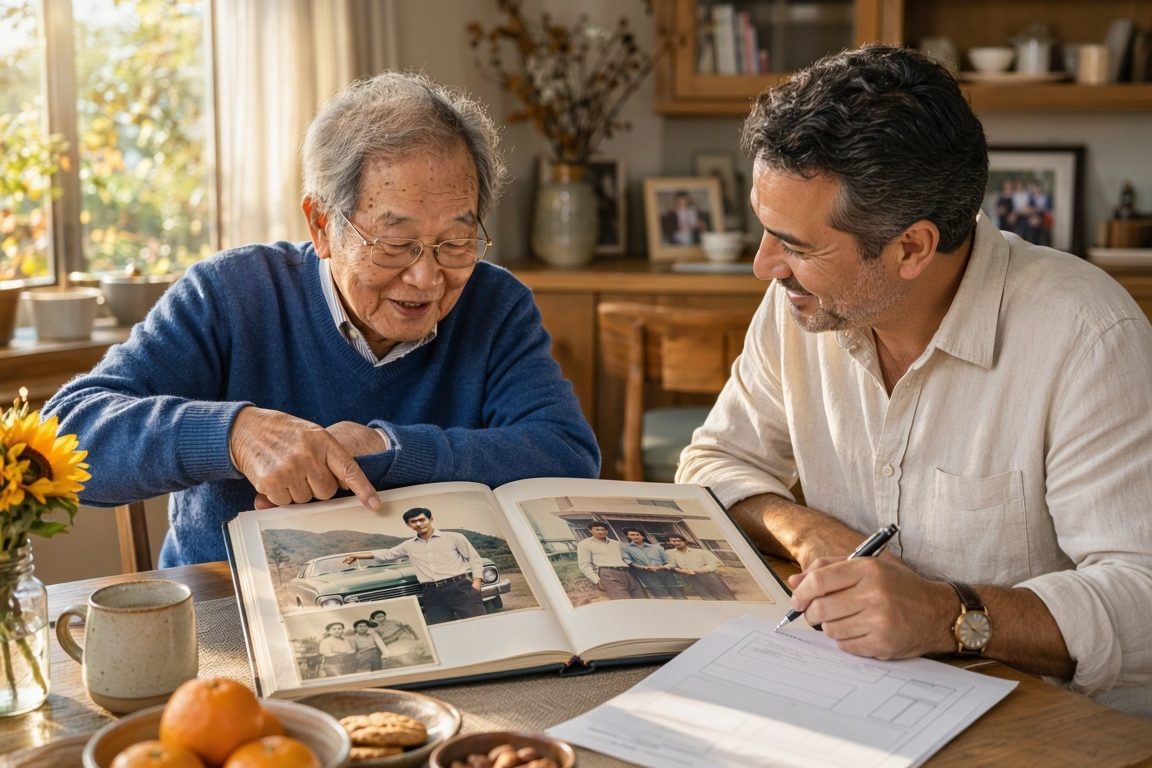
The GATHER tool (part of the GRACE behavior management system) is a free, printable form that guides you through asking about your person's life in a gentle, organized way. It starts with basics, name, nickname, who they were named after, then moves through childhood, young adulthood, education, work, and miscellaneous details. The goal is not to quiz them but to invite conversation. You can fill it out over several visits, using photos, music, or objects from their past to spark memories. The form is available inside the Dementia With Grace caregiver support group. Even if your person cannot answer every question, family members or old friends can help fill in the gaps. The key is to capture not just facts but also emotions: what made them proud, what scared them, what they loved to do.
Practical tools
6
GATHER Life History Form (Free PDF)
This is a multi-page printable form available inside the Dementia With Grace caregiver support group. It walks you through questions about name, childhood, young adulthood, education, work, and miscellaneous details. Use it as a conversation guide, not a checklist. Keep it in a binder and add photos or notes. Revisit it every few months.
The 'Red Flag' List for Trauma History
On a separate sheet, list any topics that cause your person visible distress, crying, freezing, or aggression. Examples: military service, a past assault, a house fire, a divorce. Share this list with all caregivers. When those topics come up in conversation or care, use a script like: 'I know this is hard. You are safe now. Let's take a break.'
Lifelong Routine Calendar
Based on the life history, create a simple daily schedule that mirrors their old routines. For example, if they always had coffee and read the newspaper at 7 a.m., do that. If they napped after lunch, schedule quiet time then. Post the calendar on the wall so all caregivers follow it. Consistency reduces confusion and agitation.
Memory Box or 'Life Story' Board
Gather a few objects that represent key life chapters:
Place them in a clear box or on a bulletin board in their room. When they are upset, invite them to look at the box and talk about one item. This can ground them and redirect negative emotions.
The '3 p.m. Cigarette' Script
If a behavior happens at a predictable time, use the life history to find a matching activity. Example: Walter yelled 'bad man' every afternoon. His history revealed he was a pastor who needed a cigarette break. The script: 'Walter, let's go outside for a smoke.' The behavior stopped. Create your own script based on their past habits.
Caregiver Communication Log with Life History Column
Use a simple notebook or shared app (like CaringBridge) to log daily behaviors. Add a column titled 'Possible Life History Link.' For example: 'Refused shower at 10 a.m. maybe because her father used to bathe her roughly as a child.' Over time, patterns emerge that guide better responses.
Different situations
Early-stage dementia (still verbal and aware)
In early stages, you can involve the person directly in filling out the GATHER form. Ask them to tell you stories while you write. They may enjoy reminiscing and feel valued. Use the form to plan meaningful activities, like visiting a childhood home or listening to music from their youth. Avoid trauma questions if they become upset.
Late-stage dementia (limited verbal ability)
In late stages, rely on family members, old photos, and medical records to fill out the life history. Focus on sensory details: favorite smells (baking bread), sounds (big band music), textures (a soft blanket). Use these to soothe agitation. For example, if they loved the ocean, play wave sounds during a bath. Do not expect them to answer questions, just provide comfort.
Person with a history of trauma (e.g., combat, abuse)
Be extremely cautious. Do not ask direct questions about trauma unless they bring it up. If they do, listen without judgment and do not push for details. Use the life history to identify triggers: loud noises, certain smells, being touched unexpectedly. Create a 'safety plan' with the care team: avoid triggers, use calming scripts ('You are safe now'), and have a quiet space ready. Discuss any medication needs with the clinician.
Person with intellectual/developmental disability (IDD) plus dementia
The life history must include their lifelong patterns and baseline abilities. A person with IDD may have always needed extra time to process information or may have had a specific routine for decades. When dementia adds new challenges, look for changes that are 'not consistent with them historically' (source 6). For example, if they were always calm during meals but now become aggressive, it may signal pain or a new trigger. Use the life history to distinguish lifelong traits from new dementia-related behaviors.
Person living in a facility (dementia unit or nursing home)
Provide a one-page 'Life History Snapshot' to the facility staff. Include: name, nickname, past job, favorite activity, trauma triggers, calming strategies, and preferred routine. Ask staff to post it in the room and in the care chart. Visit during shift changes to personally introduce the life history to new aides. Follow up to ensure it is being used. If a behavior emerges, ask staff to check the life history before calling the doctor for medication.
For the doctor
4
- If the life history reveals a past trauma (e.g., sexual assault, combat), ask the doctor or a dementia care specialist: 'How can we adapt personal care and communication to avoid triggering this trauma? Are there any non-medication approaches you recommend?'
- If the person has a history of violence or gun ownership, discuss with the clinician: 'What steps should we take to ensure safety at home? Should we involve a social worker or law enforcement to safely remove firearms?'
- If the person's behavior (e.g., aggression, severe anxiety) does not improve after using life history-based strategies for two weeks, ask: 'Could there be an underlying medical cause (pain, infection, medication side effect) that we need to evaluate?'
- If the person has a history of hoarding and the behavior is causing safety risks (e.g., fire hazard, falls), discuss with the clinician: 'Are there any medications or therapies that can help reduce compulsive hoarding? Should we involve an occupational therapist for home safety?'