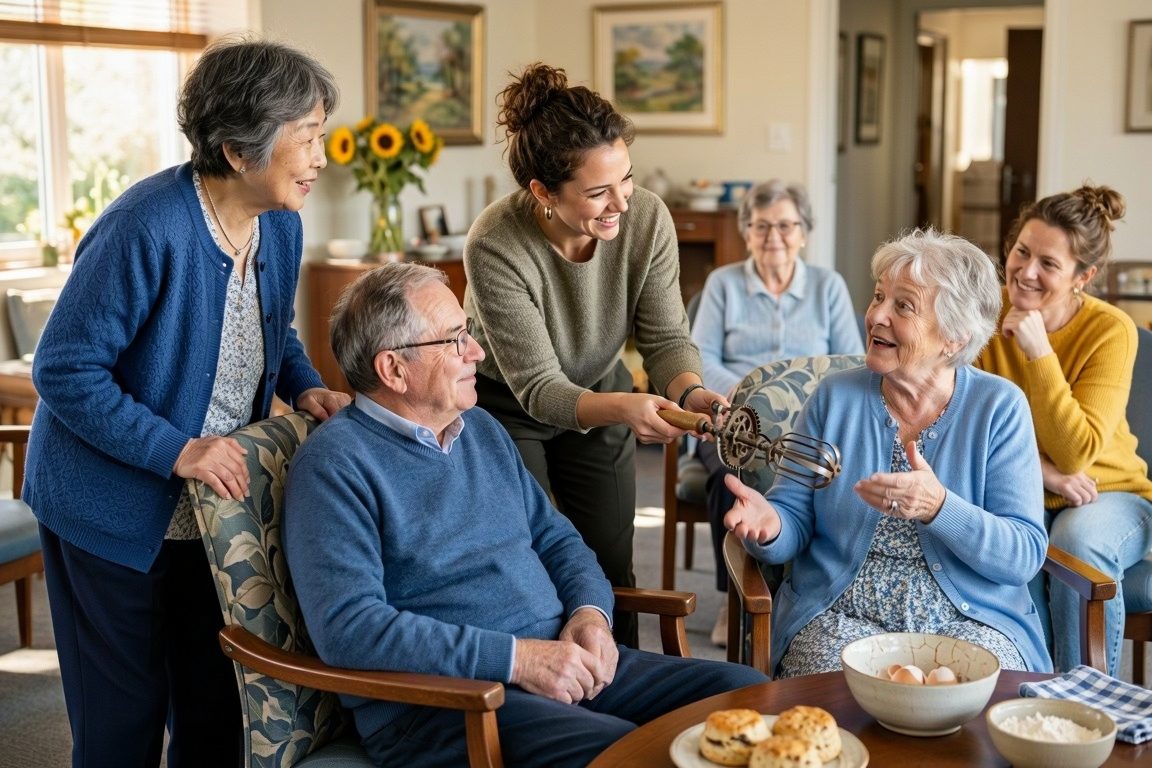
Step by step
What not to do
- Do not force participation: If a resident refuses to join or leaves mid-session, do not insist. Forcing can escalate agitation.Instead, invite them next time and offer a one-on-one reminiscence activity later.
- Do not correct or 'reality orient': Avoid saying 'No, that didn't happen that way' or 'You're thinking of the wrong year.' This can cause shame and anger.Instead, validate the emotion behind the memory.
- Do not use complex or abstract themes: Avoid topics like 'philosophy of life' or 'regrets.' Stick to concrete, positive memories. Abstract thinking is often impaired in dementia and can cause frustration.
- Do not play loud or unfamiliar music: Music that is too fast, loud, or unfamiliar can overstimulate and increase agitation. Stick to songs from the person's young adulthood (ages 15-30) that they know and love.
- Do not ignore signs of overstimulation: If a person starts to fidget, look away, or become verbally agitated, stop the current activity. Take a break, offer a drink of water, or switch to a quiet one-on-one conversation.
- Do not expect immediate results: Reminiscence therapy is not a quick fix. It may take several sessions before you see a reduction in agitation. Be patient and consistent.
Key points
- Group reminiscence therapy can reduce agitation by shifting focus to positive, familiar memories and providing a calm, predictable routine.
- Research shows modest but meaningful improvements in mood and quality of life, especially when sessions are held weekly for at least 10 weeks.
- Keep groups small (4-6 people), use a calm environment, and always validate emotions rather than correcting facts.
- Combine with other non-drug approaches like music, massage, or aromatherapy for stronger effects on agitation.
- Personalize themes and props to each person's life story, this makes the therapy more engaging and effective.
- Monitor for signs of overstimulation and adapt the session length or content as needed. Agitation can be a sign to slow down or change approach.
Videos
 Using Reminiscence Therapy To Help Dementia PatientsThis video demonstrates practical techniques for leading a reminiscence session, including how to use props and prompts to engage a person with dementia.
 Depression and Dementia in Older AdultsExplains the link between depression and agitation in dementia, and how reminiscence therapy can improve mood and reduce behavioral symptoms.
 Radio Show VoiceAmericaDiscusses Memory Lane TV and how structured reminiscence using video and music can calm agitation in care home settings.
 Simple dementia trick to get your loved one talking and feeling happy.Offers a simple, step-by-step approach to starting a reminiscence conversation, perfect for caregivers new to the technique.

Background
Why Agitation Happens and How Reminiscence Helps
Agitation in dementia often stems from a 'decreased threshold for expressing behavior', the brain's usual brakes are weakened, so small triggers like noise, pain, or confusion can spark a big reaction. The person isn't being difficult on purpose; their brain is struggling to process the present. Group reminiscence therapy works by shifting focus away from frustrating current realities and toward familiar, positive past experiences. Recalling a happy memory, like a childhood pet or a favorite song, releases dopamine and calms the nervous system, reducing the urge to act out.
What the Research Shows About Group Reminiscence for Agitation
A study of 43 older adults with dementia in a residential care setting found that a 50-minute group reminiscence session once a week for 10 weeks led to improvements in quality of life and communication, though the effect on overall agitated behavior was not statistically significant. Another review of multiple studies noted that while the effect size is small, reminiscence therapy consistently improves mood and reduces verbal agitation. This means it won't eliminate all agitation, but it can make a real difference for many people, especially when combined with other calming approaches like music or gentle touch. The key is consistency and tailoring the session to each person's life story.
How Group Setting Amplifies the Benefit
In a group, participants hear each other's memories, which can spark their own, a phenomenon called 'social reminiscence.' This shared experience reduces feelings of isolation and worthlessness, which are common in dementia and can fuel agitation. The group also provides a predictable, calm routine, which lowers anxiety. For a person who feels lost or angry, being part of a group where they are listened to and valued can be profoundly grounding. The therapist or facilitator's role is to validate emotions, not correct facts, creating a safe space where agitation has less room to grow.
Practical tools
6
The 'Memory Box' Kit
Create a box for each session with 3-5 physical props:
Let each person hold and describe the item. This engages multiple senses and reduces agitation by focusing attention on the present object.
The 'One-Minute Validation' Script
When a participant shares a memory, use this exact phrase: 'That sounds like a really special time. Thank you for telling us about it.' Then ask one follow-up: 'What did you love most about that?' This simple script validates the person and keeps the conversation flowing without pressure.
The 'Calm Transition' Routine
End every session with the same 2-minute ritual:
This helps the group transition back to the unit without agitation.
The 'Personal History' Form
For each resident, ask family to fill out a one-page form with:
Use this to tailor session themes. For example, if someone loved gardening, plan a session on 'growing up on a farm.' Personalization makes the therapy more effective.
The 'Agitation Tracker' Log
Keep a simple log for each resident: date, time of session, agitation level before and after (scale 1-5), and any triggers. After 4 weeks, review the log to see if agitation is decreasing. This helps you adjust the approach and communicate with the care team.
The 'Sensory Calming' Kit
Have a small basket with
If a participant becomes agitated during a session, offer them the basket to hold or smell. This provides a non-verbal way to self-soothe.
Different situations
Lewy body dementia or Parkinson's disease dementia
These individuals are often more sensitive to sensory overload and may have visual hallucinations. Keep the group smaller (3-4 people), use very soft lighting, and avoid any props that could be misinterpreted (e.g., avoid mannequins or dolls). Focus on music and gentle conversation rather than visual stimuli. If a person becomes paranoid, end the session early and offer a quiet space.
Late-stage dementia (severe cognitive decline)
Group sessions may be too stimulating. Instead, do one-on-one reminiscence for 10-15 minutes. Use simple, repetitive prompts like 'You loved the color blue' while showing a blue scarf. Focus on sensory items (soft fabric, familiar scents) rather than verbal recall. The goal is comfort, not conversation. Watch for signs of distress and stop immediately.
In a memory care facility vs. at home
In a facility, you have access to other residents and staff. Coordinate with the activities director to schedule the group in a common room. At home, invite a neighbor or friend with dementia to join, or do a virtual group via video call with a family member. Use the same structure but adapt the space to be calm and private.
For a person with a history of trauma (e.g., war, abuse)
Avoid themes that could trigger painful memories, such as 'military service' or 'childhood home.' Instead, focus on neutral or positive topics like 'favorite desserts' or 'holiday traditions.' Watch for signs of distress (freezing, crying, anger) and have a plan to redirect to a safe topic. Consider consulting a therapist trained in trauma-informed care.
When the person is also taking antipsychotic or antidepressant medications
Reminiscence therapy can sometimes allow for lower doses of these medications, but never change medication without consulting the doctor. Monitor for increased sedation or agitation during sessions, as medications can affect energy levels. Report any changes to the prescribing clinician. The therapy should complement, not replace, medical treatment.
For the doctor
4
- If agitation worsens during or after group sessions, discuss with the doctor whether the person might have an undiagnosed pain condition (e.g., arthritis, urinary tract infection) that is being triggered by the activity.
- If the person has a history of severe depression or suicidal thoughts, ask the clinician if reminiscence therapy is appropriate, as it can sometimes bring up sad feelings. The doctor may recommend a modified approach or additional support.
- If the person is on antipsychotic medications, ask whether the dose can be reduced if agitation improves with non-drug therapies. Never adjust medication without medical guidance.
- If the person has a known allergy to scents (e.g., lavender), discuss safe alternatives for sensory props. Some essential oils can interact with medications.