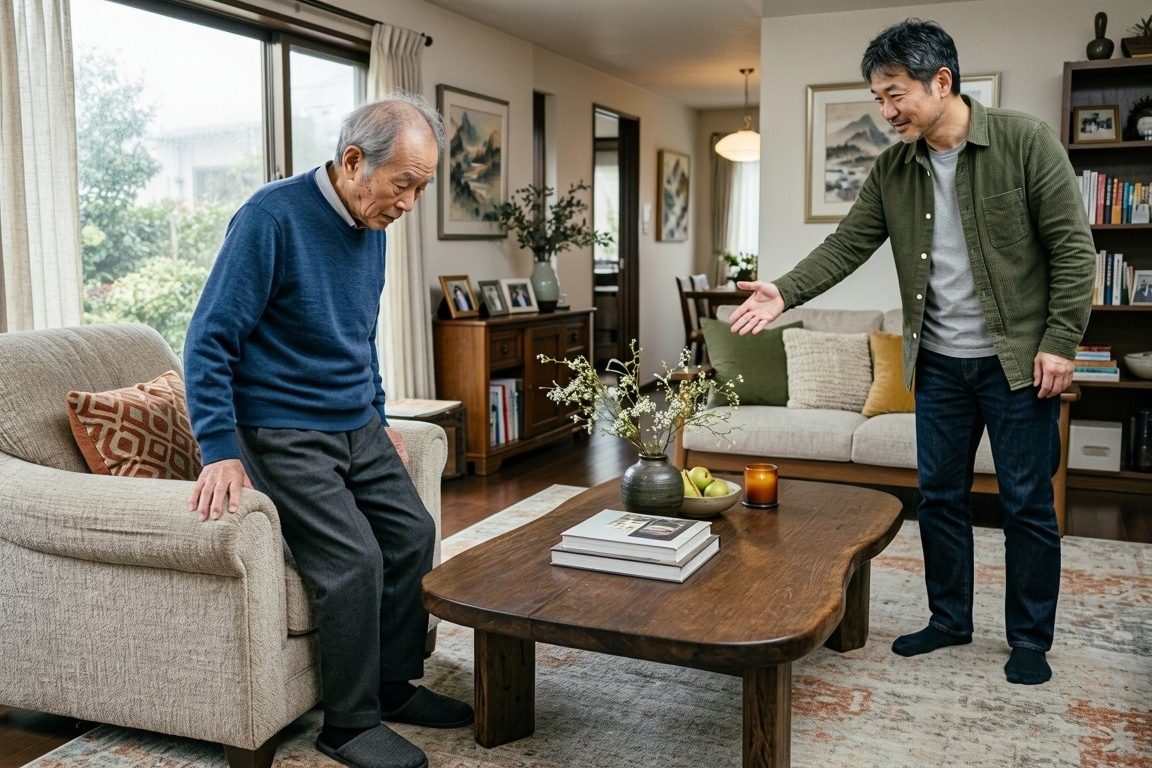
Step by step
What not to do
- Do not rearrange furniture frequently: Moving a favorite chair or table can be deeply disorienting, as the person's brain has learned a spatial map of the room.Instead, keep the layout as stable as possible. If you must change something, do it gradually and guide the person through the new arrangement.
- Do not ask 'Don't you remember where the bathroom is?': This can feel shaming and increase anxiety. The person is not forgetting, their brain is not processing the space.Instead, calmly say, 'Let me show you,' and walk with them, offering gentle guidance.
- Do not use busy patterns or dark floors: Busy wallpaper, patterned rugs, or very dark floors can look like holes or moving objects to a brain with impaired spatial processing. Stick to solid, light colors for floors and walls, and use simple, high-contrast patterns only for cues (like a bright stripe on a step).
- Do not leave the person alone in a new or unfamiliar environment: New surroundings can trigger severe disorientation and agitation. If you must go somewhere new, stay with them, provide verbal reassurance, and keep the visit short. Always have a plan for a quick exit if they become distressed.
- Do not assume they are being stubborn or difficult: If they refuse to walk down a hallway or sit in a certain chair, it may be because their brain perceives a danger or an impassable gap. Trust their experience. Offer an alternative path or a different chair, and validate their feeling: 'This feels tricky. Let's try this way instead.'
Key points
- Spatial disorientation is a brain-based change, not a choice or stubbornness. Respond with patience and practical adjustments.
- Reduce clutter, use high-contrast cues, and keep furniture in the same place to create a predictable, safe environment.
- Use simple, one-step verbal instructions instead of complex directions to help the person navigate.
- Be mindful of mirrors, TV screens, and busy patterns, which can cause confusion or fear.
- Establish a consistent daily routine and storage spots to reduce the cognitive load of searching and guessing.
- Always have a plan for wandering or getting lost, especially in new environments. Use alarms, labels, and supervision.
Videos
 Are You Spatially Oriented? How Much is Enough? | Online Dementia JournalThis video explains the 'where system' in the brain and how it breaks down in dementia, giving you a clear understanding of why spatial disorientation happens.
 Steady Steps: Practical Strategies for Managing Falls in DementiaFalls are a direct consequence of spatial disorientation. This video offers concrete, low-cost strategies to reduce fall risk at home.
 Zinnia Caregiver Support Session: Responding to Dementia-related Changes in the Person You SupportThis session covers how to adapt your communication and environment as the person's spatial abilities change, with real-life examples from caregivers.
 Providing Support When Mobility Rules Are Not Regarded | Teepa's ClipsTeepa Snow demonstrates how to physically guide someone with spatial disorientation, including hand-under-hand technique and verbal cues.
2 more videos
 Shocking Symptom: Proprioception and DementiaThis video focuses on proprioception, the sense of body position, and how its loss contributes to spatial disorientation, with practical tips for support.
 Posterior Cortical Atrophy Lecture Series with Harvard neurologist BRAD DICKERSON, MDFor those caring for someone with PCA, this lecture provides expert insight into the unique visual and spatial challenges of this condition.
Background
What is happening in the brain?
Spatial disorientation in dementia is not simply 'forgetfulness' about where things are. It stems from changes in the brain's 'where system', a network that normally helps us know where our body is in relation to objects, like reaching for a coffee cup without looking, or knowing how to lower ourselves into a chair. As dementia progresses, this system becomes damaged, so the person loses that automatic sense of where things are in space. They may struggle to find their way around, have trouble positioning their body in relation to a chair, or bump into things more often. The world that once felt like a fluid, moving movie now feels more like a series of disconnected snapshots, making it hard to piece together a stable picture of their surroundings.
Why does this feel so disorienting for the person?
Imagine waking up from a nap in an unfamiliar room. Your hippocampus has to work to figure out where you are, who you are with, and whether it is safe. For someone with dementia, this reorientation is a constant, exhausting challenge. Even in their own home, the brain may not automatically recognize the room or the furniture. When they look around, they might recognize a few familiar items, but the overall space feels wrong, triggering anxiety and a sense of being lost. This is not just confusion, it is a deep, unsettling feeling that can lead to agitation, a desire to 'go home,' or even wandering, as the brain tries to find a place that feels safe and known.
How does this affect their daily actions?
The impact is far-reaching. A person may have trouble finding items in a crowded cupboard or on a busy shelf. They might seem less confident walking through a familiar room, or they may reach for a chair and miss, because their brain can no longer automatically compute the distance. Reading becomes slower, and they may lose their place on a page. In more advanced stages, they might not recognize that a person on a TV screen is far away, and may try to shake their hand. These are not signs of carelessness, they are direct results of the brain's changing ability to process spatial information. Understanding this helps you respond with patience and practical support, rather than frustration.
Practical tools
6
The 'Clear Path' Checklist
Repeat this check weekly, as clutter can accumulate quickly.
High-Contrast Tape and Markers
Use brightly colored (e.g., red, yellow, or blue) electrical tape or painter's tape to mark the edges of steps, the rim of the toilet, the edge of the kitchen counter, and the threshold of doorways. This provides a visual boundary that helps the brain distinguish between surfaces. For a more permanent solution, consider glow-in-the-dark tape for nighttime visibility.
The 'One-Spot' Tray
This builds a reliable spatial anchor that reduces searching and frustration.
Simple Door Labels
Create large, clear labels for each door:
Use a font that is easy to read (e.g., Arial, 48pt). Laminate the labels and attach them at eye level. This helps the person find the right room without having to remember or guess.
The 'Calm Down' Kit
Prepare a small bag or box with items that engage the senses and provide comfort:
When spatial disorientation causes agitation, offer the kit and guide the person to a quiet chair. This redirects their focus and provides a sense of safety.
Nighttime Safety Setup
This reduces the risk of falls and wandering during the night.
Different situations
Lewy body dementia or Parkinson's disease dementia
Spatial disorientation can be more severe and fluctuate day-to-day. Visual hallucinations are common, so be especially careful with mirrors, reflections, and TV screens. The person may also have significant balance issues; prioritize fall prevention with grab bars, non-slip shoes, and supervised exercises like chair yoga. Consistency in routine and environment is critical, as their brain struggles more with change.
Posterior cortical atrophy (PCA)
This variant of Alzheimer's often first affects vision and spatial processing. The person may have trouble reading, recognizing faces, or navigating even in early stages. Use very high-contrast cues (e.g., black plate on white tablecloth). Avoid busy visual environments. Speak clearly and describe the space verbally: 'The chair is two steps to your left.' Occupational therapy is essential for adaptive strategies.
Late-stage dementia
The person may have very limited ability to process spatial information. Focus on safety: remove all tripping hazards, use a hospital bed with side rails (with clinician guidance), and consider a low bed to reduce fall risk. Use simple, one-step verbal prompts. Do not expect them to navigate independently; provide full physical guidance and supervision. The environment should be as simple and predictable as possible.
Spouse vs. adult child caregiver
A spouse may feel the loss of shared space more acutely and may resist changes like removing furniture. Approach changes collaboratively: 'I know this chair is special, but let's try moving it to the corner for a week to see if it helps you walk more easily.' An adult child may need to gently assert authority: 'Mom, I'm worried about you tripping. Let's try this setup for safety.' Both roles benefit from joining a caregiver support group for emotional and practical support.
In a facility (assisted living or nursing home)
Work with staff to ensure the room is personalized with familiar items from home. Request that the room layout stays consistent. Use a photo or a familiar object on the door to help the person identify their room. Advocate for a quiet, low-stimulation environment during meals and activities. If the person wanders, ask staff to use a safe walking path rather than restraining them.
For the doctor
5
- Ask the doctor or occupational therapist: 'Can we get a home safety evaluation to identify fall risks and spatial challenges specific to my loved one's condition?'
- Discuss: 'What are the best types of adaptive equipment (e.g., grab bars, non-slip shoes, raised toilet seat) for my loved one's current stage and spatial abilities?'
- Ask: 'Are there any medications that could be contributing to dizziness, balance problems, or visual disturbances that worsen spatial disorientation?'
- Discuss: 'Given my loved one's diagnosis, what is the expected progression of spatial disorientation, and what should I prepare for in the next 6-12 months?'
- Ask: 'Is it safe for my loved one to be left alone for short periods, given their spatial awareness challenges? What signs should I watch for that indicate it is no longer safe?'