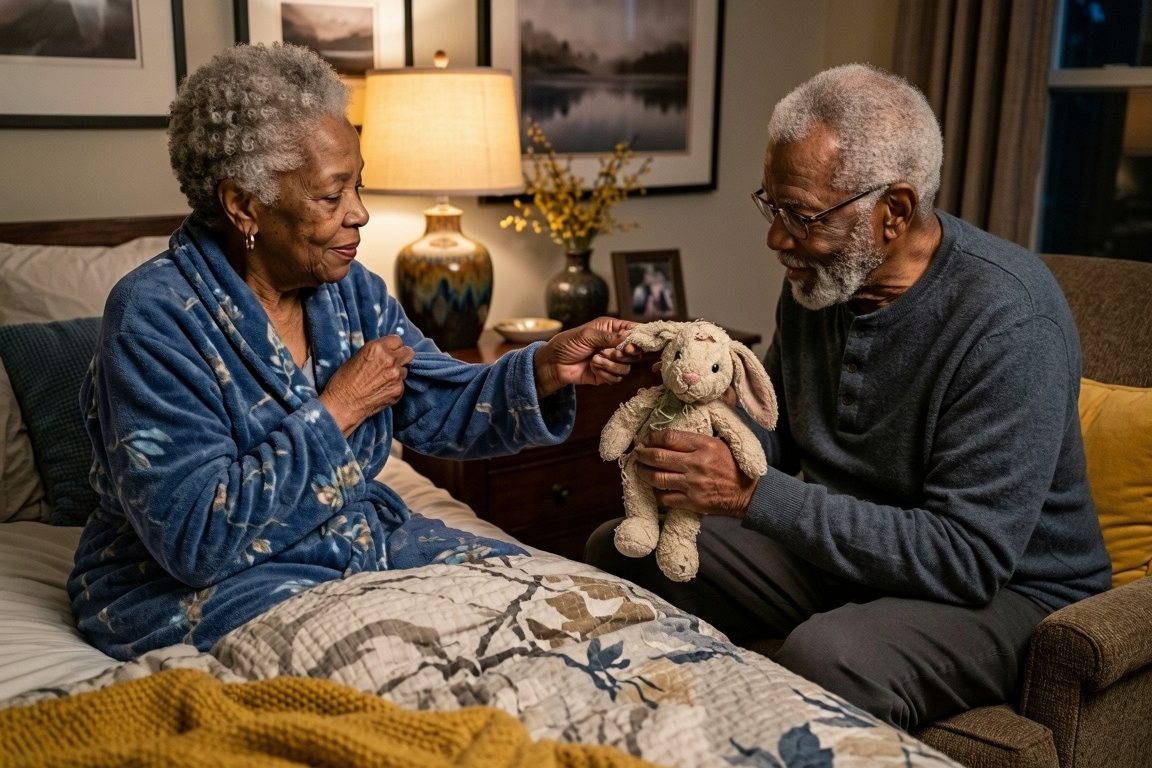
Step by step
What not to do
- Don't call it a 'stuffed animal' or toy, give it a name and treat it as a real companion.
- Don't force it if they refuse; set it aside and try another day.
- Don't let it replace your own presence, conversation, or touch.
- Don't choose a hyper-realistic animal that could frighten or confuse them.
Key points
- A stuffed animal can reduce agitation, wandering, and anxiety in later-stage dementia by providing soothing sensory input and a sense of companionship.
- Introduce it as a named 'friend' (e.g., 'Ellie'), never as a toy or doll, to preserve dignity and encourage acceptance.
- Model the behavior first, hold and stroke the animal yourself, to show your loved one how to interact with it.
- Choose a soft, washable, simple animal without hard parts or startling sounds; test any mechanical features beforehand.
- If they don't take to it, that's okay. Try a different animal, a different time, or a different approach. Never force it.
- Always supervise to ensure safety, especially if there is a risk of tearing or swallowing.
Videos
 How Does Doll Therapy Help Dementia?This video explains the research behind doll therapy and how it can reduce agitation, wandering, and caregiver stress.
 How To Use Baby Doll Therapy For Dementia And Alzheimer’sA practical guide on introducing a doll or stuffed animal, including what to say and how to handle resistance.
 Baby Doll & Stuffed Animals ~TESTED, PROVEN Dementia Behavior FIXReal-life examples of how stuffed animals have helped calm difficult behaviors, with tips from an experienced caregiver.
 The Baffled Brain: Demystifying Dementia Episode 25 May 15 ,2021Discusses the brain science behind why repetitive, soothing activities (like holding a stuffed animal) work for dementia.
2 more videos
 Does doll therapy for dementia really work?A balanced look at the pros and cons of doll therapy, including when it might not be appropriate.
 Curious Conversations about Brain Change.Teepa Snow and others discuss the importance of nurturing activities and how to adapt them for different stages of dementia.
Background
Why a Stuffed Animal Works for a Dementia-Changed Brain
As dementia progresses, especially into the later middle and late stages, the brain loses its ability to process complex information, manage emotions, and find comfort in abstract ideas. Your loved one may feel a constant, low-level anxiety because their world no longer makes sense. A stuffed animal taps into a very old, very deep part of the brain, the part that remembers the comfort of holding something soft, the rhythm of a gentle touch, and the security of nurturing. This is not about 'playing with a toy'; it's about providing a sensory experience that feels safe and familiar. The brain's need for repetitive, soothing input is real, and a stuffed animal can deliver that without requiring any thinking or remembering.
The Research Behind the Comfort
While still a newer area of study, research on doll and stuffed animal therapy is promising. Studies have shown that introducing a doll or stuffed animal can reduce agitation, decrease wandering, improve social interaction, and even lower the need for antipsychotic medications in some people with dementia. One study even found that it helps reduce caregiver stress, because when your loved one is calmer, you feel calmer too. The effect is not just emotional, it's physiological. The act of holding, stroking, or simply being near a soft object can trigger a relaxation response, lowering heart rate and cortisol levels. This is why many experts, including Teepa Snow and others, recommend it as a non-drug intervention for difficult behaviors.
When to Introduce a Stuffed Animal
This approach is most effective in the later middle stages or late stages of dementia, when your loved one may be experiencing behaviors like aggression, anxiety, restlessness, or wandering. It can also be helpful if they seem withdrawn, lonely, or are losing interest in other activities. The key is to watch for signs of distress or boredom, times when they are pacing, calling out, or seem unable to settle. A stuffed animal is not a first-line tool for early-stage dementia, where conversation, hobbies, and social engagement are still possible. But as the disease progresses, it becomes a gentle, low-effort way to provide comfort and connection.
Practical tools
2
The Dual Comfort Technique
When your loved one is agitated, sit beside them, hold the stuffed animal yourself, and gently stroke their arm or hand. Say softly, 'I'm holding [name], and she's helping me feel calm. Can you feel how soft she is?' Combining the animal's comfort with your touch reduces agitation more effectively than either alone.
Wash Day & Backup Plan
Keep a second nearly identical stuffed animal on hand so the original can be laundered or replaced without a gap in comfort, since even a brief absence can cause real distress. If the original is ever lost or damaged, replace it quickly with the closest match you can find, and don't dismiss their grief over it.
Different situations
Late-stage dementia (when verbal communication is very limited)
In late stages, the stuffed animal can be placed directly in their hands or on their lap, even if they don't actively hold it. The soft texture and weight can be soothing. You can also use a 'mechanical' animal that breathes or makes a soft heartbeat sound, as the rhythmic motion can be deeply calming. Focus on touch and presence, not conversation.
Lewy body dementia (with visual hallucinations or sensitivity to stimuli)
Be very cautious with realistic-looking animals or dolls, as they might be mistaken for real creatures and cause fear. Stick with simple, soft, and clearly 'fake' designs. Avoid any animal that makes sudden or loud noises, as people with Lewy body dementia are often sensitive to sound. Introduce it in a calm, well-lit room and watch for any signs of confusion or distress.
Frontotemporal dementia (with repetitive behaviors or disinhibition)
A stuffed animal can be helpful for redirecting repetitive movements or compulsive behaviors. If your loved one is constantly picking at their clothes or tapping, offer the animal to hold or stroke. However, be aware that some people with FTD may not respond to nurturing themes; a simple, soft animal without 'baby' connotations might work better. Observe and adapt.
Spouse vs. adult child caregiver
As a spouse, you may feel awkward or even sad introducing a stuffed animal, it can feel like a loss of the person you knew. It's okay to have those feelings. Try introducing it as 'a little comfort for both of us' and hold it together. As an adult child, you might worry about dignity. Remember that comfort is dignity. Frame it as a practical tool, like a weighted blanket, that helps them feel safe. Your own comfort with the object will influence their acceptance.
In a facility or at home
In a facility, coordinate with staff so they know the animal's name and purpose. Label it with your loved one's name to prevent loss. At home, you have more control over the environment, you can create a special spot for it and integrate it into daily routines more easily. In both settings, having a backup animal (identical) is wise in case one gets lost or needs washing.
For the doctor
3
- If your loved one has a history of swallowing non-food items (pica), ask the doctor or occupational therapist about safe alternatives to a stuffed animal, such as a weighted lap pad or a sensory 'fidget' blanket.
- If your loved one is on antipsychotic or sedative medications, ask whether introducing a stuffed animal might help reduce the need for those medications, and whether any dose adjustments should be considered under medical supervision.
- If your loved one becomes overly attached to the stuffed animal and shows signs of distress when it's not available (e.g., crying, searching), discuss with a dementia care specialist how to manage this attachment without causing additional anxiety.