Step by step
What not to do
- Don't trust marketing or the word 'homelike' alone; visit in person and verify the actual resident count, absence of long hallways and nurses' stations, and presence of real residential kitchens and living rooms.
- Don't assume a small group home is automatically superior or cheaper; the higher staff ratio often makes it more expensive. Compare medical support, staff training, and emergency protocols, and request a full cost breakdown including what triggers fee increases.
- Don't choose a home where staff cannot describe what they did with residents yesterday or seem rushed and unfamiliar, this signals poor dementia-care training and a lack of person-centered engagement.
- Don't sign anything without checking the home's licensing status, state regulations, and complaint/inspection history with your state regulatory agency; repeated deficiencies around dignity, medication errors, or staffing are more telling than any tour.
- Don't overlook policies on progression and family involvement: avoid homes with strict visiting hours, vague answers about care changes, or contracts with easy-discharge clauses.
- Don't rely solely on scheduled tours, drop in unannounced at mealtimes or in the evening to observe real staff interactions and response times.
- Don't expect immediate adjustment; plan a gradual move-in with short visits first, and bring familiar items like a favorite blanket or photos to ease the transition.
Key points
- Small group homes and Greenhouse/Eden Alternative models create family-like households of 10–16 residents with their own kitchen, dining area, and living room, reducing overwhelm and promoting engagement.
- Residents are encouraged to take part in meaningful daily activities like cooking, gardening, and household tasks, which provide cognitive stimulation, purpose, and a sense of normalcy.
- Flexibility is central: safety features and door access can be adjusted per resident and per dementia stage, so the best designs let care adapt as the condition progresses without moving the person.
- Care is relationship-based, not task-based: cross-trained staff are consistently assigned to the same household and know each resident's history, preferences, and routines.
- Not all small group homes are equal, visit multiple options in person, use a checklist, and verify size, staff consistency, resident engagement, and licensing.
- These homes may cost more than traditional facilities, but some accept Medicaid waivers, offer sliding scales, or have charitable care funds; expect possible waitlists.
- You can adapt small group home principles at home through simple mealtime routines, residential-grade safety devices, and purposeful daily activities, and you can advocate for these principles inside traditional facilities.
Videos
 Designing a Safe Living Space For a Loved One With Dementia | LiveTalk | Being PatientThis video discusses how small households with residential kitchens and safety devices can be designed to feel like home, and how these environments reduce overwhelm for people with dementia.
 Dementia Care Partner Talk Show Podcast: Ep. 77 - Different Approaches to Long-Term CareThis episode explores innovative care models like Prairie Elder Care, which operates four homes with eight residents each, emphasizing intimate settings where people feel valued.
 Dementia Care Partner Talk Show Podcast Ep. 58: Care and Nursing Homes, Are They Still a Good Idea?This podcast questions whether large nursing homes are still viable and discusses the challenges of funding alternative models, providing context for why small group homes are gaining attention.
 Dementia Memory Skilled Care UNIT ABCs of Dementia FAQs: UThis video covers the basics of dementia care units, including the importance of a homelike environment, which aligns with the Greenhouse model’s philosophy.
4 more videos
 Ep. 150: Adult Day Center Care vs Respite CareWhile focused on day programs, this video helps caregivers understand the range of community-based options, including how small group homes can offer a more permanent homelike setting.
 A Different Kind Of Care FacilityThis video profiles a care facility that uses the small household model, showing real examples of how residents engage in cooking and daily life, making the concept tangible.
 How Can Local Dementia Support Groups Prevent Caregiver Burnout? - Dementia Help HubThis video reinforces the importance of caregiver support groups, which are essential for families navigating the transition to a small group home or adapting care at home.
 Ep. 115: What to Expect with Young Onset and Vascular DementiasThis video provides insights into young-onset dementia, which may require age-appropriate activities and a different approach when choosing a small group home.
Background
Understanding the situation
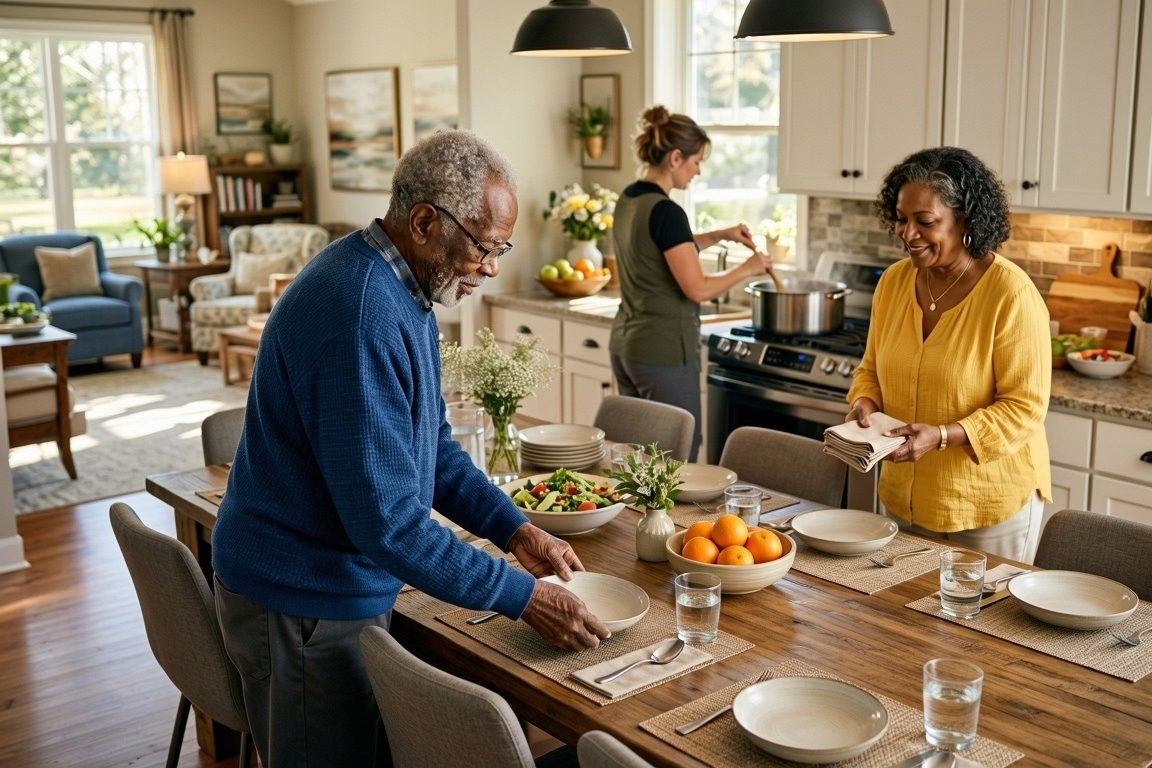
Traditional nursing homes and assisted living facilities can overwhelm a person with dementia: large dining rooms, long hallways, loud paging systems, rotating staff, and constant glare or noise often trigger anxiety, agitation, and disorientation. Small group home and Greenhouse models were designed to counter this by breaking care into intimate, residential households of roughly 10–16 people. Each home has its own kitchen, living room, and dining space so daily life revolves around normal household rhythms rather than institutional routines. Staff are cross-trained to both provide personal care and handle cooking and cleaning, meaning the same familiar faces help with bathing, meals, and chores while learning each resident's life story, preferences, and routines. The design is intentionally flexible: safety systems use residential-grade devices, and door locks, alarms, and freedoms can be adjusted per individual and per dementia stage. This means the environment can adapt as a person's needs change, sometimes without ever requiring a move to a different unit. Shared, supervised meal preparation is central, giving residents purpose, cognitive stimulation, and a sense of normalcy. Experts describe the goal as a 'positive environment': privacy, sufficient lighting, pleasant music, and multiple chances to eat and drink throughout the day, with negative stimuli like glare and noise minimized.
Practical tools
8
Visit Observation Checklist
Take on every tour and verify:
Questions for the Director and Staff
Ask:
Stay-for-a-Day Observation Test
Ask whether you can stay from breakfast through evening to experience the home's rhythm. Note whether residents seem calm and engaged versus anxious or passive, and observe how staff interact during transitions, meals, and unstructured time.
Mealtime Engagement Script
Use a calm, step-by-step approach with closed-choice invitations rather than open-ended questions. Example: 'Let's make lunch together. First, we'll wash these tomatoes. Can you hold the colander?' Then offer simple either/or choices: 'Would you like to stir the soup or set the plates?' Keep instructions short, one step at a time, and praise participation. This works both in a small group home kitchen and at home.
Safety Device List for Home Adaptation
Recreate residential-grade safety at home:
These are affordable single-family alternatives to expensive commercial systems.
Daily Purpose Activity List
Keep a list of meaningful household tasks, folding towels, sorting socks, watering plants, setting the table, wiping counters, sorting silverware, arranging flowers. Post it on the refrigerator. Each morning choose one and invite participation with phrasing like 'I need help folding towels, can you show me how?' This brings the small group home's sense of purpose into a home routine.
All About Me One-Pager
Create a single-page snapshot for care teams (in a facility or at home):
Helps any care worker deliver relationship-based, person-centered care quickly.
Advocacy Steps for Traditional Facilities
If your loved one is already in a large facility or you are a care worker, advocate for small-group principles:
Different situations
Early-stage dementia: The person may still cook, garden, and socialize. Look for a home that allows a private room and bathroom and some freedom to come and go (e.g., unlocked daytime doors), and that offers cognitive stimulation like word games or reminiscence rather than passive entertainment.
Late-stage / severe dementia: Confirm a higher staff-to-resident ratio (e.g., 1 staff per 4–5 residents) and staff trained in palliative and end-of-life care. Ensure the household can accommodate a hospital bed, a lift, and feeding equipment, with secure doors, and a plan for pain, comfort, swallowing difficulties, and bed care. Ask whether they partner with hospice and whether the person can remain rather than transfer. The kitchen may still be used for pureed meals or favorite flavors, with soft music and familiar objects.
Lewy body or Parkinson's disease dementia: These involve movement difficulties, hallucinations, and medication sensitivity. Look for clear pathways, good lighting, minimal visual clutter, non-slip floors, grab bars, and wide doorways for walkers or wheelchairs. Ask about staff experience recognizing and calmly responding to hallucinations without agitation, and how they manage strict medication timing. The kitchen should have easy-grip utensils and a stable chair for seated meal prep. Avoid sudden routine changes.
Young-onset dementia (under age 65): The person may be physically strong, have different interests, and may have children at home. Seek a home offering age-appropriate activities (gardening, woodworking, music) and a household that feels like a home rather than a retirement community. Ask about flexible schedules, a later bedtime or more active outings, and whether they accept Medicaid or have a young-onset specialty program.
Spouse vs. adult child caregiver: Spouses often feel guilt about placement; visit together, ask if the spouse can join meals/activities or stay overnight occasionally, and prioritize connecting with a caregiver support group. Adult children often focus on logistics and finances and may need to coordinate with siblings, consider a shared online document to record observations from each visit. Both should ask about family participation policies and whether a family council exists.
Medicaid or limited budget: Small group and Greenhouse homes can be costly, but some states offer Medicaid 'home and community-based services' waivers; contact your state Medicaid office or local aging agency. Some homes accept a mix of private pay and Medicaid, have sliding scales, or (especially nonprofit Greenhouse communities) charitable care funds. Expect waitlists. Adult day programs are a lower-cost alternative offering similar social and engagement benefits.
Common questions
5
Drop in unannounced at mealtimes and in the evening, the real test of a home is how staff and residents interact when no tour is scheduled.
A genuine red flag isn't the building's age but whether staff can tell you what a specific resident did or enjoyed yesterday.
Bring familiar items, photos, a favorite blanket, and plan short visits before a full move-in to ease the transition.
If you can't find or afford a small group home, you can still capture much of its value: a predictable mealtime routine, residential safety devices, an All About Me one-pager, and small-group advocacy within an existing facility.
Caregiver support groups (in person or online) are not optional extras, they protect you from burnout during placement decisions and transitions.
For the doctor
2
- Ask your loved one's doctor: 'Given my family member's specific dementia type and stage, is a small group home with a household kitchen and shared activities safe and appropriate? Are there medical risks, such as fall risk or swallowing difficulties, we should consider?' Ask the home's nursing staff how they manage medications for complex regimens (e.g., Parkinson's or Lewy body dementia) and whether they can coordinate with the doctor's office
- never treat any medication information as a dosing instruction, confirm all medication decisions with the prescribing clinician. If there is a history of wandering or aggression, ask about elopement protocols, door locks/alarms, and how staff de-escalate agitation without relying on antipsychotics. For residents with swallowing difficulties, ask whether staff are trained in modified diets, feeding assistance, and pureed or thickened liquids. For end-of-life planning, ask whether the person can remain in the home with hospice support or would need to transfer, and what the facility's palliative care policy is.