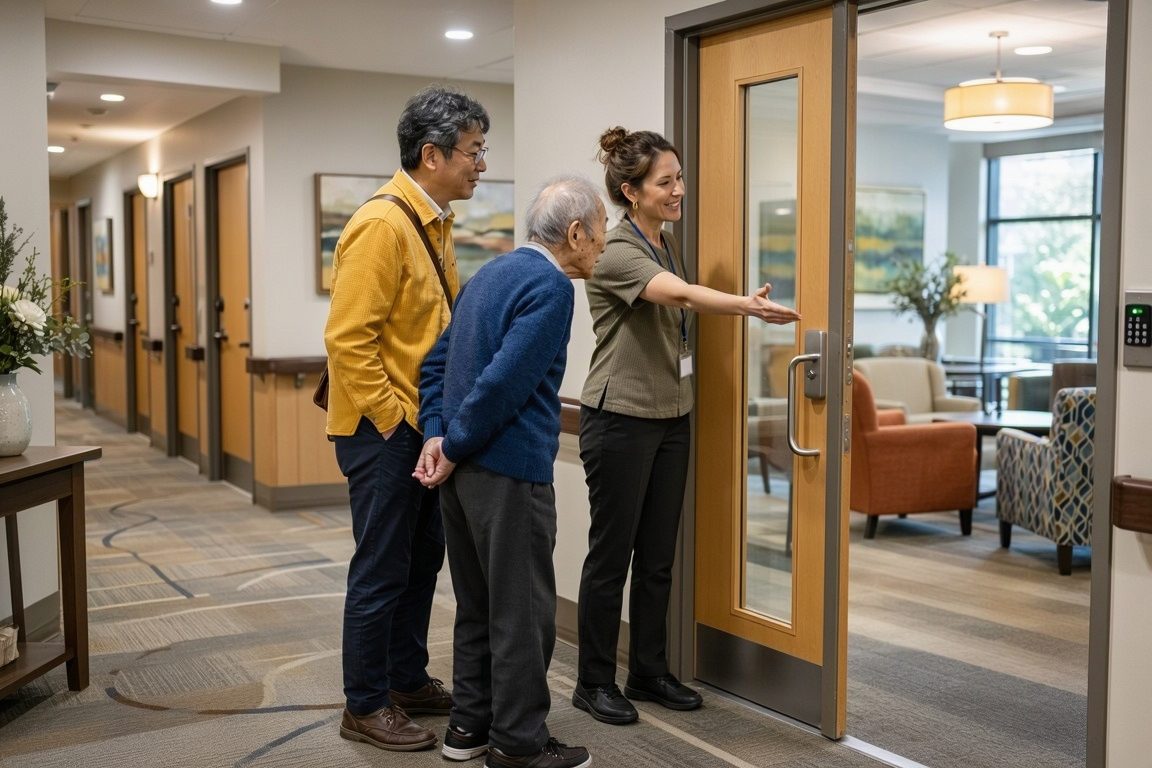
Step by step
What not to do
- Do not assume that any assisted living can handle dementia. Many assisted living facilities are not equipped to manage wandering, aggression, or the progressive nature of dementia. Placing a parent with moderate dementia in a general assisted living unit can lead to accidents, elopement, or social rejection by other residents (source 4).Instead, specifically ask if they have a dedicated memory care unit or if they accept residents with dementia.
- Do not choose a facility based solely on cost or location. Cheaper options may have fewer staff, less training, or no locked unit. A facility that is far away but provides excellent care is better than one nearby that cannot meet your parent's needs. You will visit less often, but your parent will be safer.
- Do not wait until a crisis to make a decision. If your parent has a fall, gets lost, or your caregiver health declines, you may be forced into a rushed choice with limited options. Start touring facilities as soon as your parent is diagnosed with dementia, even if they are still at home (source 26). This gives you time to plan and compare.
- Do not assume that memory care is the same as a nursing home. Nursing homes provide skilled medical care (e.g., IV therapy, wound care) and are often covered by Medicare for short stays after a hospital discharge. Memory care focuses on cognitive support and safety, not medical treatment. If your parent needs complex medical care, a nursing home may be more appropriate (source 11).
- Do not ignore the emotional impact of the move. Transitioning a parent with dementia can cause confusion, anger, or grief. Avoid moving them without preparation. Visit the facility together beforehand, bring familiar items like photos or a favorite blanket, and plan a gradual transition if possible. Expect the first few weeks to be difficult, but know that most people eventually settle in.
- Do not forget to ask about the facility's policy on family involvement. Some memory care units encourage family visits and participation in activities, while others have restricted hours. Choose a facility that welcomes you as a partner in care, not as an outsider.
Key points
- Memory care is a locked, specialized unit for people with dementia; assisted living is for those who need some help but can still move freely.
- Safety is the top priority: if your parent wanders or is at risk of elopement, memory care is essential.
- Not all assisted living facilities have memory care units, always ask specifically.
- Memory care in assisted living is usually private pay; memory care in nursing homes may be covered by Medicaid.
- Tour multiple facilities, ask detailed questions about staff training and included services, and trust your observations.
- Plan ahead: start exploring options early, before a crisis forces a rushed decision.
Videos
 MEMORY CARE ASSISTED LIVING FACILITY VS MEMORY CARE NURSING HOMEThis video directly compares memory care units in assisted living versus nursing homes, covering costs, Medicaid eligibility, and the pros and cons of each setting.
 Choosing the Right CareProvides a broad overview of care options (independent living, assisted living, memory care, nursing home) and how to match them to your parent's needs.
 What Level Of Care Does A Dementia Patient Need?Helps you assess your parent's current abilities and determine whether assisted living or memory care is the appropriate level of support.
 How Do I Know if a Parent Needs Memory Care or Assisted LivingOffers practical signs to look for, such as wandering, inability to manage daily tasks, and safety concerns, to guide your decision.
2 more videos
 Michala Gibson & Mandy Shoemaker Founders of Prairie Elder Care and ConnectivitiesDiscusses the importance of finding a facility that offers a continuum of care and how to evaluate the quality of dementia-specific programming.
 Conscious Caregiving with L & L 'The Bureaucracy of Care & Seniors'Explores the financial and bureaucratic challenges of navigating care options, including tips for working with insurance and Medicaid.
Background
What Is Assisted Living?
Assisted living is a residential setting for older adults who need help with daily activities like bathing, dressing, medication management, and meals, but who do not require the intensive medical care of a nursing home. Residents typically have their own apartment or room and can move around freely within the community. Staff provide support, but the environment is designed for relative independence. As one expert notes, assisted living is not regulated by the federal government, so definitions and services vary widely from state to state (source 15). This means you must ask specific questions about what care is included and what costs extra.
What Is Memory Care?
Memory care is a specialized type of care within some assisted living facilities or nursing homes, designed specifically for people with Alzheimer's disease or other dementias. The most critical difference is that memory care units are locked to prevent residents from wandering away, which is a major safety concern for someone with moderate to advanced dementia (source 3). These units also have specially trained staff, structured daily routines, and environmental cues like colored carpets leading to the dining room or memory boxes outside each door to help residents recognize their own room (source 1). Memory care is not the same as a nursing home, nursing homes provide around-the-clock medical care for all types of patients, while memory care focuses on the unique needs of people with cognitive decline (source 11).
Why the Distinction Matters for Moderate to Advanced Dementia
For a parent with moderate to advanced dementia, the choice between assisted living and memory care often comes down to safety and the level of specialized support. In assisted living, a resident with dementia may wander, become agitated in an unstructured environment, or struggle to fit in with peers who do not have cognitive issues. As one caregiver expert explains, other residents can be critical or unkind to someone who behaves differently, leading to isolation or distress (source 4). Memory care units are designed to prevent these problems by providing a secure, structured setting where all residents have similar cognitive challenges, fostering a more accepting community. Additionally, memory care staff are trained in dementia-specific communication and behavior management, which is not guaranteed in assisted living (source 22). If your parent needs help with feeding, bathing, dressing, or moving, memory care is likely the better fit (source 2).
Practical tools
6
The 'Needs vs. Wants' Comparison Checklist
Create a simple two-column list. In the 'Needs' column, write down what your parent absolutely requires: a locked unit, help with bathing, medication management, dementia-trained staff, etc. In the 'Wants' column, list preferences: a private room, a garden, proximity to your home. Use this checklist when touring facilities to quickly see which ones meet the non-negotiable needs.
Script for Asking About Care Levels
When you call or visit a facility, use this exact phrasing: 'My parent has moderate dementia and needs help with bathing and dressing.
I want to understand what is covered and what would cost more.' This prevents surprise charges later (source 3).
The 'Memory Box' Observation Tool
During a tour, look for memory boxes outside residents' doors. These are small display cases with personal photos, a favorite hat, or a familiar object. They help residents recognize their own room and reduce confusion (source 1). If a facility does not have them, ask why. Their presence indicates a dementia-aware design.
The 'Wandering Risk' Self-Assessment
Answer these three questions honestly:
If you answer 'yes' to any, a locked memory care unit is strongly recommended for safety.
Financial Planning Worksheet
The 'Three-Visit Rule'
Plan to visit any serious candidate facility at least three times:
This gives you a fuller picture than a scheduled tour.
Different situations
Parent has Lewy body dementia (LBD)
LBD often involves hallucinations, fluctuating cognition, and movement problems like stiffness or falls. Memory care units that are locked and have staff trained in LBD are crucial. Ask the facility: 'How do you handle visual hallucinations? Do you have experience with Parkinson's-like symptoms?' Avoid facilities that use antipsychotic medications as a first-line response, as these can be dangerous for LBD. Also, ensure the environment has good lighting and non-slip flooring to reduce fall risk.
Parent is in late-stage dementia (bedbound, nonverbal, needs full care)
At this stage, the parent may need a nursing home with a memory care unit rather than an assisted living memory care unit. Nursing homes provide 24/7 skilled nursing, including tube feeding, wound care, and pain management (source 2). Ask about hospice integration, as many late-stage patients qualify for hospice services that can be provided in the facility. The focus shifts from stimulation to comfort and dignity.
You are an adult child caregiver vs. a spouse caregiver
Adult children often feel guilt about 'placing' a parent, while spouses may feel a duty to care at home longer. If you are a spouse, consider your own health, caregiver burnout is real and can lead to hospitalization (source 19). If you are an adult child, you may have more emotional distance but also less firsthand knowledge of daily care needs. In both cases, involve a geriatric care manager or social worker to help you evaluate options objectively.
Parent is already in a facility and needs to transition from assisted living to memory care
If your parent is in assisted living but their dementia has progressed, moving them to a memory care unit within the same campus is less disruptive than moving to a new facility. Ask the current facility: 'Do you have a memory care unit? What is the process for transferring? Will the same staff be involved?' If not, you may need to find a new facility. Prepare your parent by visiting the new unit several times before the move, and bring familiar items from their current room.
Parent is on Medicaid or has limited assets
Medicaid typically covers memory care in a nursing home but not in assisted living (source 9). If your parent has assets, you may choose to start in assisted living memory care and 'spend down' until they qualify for Medicaid, then transfer to a nursing home. However, this transition can be very hard on someone with dementia. Discuss with an elder law attorney whether a 'life care plan' or 'Medicaid-compliant annuity' could help. Also, check if the facility has a 'Medicaid bed' or a 'charity care' program.
For the doctor
4
- Ask your parent's doctor: 'Given my parent's specific type and stage of dementia, what level of supervision and care do they need? Would a locked memory care unit be safer than assisted living?'
- Ask the facility's nurse or director: 'What is your policy on using antipsychotic or sedative medications for behavioral symptoms? Can you provide a copy of your medication management protocol?'
- Ask a geriatrician or neurologist: 'Are there any medical conditions (e.g., heart disease, diabetes, fall risk) that would make a nursing home more appropriate than memory care in assisted living?'
- Ask the facility: 'Do you have a registered nurse on staff 24/7? If my parent has a medical emergency, what is your protocol? Do you call 911 or have a doctor on call?'