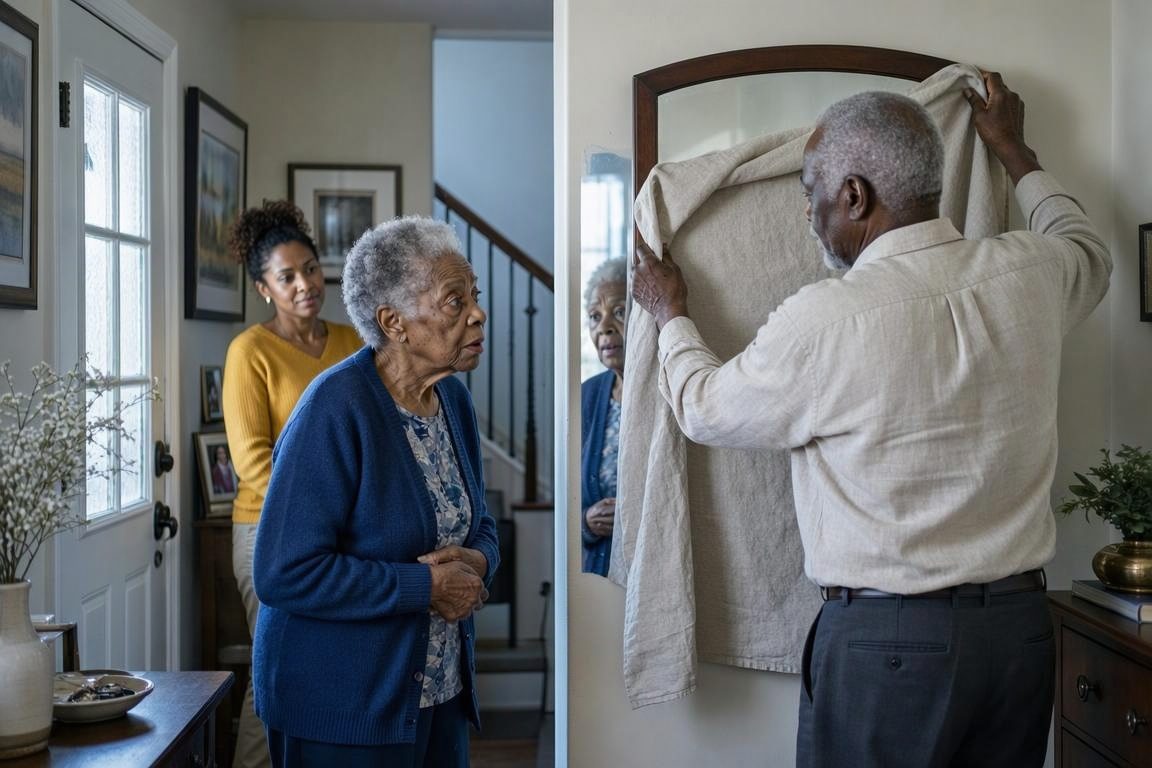
Step by step
What not to do
- Do NOT argue or say 'That's you in the mirror.' This will likely escalate distress because their brain cannot process that information.Instead, validate their feeling and redirect: 'I can see you're scared. Let's go to the kitchen for a snack.'
- Do NOT leave the mirror uncovered and hope they get used to it. The confusion often worsens over time. Proactively cover or remove the mirror to prevent repeated distress.
- Do NOT assume it is a hallucination that needs medication. First, check for environmental triggers, lighting, and physical issues like a UTI or medication side effects. Always consult a clinician before assuming medication is needed.
- Do NOT use a TV as a constant background noise. The TV can be a major trigger for confusion, especially if it shows people talking or moving. Turn it off when not in use, or switch to calming nature scenes.
- Do NOT take their reaction personally. They are not being difficult; their brain is struggling. Your calm, neutral response is the best medicine. If you feel frustrated, step away for a moment and take a deep breath.
- Do NOT try to 'fix' the situation by moving furniture or covering mirrors without warning. Sudden changes can increase confusion. If possible, involve them in the change or do it gradually.
Key points
- Mirror and TV confusion is a common perceptual problem in dementia, not a sign of stubbornness or psychosis.
- Cover or remove mirrors as a first-line intervention; use fabric, film, or a bedsheet.
- Turn off the TV when not in use, or switch to calming nature scenes with no human figures.
- Never argue or try to reason about the reflection; validate their emotion and redirect gently.
- Check for physical issues (UTI, pain, hunger, poor vision) before assuming the mirror is the only trigger.
- Use distraction with a favorite activity or a simple task to move them away from the source of distress.
Videos
 Why Mirrors Confuse People with Dementia (And How to Fix It!)This video directly addresses the confusion around mirrors and TV, offering practical steps like covering mirrors and using distraction.
 Understanding the signs of paranoia, hallucinations and delusional behaviors w/ Lucy Barylak Sept 12Lucy Barylak explains how to distinguish between hallucinations and delusions, and how to respond without arguing, which is key for mirror-related distress.
 The Baffled Brain: Demystifying Dementia Episode 23 May 1 ,2021This episode covers perceptual disturbances and how the environment (including mirrors) can trigger confusion, with tips on simplifying the space.
 Why Does Dementia Cause Hallucinations, Delusions, and Paranoia with Lucy Barylak, MSW Aug 10 23Lucy Barylak discusses the brain changes behind these symptoms and offers validation and redirection strategies that are directly applicable to mirror/TV issues.
2 more videos
 Dementia Paranoia Explained: Why It Happens & How to RespondThis video explains paranoia in dementia, including how mirrors can trigger paranoid thoughts, and provides a step-by-step response framework.
 Dementia Got Worse Overnight? Think Delirium (Act Fast) | Dr. Khushboo VermaIf mirror confusion appears suddenly, this video helps you recognize delirium (often from infection or medication) and when to seek medical help.
Background
Why Mirrors and TV Become Confusing
As dementia progresses, the brain's ability to process visual information changes. A mirror reflection may no longer be recognized as the person themselves. Instead, they might see a stranger staring back at them, or believe someone is in the room who shouldn't be there. This is not a hallucination in the classic sense, but a perceptual disturbance rooted in the brain's altered wiring. Similarly, a person on a TV or computer screen may be perceived as actually present in the room. One clinician described a patient who kept trying to shake hands with a doctor on a video call, unable to grasp that the image was remote. This confusion can be deeply unsettling, leading to fear, agitation, or even attempts to 'help' the stranger they see.
The Role of Environment and Sensory Triggers
The environment plays a huge role. Dark or cluttered spaces can increase disorientation, making it harder for the brain to interpret reflections. Loud noises, unfamiliar people, or even a recent change in furniture can amplify confusion. In some cases, what looks like a hallucination triggered by a mirror may actually be a reaction to poor lighting, a urinary tract infection, or medication side effects. That is why it is critical to look for patterns: does the distress happen only in the bathroom mirror? Only in dim light? Only when the TV is on with certain programs? Noticing these patterns helps you target the real trigger. Also, remember that the person's own sensory aids matter: if their glasses are dirty or their hearing aids are off, they are more likely to misinterpret what they see.
Why Arguing or Reasoning Backfires
Your instinct may be to say, 'That's you in the mirror, honey,' or 'There's nobody on the TV, it's just a show.' But for a brain that cannot process that information, this feels like you are lying or dismissing their very real experience. They may become more agitated, lose trust in you, or feel even more frightened. The goal is not to correct their perception, but to validate their emotion and gently redirect. Acknowledging their distress first ('I can see you're upset. Let's go have a cup of tea.') is far more effective than trying to pull them back to your reality. This approach reduces their anxiety and keeps the connection between you strong.
Practical tools
6
Mirror Covering Kit
Use a large piece of fabric, a removable mirror film (like frosted window film), or a bedsheet. Attach with painter's tape or Velcro so it can be removed easily. Choose a color or pattern that blends with the room decor to avoid drawing attention.
Calming TV Content
Switch to nature documentaries with slow-moving animals (like fish or birds), a fireplace video, or a screensaver with no human figures. Avoid news, talk shows, or any program with rapid scene changes or loud sounds. Some caregivers use a 'Memory Lane TV' app designed for dementia patients.
Redirection Script
Have a few go-to phrases ready: 'I need your help with something in the kitchen,' 'Let's go look at the flowers outside,' or 'Would you like some tea?' Practice these so they come naturally in the moment. Pair with a gentle touch on the arm or hand to guide them away.
Lighting Check
Use a nightlight in the bathroom and hallway. In the evening, turn on lamps to reduce shadows. Consider a motion-sensor light for the bathroom so it turns on automatically. Good lighting reduces the chance that a reflection will be misinterpreted.
Pattern Tracking Log
Keep a simple notebook or use a phone note to track: time of day, location, what the person was doing, what they said, and what you did that helped. Over a week, patterns will emerge that guide your next steps.
Sensory Aid Check
Before assuming the mirror is the problem, check that their glasses are clean and on, and hearing aids are working. Poor vision or hearing increases confusion and can make reflections more frightening.
Different situations
Lewy body dementia
People with Lewy body dementia are especially prone to visual hallucinations and may react more intensely to mirrors or TV. Cover mirrors completely and avoid any reflective surfaces. Also, check for medication side effects, as some drugs can worsen hallucinations. Consult a clinician promptly if hallucinations increase.
Late-stage dementia
In late stages, the person may not be able to communicate their distress verbally. Watch for non-verbal cues like agitation, turning away from mirrors, or trying to touch the TV. Cover mirrors permanently and keep the TV off or on a static nature scene. Focus on soothing touch and familiar music.
Spouse vs. adult child caregiver
A spouse may feel more personally hurt by the confusion ('He doesn't even recognize me in the mirror?'). Remind yourself it is the disease, not a reflection of your relationship. Adult children may need to involve siblings in decision-making about covering mirrors or changing the environment. Both roles benefit from taking breaks and seeking support groups.
In a facility (nursing home or assisted living)
Work with staff to cover mirrors in the resident's room and common areas. Request that the TV in the common room be turned off during quiet times or set to calming content. If the resident shares a room, use a privacy curtain to block the mirror when needed. Advocate for a dementia-friendly environment with non-reflective surfaces.
Medicaid or limited resources
You do not need expensive products. Use a bedsheet, a scarf, or even a large piece of cardboard to cover a mirror. Use painter's tape or clothespins. For TV, use a free nature video on YouTube. Focus on low-cost redirection like folding towels, sorting coins, or looking at a photo album.
For the doctor
5
- If the mirror/TV confusion is accompanied by new hallucinations (seeing people or animals that are not there), especially in a person with Lewy body dementia, discuss medication options with a doctor.
- If the person has a sudden increase in confusion or agitation, rule out a urinary tract infection (UTI), dehydration, or medication side effects. A clinician can order a urine test or review medications.
- If the person is on medications that list hallucinations as a possible side effect, ask the pharmacist or doctor if an alternative is available.
- If the person's distress is severe and does not improve with environmental changes, a clinician may recommend a referral to a dementia specialist or a geriatric psychiatrist.
- If the person has a history of falls or wandering, discuss safety measures (e.g., removing mirrors that could be broken) with a doctor or occupational therapist.