
Step by step
What not to do
- Don't assume all PET scans are the same. Always confirm whether it's FDG-PET or amyloid PET, prep differs significantly.
- Don't let the patient eat or drink anything except water before an FDG-PET. If they accidentally eat, call the imaging center immediately.
- Don't keep the patient awake or active during the FDG-PET waiting period. Falling asleep is helpful.
- Don't argue if staff say you can't be in the scan room. Ask to be nearby or to be called when the scan ends.
- Don't forget to ask about cost and insurance coverage. Amyloid PET may not be covered by Medicare; FDG-PET coverage varies.
- Don't skip the stillness drill. Even a few minutes at home reduces movement during the scan, avoiding repeat scans.
Key points
- Know which type of PET scan is scheduled: FDG or amyloid, because the preparation is completely different.
- For FDG-PET: fasting is required, and the patient needs a quiet, dark room after the injection.
- For amyloid PET: no fasting is usually needed, and the waiting period is more flexible.
- Practice lying still at home before the scan to reduce anxiety.
- Pack a comfort kit with familiar items and a snack for after the scan.
- Ask the imaging center ahead of time about their policies on caregivers in the room.
- Discuss costs and insurance coverage before the day of the scan.
Videos
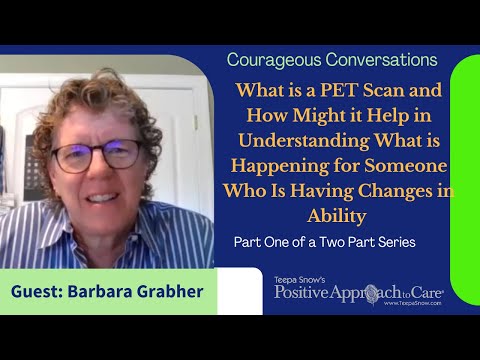 Courageous Conversation with Barbara Grabher from Life Molecular ImagingBarbara Grabher explains the amyloid PET scan process in detail, including the different tracers and waiting times. This video is excellent for understanding the logistics of an amyloid scan.
 Courageous Conversation with Barbara GrabherA second conversation with Barbara Grabher that covers practical tips for caregivers preparing for an amyloid PET scan, including what to expect at the imaging center.
 PCALECTURE with UCSD neurologist Dr. Douglas GalaskoDr. Galasko discusses the use of FDG-PET and amyloid PET in diagnosing posterior cortical atrophy (PCA), a variant of Alzheimer’s. This helps caregivers understand why these scans are used for atypical presentations.
 Posterior Cortical Atrophy LECTURE with GIL RABINOVICI, MDDr. Rabinovici explains how PET scans help differentiate between Alzheimer’s and other dementias, including Lewy body dementia. This video provides context for why the pattern of hypometabolism matters.
2 more videos
 The Association for Frontotemporal Degeneration with Esther Kane & Debbie Elkins (AFTD)While focused on FTD, this video discusses the role of FDG-PET in diagnosing frontotemporal dementia, which can sometimes be confused with Alzheimer’s or Lewy body dementia. It helps caregivers understand the broader diagnostic landscape.
 Are We Actually Making Progress in Dementia Research? (NIH 2025 Update)This update from the NIH covers recent advances in dementia research, including the use of amyloid PET scans in clinical trials for anti-amyloid therapies. It helps caregivers see how these scans fit into the bigger picture of treatment and research.
Background
Why a PET scan? What does it show?
A PET scan is a special imaging test that looks at how the brain is working, not just its structure. There are two main types used in dementia evaluation. An FDG-PET scan measures how well brain cells are using sugar (glucose) for energy. In Alzheimer’s disease, certain brain regions show a pattern of reduced activity, called hypometabolism, especially in the temporal, parietal, and posterior cingulate areas. In Lewy body dementia, the pattern is different, it often shows reduced activity in the back of the brain, including the occipital cortex, which is the visual processing center. This difference in the pattern of hypometabolism helps doctors distinguish between types of dementia. An amyloid PET scan, on the other hand, looks for sticky protein clumps called amyloid plaques, which are a hallmark of Alzheimer’s disease. The tracer used in this scan binds to amyloid plaques, and the result is simply ‘positive’ or ‘negative’, meaning the plaques are either present or not. Both scans are powerful tools, but they answer different questions.
How are FDG and amyloid PET scans different in preparation?
The preparation for these two scans is very different, and it’s crucial to know which one your loved one is having. For an FDG-PET scan, the patient needs to have a quiet, dark room for about 30 minutes after the tracer is injected. This is because the brain’s activity during that time will affect the scan results, if the patient is talking, listening to music, or even just thinking actively, it can change where the tracer goes and make the results harder to read. For an amyloid PET scan, there is no such requirement. The amyloid plaques are already there, so the patient can be in a normal, lit room and can talk or listen to music during the waiting period. The waiting time after the injection also differs: for FDG, it’s typically 30–60 minutes; for amyloid, it can range from 30 to 130 minutes, depending on the specific tracer used at your imaging center. Both scans involve lying still in the scanner for about 10–20 minutes, but the prep beforehand is what really matters.
What happens during the scan itself?
For both types of PET scans, the process starts with an IV line placed in the arm. The radioactive tracer is injected through this IV. Then comes the waiting period, which varies by scan type as described above. After the waiting period, the patient is positioned on the scanner table. They need to lie very still for the duration of the scan, which is usually 10 to 20 minutes. The scanner itself is a large, doughnut-shaped machine, and the table moves slowly through it. The patient may hear clicking or whirring sounds. Some imaging centers allow a caregiver to stay in the room during the scan, but policies vary, some will say yes, others will say no. It’s best to ask ahead of time and not to take it personally if they say no. The scan itself is painless, but the stillness can be challenging for someone with dementia. Knowing this in advance lets you prepare your loved one and yourself.
Practical tools
4
Two-Scan Checklist
On paper or phone, list:
Check off each item.
Reassuring Phrases for Your Loved One
Say: 'We're going to a place where they take pictures of your brain. You'll get a small poke in your arm, then we'll rest. Then you'll lie on a soft table and stay still for a few minutes. I'll be right with you.' Avoid words like 'test' or 'procedure' if they cause anxiety.
Comfort Kit Bag
Pack:
Label the bag with the patient's name.
Stillness Drill Timer
Use a kitchen or phone timer. Practice lying still for 5 minutes, then 10. Say: 'Let's be very still until the timer beeps. You're doing great!' Gradually increase duration.
Different situations
For Lewy body dementia
Patients with Lewy body dementia may have more sensitivity to noise and light, and they may be more prone to anxiety or confusion in unfamiliar settings. Plan for a very calm environment during the waiting period, even for an amyloid PET. Also, Lewy body patients may have fluctuations in alertness, so schedule the scan for a time of day when they are typically most alert. Discuss with your clinician whether a mild sedative might be appropriate, as some sedatives can worsen symptoms in Lewy body dementia.
For early-stage Alzheimer’s (mild cognitive impairment or mild dementia)
The patient may still be able to understand and cooperate with instructions. Use clear, simple language and give them choices where possible, like: ‘Do you want to wear your blue shirt or your gray shirt today?’ They may also be able to help with the ‘stillness drill’ practice. Reassure them that the scan is a routine part of getting the best care.
For moderate to advanced dementia
The patient may not understand why they are at the imaging center and may become agitated. Bring a familiar caregiver or family member who can stay with them throughout. Ask the imaging center if they have experience with dementia patients. Some centers may allow the caregiver to lie on the scanner table with the patient, or to hold their hand during the scan. Be prepared to reschedule if the patient is too distressed. Your clinician can help decide if the scan is still necessary at this stage.
For a spouse caregiver vs. an adult child caregiver
A spouse may feel more comfortable advocating for their partner and may know the patient’s routines and triggers better. An adult child may need to be more assertive in communicating with staff, especially if the parent is used to being in charge. Both should practice saying: ‘My loved one has dementia and may need extra patience and reassurance.’ If you are an adult child, consider bringing a sibling or another family member for support.
If the scan is not covered by insurance
Amyloid PET scans are often not covered by Medicare or private insurance unless specific criteria are met. FDG-PET scans may be covered for certain indications. Before scheduling, ask the imaging center about the cost and whether they offer a payment plan or financial assistance. Discuss with your clinician whether a less expensive alternative, like a blood test for amyloid (such as the PrecivityAD test), might be appropriate. The blood test can predict the likelihood of amyloid plaques and may be more affordable.
For the doctor
6
- Ask your doctor: ‘Is an FDG-PET or an amyloid PET scan the right test for my loved one’s specific symptoms and suspected diagnosis?’
- Ask your doctor: ‘Are there any medications my loved one should stop taking before the scan? For example, some medications can affect brain activity and may need to be paused for an FDG-PET.’
- Ask your doctor: ‘What are the risks of the radioactive tracer? Are there any side effects I should watch for?’
- Ask your doctor: ‘If the scan shows amyloid plaques, what does that mean for treatment options? Are there anti-amyloid medications like lecanemab or donanemab that might be appropriate?’
- Ask your doctor: ‘If the scan is negative for amyloid but symptoms suggest Alzheimer’s, what are the next steps?’
- Ask your doctor: ‘For Lewy body dementia, would a different test, like a dopamine transporter SPECT scan (DaTscan), be more helpful?’