Step by step
What not to do
- Do not assume responders know what FTD is. Many healthcare professionals have only superficial knowledge of dementia, and FTD is even less understood.Instead, provide a written explanation every time.
- Do not shout or use a bossy tone with your spouse in front of responders. This can escalate tensions and make your spouse more agitated.Instead, use a calm, low voice and simple words.
- Do not let responders separate you from your spouse unless absolutely necessary for medical care. Your presence is their anchor. If separation is required, ask to stay within sight and speak to them from a distance.
- Do not try to force your spouse to answer questions. If a responder asks 'What is your name?' and your spouse cannot answer, gently interject: 'They have trouble speaking. I can answer for them.' Then provide the information yourself.
- Do not leave your spouse alone with responders while you gather documents. If you must get paperwork, ask a neighbor or another family member to stay with your spouse, or bring them with you if safe.
- Do not expect your spouse to remember the emergency afterward. They may not retain the event, but they will remember the feelings. Keep the aftermath calm and reassuring, not punitive.
Key points
- FTD with limited language means your spouse cannot explain their needs or follow complex instructions during an emergency.
- Emergency responders may misinterpret symptoms as intoxication, mental illness, or defiance without a written explanation.
- Create a communication card and a door sign that clearly state the diagnosis and give simple instructions for interaction.
- Your calm body language and low, slow voice are the most powerful tools to keep your spouse from escalating.
- Practice a 30-second calming script and a redirect object (like a pillow) to use when responders arrive.
- Pre-register with local emergency services if possible, and give a trusted neighbor a copy of your emergency folder.
Videos
 PAC Round Table - Caregiver in crisisThis roundtable discusses the real-life crisis of a caregiver with FTD who is worried about emergency situations. It validates your fears and offers community support.
 Caregiver Training: Aggressive Language/Behavior | UCLA Alzheimer's and Dementia Care ProgramProvides practical tips on de-escalating aggressive behavior using calm tone, simple instructions, and redirection, directly applicable to FTD.
 The Association for Frontotemporal Degeneration with Esther Kane & Debbie Elkins (AFTD)Hear from caregivers and experts about the unique challenges of FTD, including language loss and behavioral changes, and learn about AFTD resources.
 Dealing with Difficult Behaviors in DementiaOffers strategies for handling difficult behaviors like agitation and wandering, which are common in FTD emergencies.

Background
Why FTD with Limited Language Is Different
Frontotemporal dementia (FTD) often strikes the frontal and temporal lobes first, causing early changes in personality, behavior, and language, not memory. Your spouse may have lost the ability to form coherent sentences or understand spoken words, yet they can still feel emotions and read your body language. This means that when emergency personnel arrive, your spouse cannot explain what is wrong or follow complex instructions. They may appear confused, agitated, or even aggressive, but that is their brain struggling to process a frightening situation, not willful defiance. As one expert notes, 'They are doing the best they can to operate in a world that has gone upside down and sideways.'
How Responders May Misread the Situation
Without preparation, a police officer or paramedic might see your spouse's repetitive movements, lack of eye contact, or inability to answer questions and assume they are intoxicated, mentally ill, or being uncooperative. This can lead to forceful commands, handcuffing, or unnecessary restraint. FTD can also cause disinhibition, your spouse might touch a responder's equipment, laugh inappropriately, or try to walk away. These are symptoms of the disease, not intentional rudeness. By giving responders a simple, written explanation ahead of time, you help them shift from 'control mode' to 'care mode.'
The Role of Body Language and Tone
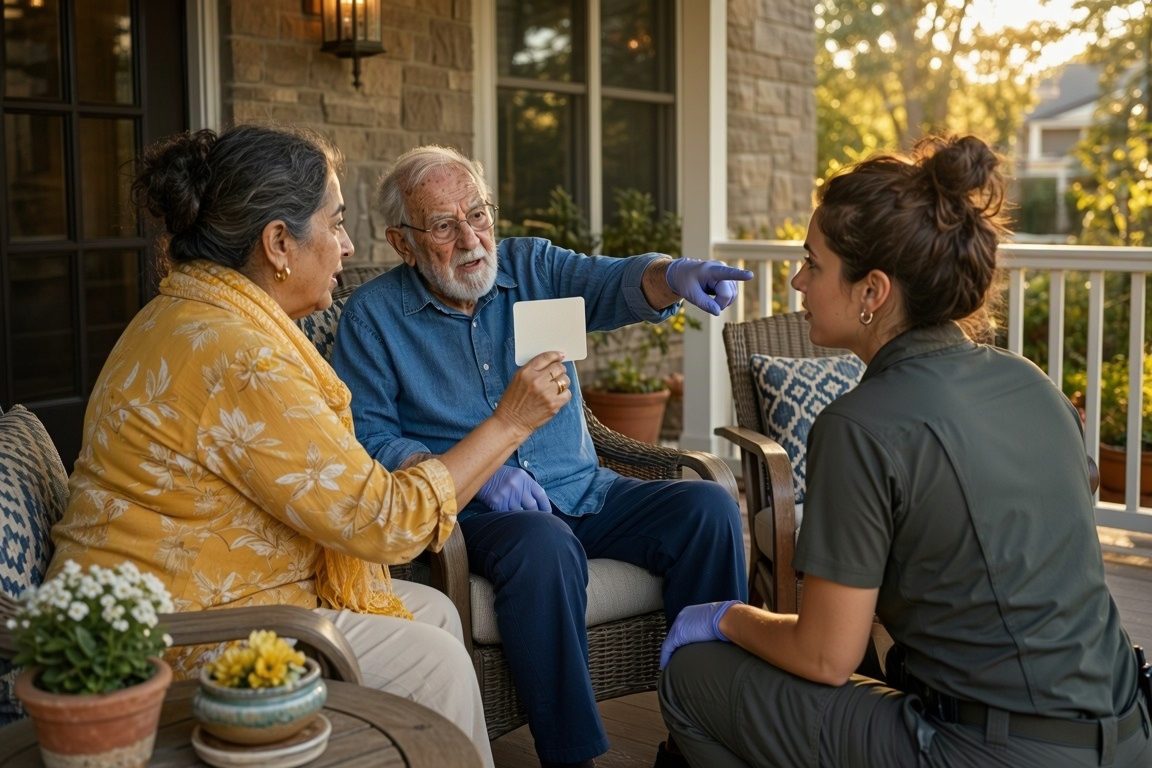
Because your spouse's receptive language is limited, they rely heavily on your facial expressions, tone of voice, and gestures. If you are tense or frightened, they will mirror that anxiety. One caregiver described becoming 'a mime', using exaggerated smiles, slow hand movements, and gentle touch to communicate safety. When you prepare emergency personnel, you are also preparing yourself to stay calm. Practice taking a deep breath, smiling softly, and using a low, slow voice. Your calm presence is the most powerful tool to keep your spouse from escalating.
Practical tools
6
Emergency Communication Card
A laminated card your spouse carries in their pocket or on a lanyard. Write: 'I have Frontotemporal Dementia. I may not be able to speak or understand. Please be patient. Call [your name] at [phone].' Keep a copy in your wallet and one on the fridge.
Door Sign Template
A bright 8.5x11 sign posted inside the front door or on the refrigerator. Text: 'IMPORTANT: Person with Frontotemporal Dementia lives here. Limited language. Please speak slowly, use simple words, and give time to respond. Do not shout or touch suddenly. Contact [name] at [phone].' Use a large, bold font.
Calming Script for First 30 Seconds
Memorize this phrase: 'I see you are worried. I am here. Let me help you.' Say it in a low, slow voice with a gentle smile. Repeat as needed. This gives your spouse a predictable anchor and models calm behavior for responders.
Redirect Object Kit
Keep a soft pillow, a favorite stuffed animal, or a textured cloth near the door. If your spouse becomes agitated or tries to touch equipment, hand them the object and say: 'Hold this for me, please.' This redirects their hands safely.
Pre-written Medical Information Sheet
A one-page document with:
Keep copies in an emergency folder near the door.
Practice Role-Play with a Friend
Ask a friend to pretend to be a responder. Practice meeting them at the door, handing them the card, and using your calming script. This builds your confidence and helps you stay calm in a real emergency.
Different situations
If your spouse also has behavioral variant FTD (bvFTD) with disinhibition
Add to your communication card: 'They may touch things or say things that seem inappropriate. This is part of their condition. Please do not react with shock or anger. Redirect them gently.' Practice redirecting them to a safe object (like a pillow) before responders arrive.
If your spouse has primary progressive aphasia (PPA) and can still understand some speech
Use short, simple sentences like 'Sit here.' 'Drink this.' Avoid open-ended questions. Your communication card should say: 'They can understand simple words. Please speak slowly and use gestures.'
If you are the sole caregiver and have your own health issues
Give a trusted neighbor or friend a copy of your emergency folder and a key to your home. Tell them: 'If I am taken to the hospital, please go to my house and stay with my spouse until I can call.' Also, pre-register with your local police or fire department's 'vulnerable person' registry if available.
If your spouse is in late-stage FTD and nearly non-verbal
Focus on body language: smile, nod, and use gentle touch. Your communication card should say: 'They cannot speak or understand words. Please use calm facial expressions and slow movements. Do not shout. I will stay with them.'
If you live in a rural area with volunteer responders
Volunteer responders may have less training in dementia. Call your local non-emergency number and ask to speak to the chief or training officer. Explain your situation and offer to provide a short written guide. Many will appreciate the heads-up.
For the doctor
4
- Ask your doctor about a medical ID bracelet for your spouse that lists 'FTD - Limited Language' and your contact number.
- Discuss with your neurologist whether a low-dose anti-anxiety medication might help your spouse stay calmer during emergency situations.
- Ask your primary care provider to write a 'letter of medical necessity' explaining that your spouse cannot be restrained or sedated without your presence, if that is the case.
- Inquire about a 'crisis plan' with your local mental health crisis team, especially if your spouse has a history of aggression.