Step by step
What not to do
- Don't try to hide the dementia diagnosis from staff.
- Don't assume your loved one will remember the plan you discussed at home.
- Don't rush through security or boarding.
- Don't expect your loved one to handle multiple-step instructions.
- Don't get into a power struggle if your loved one refuses the wheelchair.
- Don't correct or contradict your loved one in front of staff or strangers if they say something confused.
Key points
- Call the airline’s special assistance line and TSA Cares 48–72 hours ahead to arrange a meet-and-greet service and wheelchair escort, even if your loved one doesn’t usually use a wheelchair.
- Use the Hidden Disabilities Sunflower Lanyard or a simple card to discreetly signal to staff that your companion has dementia and needs extra patience.
- At security, tell the TSA officer clearly: “My companion has dementia. Please give one instruction at a time.” Speak slowly yourself to model the pace you want.
- Accept the wheelchair at the airport, it keeps your loved one safe, reduces wandering, and gets you through priority lanes.
- Bring noise-canceling headphones and sunglasses to cut down on sensory overload from airport lights and sounds.
- Always carry an emergency contact card on your loved one with your phone number and the diagnosis, in case you get separated.
Videos
 Conscious Caregiving with L & L "Seniors and Travel"This video offers practical travel tips specifically for seniors with cognitive challenges, including how to prepare for airport security and what to pack for comfort.
 Ask Teepa Anything! February 2020Teepa Snow answers real caregiver questions about travel, including how to handle airport staff and the emotional challenges of flying with dementia.
 Curious Conversations about Brain Change with Teepa Snow and the PAC™ TeamThis conversation covers the hidden disability concept and how to use tools like the sunflower lanyard and calm music to reduce travel stress.
 How to communicate with a dementia patientA crash course in dementia communication basics, essential for learning how to speak to your loved one and to staff in a way that reduces confusion.
2 more videos
 Traveling with someone who has dementia- 5 tipsA concise video with five actionable tips for traveling, including how to prepare for the airport and what to do if your loved one becomes agitated.
 Travel with Dementia - How to Help with Making a Selection in a Retail StoreWhile focused on retail, this video’s strategies for reducing choice overload apply directly to airport decisions like which gate to go to or what to eat.
Background
Why Airports Are So Challenging for Someone with Dementia
Airports are designed for efficiency, not comfort, and for a person with dementia, that efficiency can feel like chaos. The sensory overload of flashing lights, echoing announcements, and crowds of strangers moving in every direction can dramatically increase dementia symptoms. As one person living with dementia described, being in a “herd of people” at the airport made their symptoms much worse. The brain changes that come with dementia make it harder to filter out background noise and visual clutter, so what feels like normal airport bustle to you can feel like a full-blown assault to your loved one.
Beyond the sensory overload, airports demand constant decision-making: which line to stand in, where to show your ID, when to take off shoes, which gate to walk toward. For someone with dementia, these rapid-fire choices can be exhausting and humiliating. They may freeze, become irritable, or try to walk away. This isn’t stubbornness, it’s their brain’s way of protecting itself from too much input. Understanding this helps you shift from frustration to compassion, and from trying to “manage” them to actually supporting them through the experience.
The Hidden Disability That Airport Staff Can Help With
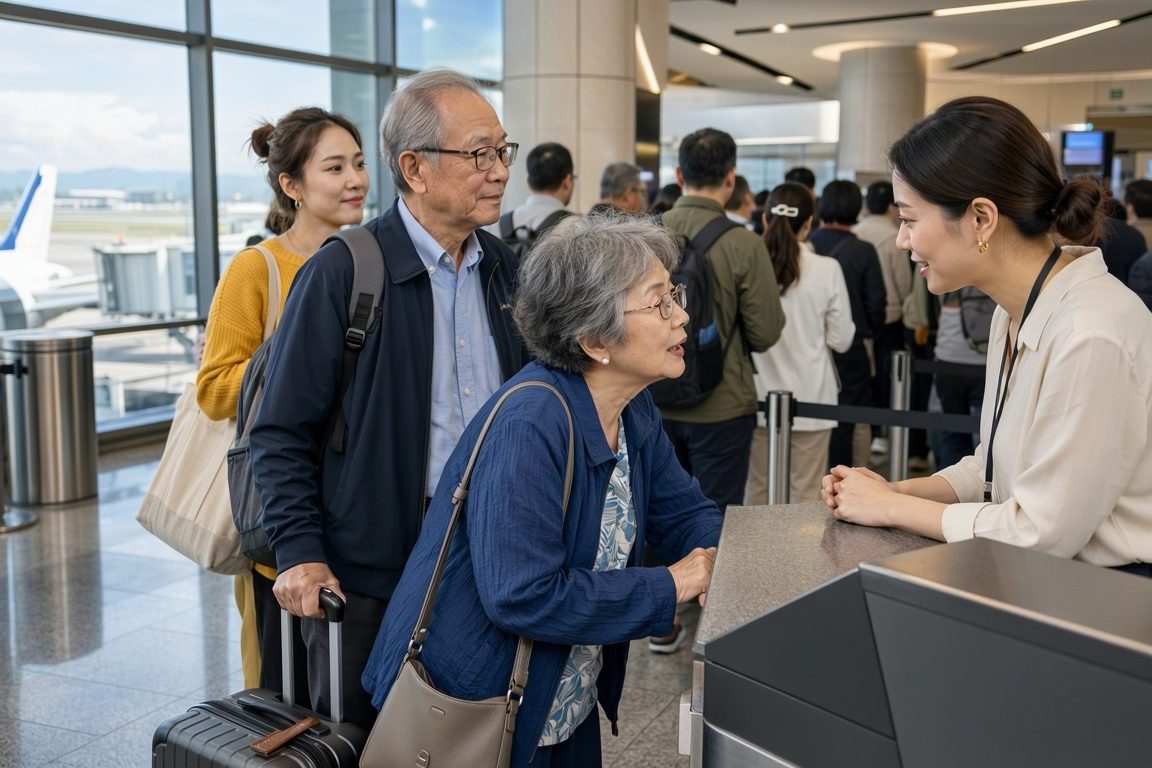
Dementia is often called a “hidden disability”, you can’t see it, but it profoundly affects how a person navigates the world. Many airports and airlines have programs specifically designed to assist travelers with hidden disabilities, including dementia. The key is knowing how to ask. TSA agents, gate agents, and flight attendants are trained to help, but they can’t read minds. If you tell them your travel companion has dementia, they will often do everything they can to make the process smoother, from moving you to a quieter line to allowing a companion to accompany you through security.
However, the help often comes with a catch: many airports will require the person with dementia to use a wheelchair, even if they don’t ordinarily need one. As one person with dementia put it, “They’re going to put you in a wheelchair and just suck it up.” While it can feel infantilizing, the wheelchair serves a practical purpose, it signals to every staff member that this person needs extra time and gentleness, and it keeps the person with dementia contained and safe in a chaotic environment. You can think of it as a tool, not a label.
Practical tools
5
The 'Hidden Disabilities' Sunflower Lanyard
A green lanyard with sunflowers recognized at many airports as a discreet signal that the wearer has a hidden disability. Order online or pick up at participating airport information desks.
The 'What to Say to TSA' Script Card
Write on a small card: 'My companion has dementia. They may have trouble following instructions. Please speak slowly, one step at a time, and point to where you want them to go. I will stay with them.' Hand it to the TSA officer.
Noise-Canceling Headphones and Sunglasses
Use over-ear headphones and sunglasses (even indoors) before entering the terminal to reduce overstimulation from noise and lights.
The 'Emergency Contact' Card
A small card your loved one carries stating: 'I have dementia. If I am lost or confused, please call [your name and phone number]. Do not call 911 unless I am in immediate danger.' Include
The 'Companion Care' Bathroom Strategy
Ask a staff member: 'Where is the nearest companion care restroom?' Use the single-occupancy, lockable restroom proactively before boarding and after deplaning.
Different situations
Frontotemporal Dementia (FTD)
People with FTD often have more difficulty with impulse control and may become agitated or say things that are socially inappropriate. At the airport, this can look like yelling at a gate agent or trying to walk into a restricted area. Use very short, direct instructions: “Sit here. Wait with me.” Avoid reasoning or explaining, just redirect physically. Inform staff ahead of time: “They may say things that seem rude. Please don’t take it personally. It’s the disease.” Have a backup plan to step away to a quiet area if they become overwhelmed.
Late-Stage Dementia
In late stages, the person may be nonverbal, unable to walk, or easily startled. The wheelchair is not optional, it’s necessary. You will need to do all the communicating. Bring a written note from their doctor stating the diagnosis and any special needs (e.g., “Must have assistance with eating and using the restroom”). Request a seat near the lavatory. Consider booking a nonstop flight to minimize transitions. If the person is prone to agitation, ask the airline if you can sit in a bulkhead row for more space and less disturbance.
Spouse vs. Adult Child Caregiver
If you are the spouse, you may be used to your partner being your equal, and it can be hard to ask for help. Remind yourself: asking for a wheelchair or early boarding is not taking away their dignity, it’s protecting their safety. If you are an adult child, you may feel more comfortable advocating. Use that strength to speak up for your parent. But also be aware that your parent may resist help from you more than from a stranger. In that case, let the airline staff be the “bad guy”, they can insist on the wheelchair, and you can say, “I know, honey, but they said we have to.”
Traveling Alone with Early-Stage Dementia
If the person is in early stages and traveling alone, they should still call the airline’s special assistance line and request a meet-and-greet service. They should carry a card that says: “I have early-stage dementia. I may need help finding my gate or remembering my flight number. Please help me get to my gate and call this number if I seem confused.” They should also wear an ID bracelet with your contact info. Avoid booking connecting flights, direct is safer.
Traveling with a Group or Family
If you are traveling with other family members, assign one person to be the “dementia support person” for the entire airport experience. That person stays with the person with dementia at all times, while others handle luggage, tickets, and children. The support person should not be distracted by other tasks. Before the trip, brief all family members: “If Mom gets confused, don’t all talk at once. Let one person speak slowly and calmly. If she gets upset, we’ll step to a quiet area.”
For the doctor
4
- Ask your doctor: “Is my loved one medically stable enough to fly? Are there any risks of agitation or confusion that could be worsened by the flight?”
- Ask your doctor: “Should we adjust any medications (e.g., anti-anxiety or sleep aids) for the travel day? What about timing of doses across time zones?”
- Ask your doctor: “If my loved one becomes severely agitated on the plane, what is the safest way to calm them? Are there any medications I should carry as a backup?”
- Ask your doctor: “Are there any specific medical conditions (e.g., heart disease, recent surgery) that would make air travel risky?”