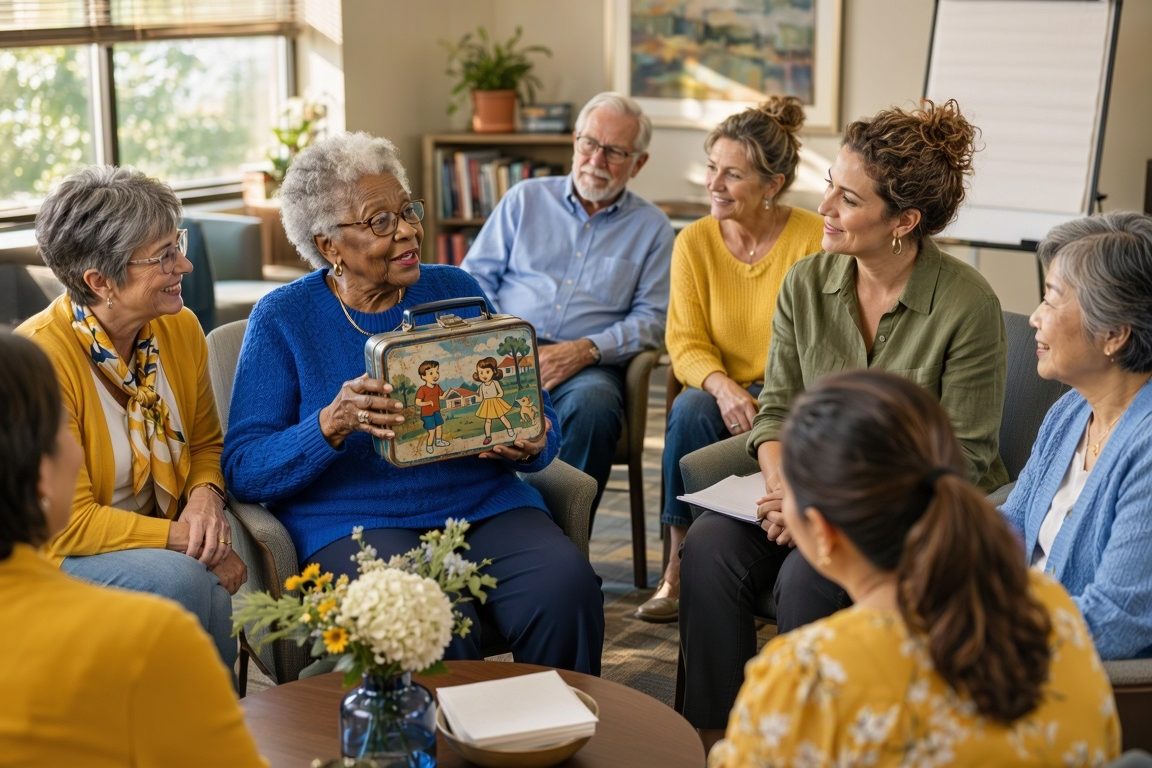
Step by step
What not to do
- Do not force participation or quiz your loved one on memories. This can cause frustration and anxiety, undermining the positive intent.Instead, let the facilitator guide the conversation and allow your loved one to share at their own pace.
- Do not correct your loved one if they misremember a detail. The goal is connection, not accuracy. Correcting can damage their confidence and the warm atmosphere.Instead, acknowledge their memory with a nod or a gentle 'That's a wonderful story.'
- Do not expect dramatic improvements in cognition or daily function. The evidence shows small effects on quality of life and communication, not on memory scores or independence. Setting realistic expectations prevents disappointment and allows you to appreciate the subtle benefits.
- Do not attend a group that is not specifically designed for dyads. Some reminiscence groups are only for people with dementia, without caregiver involvement. For the joint benefit, the group must include both of you together. Ask the organizer explicitly.
- Do not ignore your own needs as a caregiver. If the group triggers sadness or grief about your loved one's decline, that is normal. Allow yourself to feel it, and consider joining a separate caregiver-only support group to process these emotions. Many programs offer both.
- Do not assume one type of group works for everyone. If your loved one has a different type of dementia (e.g., Lewy body or frontotemporal), the group's structure may need adjustment. Discuss with the facilitator whether the group can adapt to your loved one's specific needs, such as sensitivity to noise or changes in social behavior.
Key points
- Joint reminiscence groups can improve quality of life, communication, and mood for both the person with dementia and the caregiver, though the effect size is small.
- Choose a group specifically designed for dyads (person with dementia and caregiver together), led by a trained facilitator.
- Prepare your loved one with positive, inviting language, avoid asking 'Do you want to?', and use a memory box or photo album to build comfort.
- Do not correct or quiz your loved one; the goal is connection, not accuracy.
- Use the group as a way to connect with other caregivers for mutual support, both in person and online.
- If the group isn't a good fit, try a different type of group or a smaller, more personalized setting.
Videos
 Using Reminiscence Therapy To Help Dementia PatientsThis video demonstrates practical examples of reminiscence prompts and how to engage a person with dementia in a group or one-on-one setting, which is directly applicable to joint groups.
 Caregiver Stress and Depression, Dr. Helen Lavretsky - UCLAMDChatThis video addresses caregiver stress and the importance of self-care, which is crucial when participating in joint groups that may evoke strong emotions.
 How Does Dementia Assistance Help Relieve Caregiver Stress?This video explains how community programs, including support groups and respite care, can reduce caregiver burden, key context for why joint groups can be beneficial.
 4 Most Common Types of Dementia in AgingUnderstanding the different types of dementia helps you tailor the reminiscence group experience to your loved one's specific needs, as discussed in the personalization section.
2 more videos
 Ambiguous Loss in a Time of Pandemic with Pauline BossThis video explores the emotional experience of ambiguous loss, which is common for caregivers in joint groups, helping you process feelings of grief while still connecting with your loved one.
 How Do You Get Specialized Support For Mixed Dementia?This video provides guidance on finding specialized support, including groups that may be appropriate for mixed dementia, which is relevant if your loved one has a complex diagnosis.
Background
What Are Joint Reminiscence Groups and Why Do They Work?
Joint reminiscence groups are structured sessions where people with dementia and their family caregivers meet together to recall and share memories from the past. Unlike individual reminiscence therapy, these groups involve multiple dyads, creating a social environment that taps into long-term memories, which are often better preserved in early to moderate dementia. The REMCARE study, a large pragmatic trial, found that these groups probably offer a slight benefit immediately after the program and at later follow-up, particularly for community-dwelling participants. The effect size is small, but the real value lies in the shared experience: caregivers and their loved ones engage in a positive, meaningful activity together, which can improve communication and mood for the person with dementia.
Why This Matters for the Caregiver-Person with Dementia Dyad
For caregivers, these groups provide a rare opportunity to interact with their loved one in a structured, positive context, rather than focusing on daily challenges or losses. The group format also connects you with other caregivers who understand your journey, reducing feelings of isolation. For the person with dementia, the group offers a safe, supportive environment where they can interact with peers, feel valued, and engage in activities tailored to their abilities. The focus on long-term memories, often from childhood or early adulthood, can bring comfort and joy, as these memories are typically the last to fade. While the evidence shows no clear effect on daily functioning or agitation, the improvement in quality of life and communication is a meaningful gain for both partners in the dyad.
What to Expect in a Typical Session
Sessions usually last about 60 to 90 minutes and are led by a trained facilitator, such as an occupational therapist, social worker, or dementia care specialist. Each meeting centers on a theme, like school days, holidays, or first jobs, using prompts such as photographs, music from the era, familiar objects, or even food. The facilitator guides the group to share memories in a non-judgmental way, encouraging everyone to participate at their own comfort level. For the person with dementia, the emphasis is on enjoyment and connection, not on accurate recall. Caregivers are encouraged to listen and share their own memories, but also to support their loved one gently if they become confused or frustrated. The goal is to create a positive, affirming experience for both.
Practical tools
6
Memory Box or Life Story Book
Create a small box or book with photographs, ticket stubs, a favorite song lyric, or a fabric swatch from a meaningful event. Use this at home before the group to practice reminiscing. For example, hold up a photo and say 'This is from our trip to the lake, what do you remember about that day?' This builds comfort and gives the facilitator a sense of your loved one's interests.
Positive Communication Scripts
Use these phrases to invite your loved one to the group: 'I have something special to show you, come with me!' or 'We're going to a place where we'll listen to old music and have a good time.' Avoid questions that start with 'Do you want to...' as they often trigger a 'no.' Instead, use declarative, inviting statements.
The 'One Good Moment' Reflection
After each group session, ask your loved one one simple question: 'What was the best part today?' If they can't answer, share your own: 'I loved hearing that story about your first car.' This reinforces the positive experience and helps both of you carry the joy forward.
Online Peer Support Groups
Join a Facebook group like 'Dementia With Grace Caregiver Support Group' or the Alzheimer's Association online community. These groups often have members who have tried joint reminiscence groups and can offer local recommendations, tips for handling specific challenges, and emotional support. They are as effective as in-person groups for many caregivers.
Respite Care Backup Plan
If your loved one is having a bad day and cannot attend, have a backup plan. Arrange for a trusted friend or family member to stay with them, or use a local respite care service. This ensures you can still attend the group yourself if needed, or simply take a break. The Alzheimer's Association Community Resource Finder can help locate respite services.
Facilitator Communication Checklist
Before joining, ask the facilitator: '
' This helps you choose a group that matches your needs and ensures a safe, supportive environment.
Different situations
For a person with Lewy body dementia
Be aware that visual hallucinations or sensitivity to noise may be present. Choose a group with a calm, quiet setting and a facilitator experienced with Lewy body dementia. Avoid groups that use loud music or many visual stimuli. The focus should be on gentle conversation and simple prompts, like a single photograph or a familiar scent.
For a person with frontotemporal dementia (behavioral variant)
This type often affects social behavior and empathy. The person may not engage in typical reminiscing or may make inappropriate comments. A group with a flexible facilitator who can redirect gently is essential. Consider a smaller group (2-3 dyads) to reduce overstimulation. The focus may need to be on concrete, sensory prompts rather than abstract memories.
For a spouse caregiver vs. an adult child caregiver
Spouse caregivers often have a deeper shared history, which can make reminiscing more natural but also more painful if the spouse feels they are 'losing' their partner. Adult children may need to rely on stories from their parent's earlier life (before they were born) and may benefit from bringing a photo or object from that era. Both roles benefit from separate caregiver support groups to process their unique grief.
For a person in a memory care facility
If your loved one lives in a facility, ask the activities director if they offer joint reminiscence groups for residents and family. These may be scheduled during visiting hours. You can also request a private reminiscence session with your loved one using a memory box. The facility may have a social worker who can facilitate.
For a person with severe communication difficulties (late moderate stage)
Focus on sensory prompts like music, scents (e.g., fresh bread, lavender), or tactile objects (e.g., a soft blanket, a wooden toy). The group may need to be shorter (30 minutes) and more structured. The caregiver's role becomes more active, narrating memories gently while the person with dementia listens or responds non-verbally. The goal is comfort and connection, not verbal recall.
For the doctor
4
- Ask your doctor if a joint reminiscence group is safe and appropriate given your loved one's current health status, especially if they have a history of agitation, anxiety, or recent behavioral changes.
- Discuss any medications that might affect mood or alertness during group sessions. Some medications can cause drowsiness or dizziness, which may interfere with participation.
- If your loved one has a diagnosis of mixed dementia (e.g., Alzheimer's and vascular dementia), ask if the group facilitator has experience with this combination, as symptoms may fluctuate more.
- Inquire about the group's approach to handling medical emergencies, such as a fall or sudden confusion, and whether a healthcare professional is present or on call.