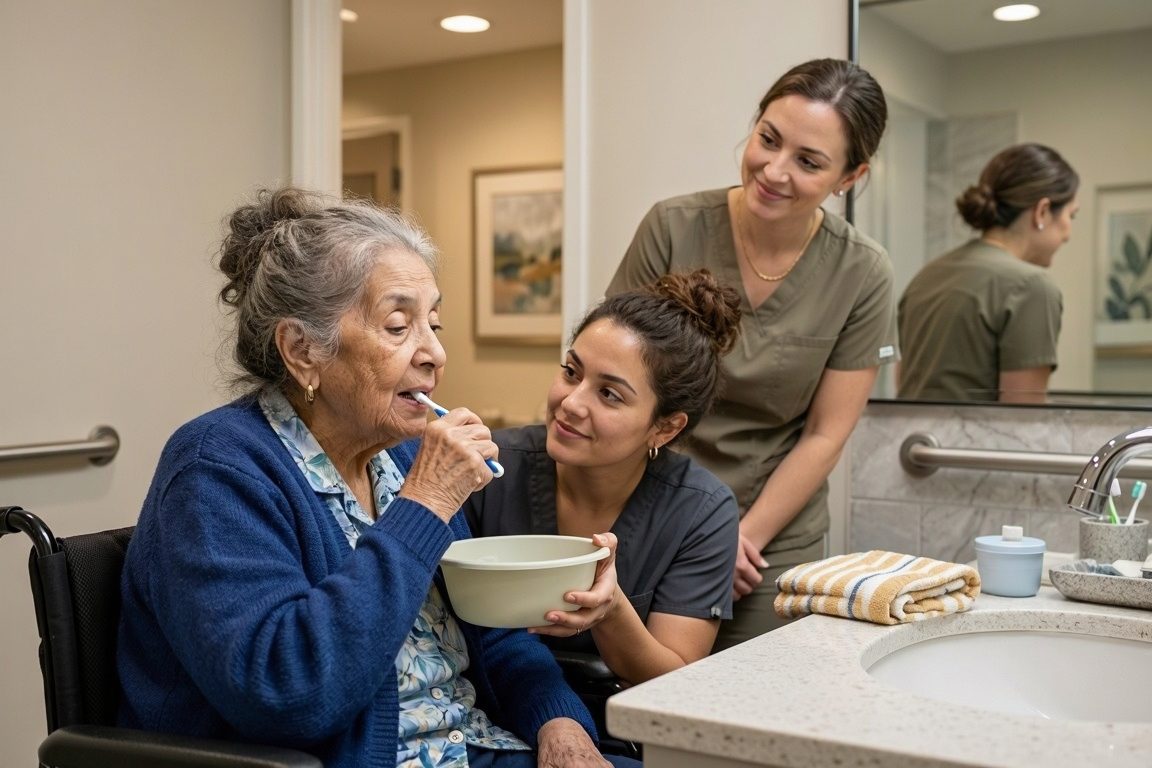
What not to do
- Do not assume residents who refuse care are being difficult; assess for sensory or cognitive causes like fear of items near the face.
- Do not skip oral care when a resident is agitated; try a slower approach or break the task into smaller steps.
- Do not use standard toothbrushes for residents with advanced dementia; prefer soft, angled or three-sided brushes when tolerated.
- Do not rely only on verbal instructions; use hand-over-hand guidance or visual demonstration instead.
Key points
- Appoint a dedicated Clinical Nurse Consultant or champion to lead oral health training, audits, and care plan updates.
- Use a simple monthly oral health audit tool to track progress and identify areas for improvement.
- Train all staff in a calm, person-centered approach: approach from the front, use simple phrases, and avoid TV as a distractor.
- Stock the right tools: soft toothbrushes, oral swabs, mouth props, denture cups, and saliva substitutes.
- Document everything in the care plan and daily records to ensure consistency and accountability.
- Involve families and professional dentists to create a team approach that respects the resident's preferences and dignity.
Videos
 Oral Care Tips for Loved Ones with DementiaThis video demonstrates gentle, practical techniques for providing mouth care to someone with dementia, including how to use a mouth prop and calming phrases.
 Home Health vs Palliative Care vs Hospice for Dementia Patients with Candance RamosUnderstanding the different care levels helps you know when to shift oral health goals from maintenance to comfort, especially in later stages.
 Loss of Appetite in DementiaOral pain is a common hidden cause of appetite loss. This video helps you connect mouth care to nutrition and overall well-being.
Background
Why oral health matters so much for dementia residents
Residents in aged care facilities, especially those living with dementia, often have a high number of oral health problems. Poor dental health can lead to pain, infections, difficulty eating, and even worsen behavioral expressions like agitation or refusal to eat. When a resident cannot communicate discomfort, a sore tooth or ill-fitting dentures may show up as shouting, hitting, or withdrawing from meals. The mouth is also a gateway to overall health: untreated gum disease and tooth decay can contribute to pneumonia and other serious infections. For someone with dementia, maintaining oral health is not just about a nice smile, it is about comfort, nutrition, and quality of life.
What the evidence tells us about making it work
Research in Australian residential aged care facilities shows that improving oral health care requires more than just telling staff to brush teeth. A successful program includes specialized training for a Clinical Nurse Consultant, regular oral health audits, and training all facility staff in how to use an oral audit tool. When these elements were put into practice, care plans became more comprehensive and better quality. Staff reported seeing real improvements in residents' oral health, including increased use of oral swabs and saliva substitutes, better care of dentures, and mention of mouth props in care plans. Importantly, these changes appeared to be sustainable over time. The key is not a one-off training session but embedding oral health into the everyday routines and documentation of the facility.
The unique challenges of dementia that affect mouth care
Dementia changes how a person experiences care. They may forget what a toothbrush is for, feel threatened by something coming toward their face, or be unable to cooperate with opening their mouth. The three most intimate things we do for another person are eating, drinking, mouth care, and toileting, yet we receive very little preparation for how to maintain a trusting relationship during these moments. People with dementia keep some skills and lose others, so the more we tune in to what they can still do and what they are missing, the better we can match our approach. For example, a person in early stages may be able to brush their own teeth with verbal cues, while someone in later stages may need full assistance and a mouth prop to keep their mouth open safely.
Practical tools
3
Oral Health Assessment Tool (OHAT)
Validated tool for non-dental staff to routinely evaluate oral health in aged care residents.
Soft, angled or three-sided toothbrush
Designed to reduce gagging and improve plaque removal with minimal cooperation.
Fluoride varnish application kit
Non-invasive topical fluoride applied during personal care to prevent decay in residents who cannot manage toothpaste.
Different situations
For residents in early-stage dementia (mild cognitive decline)
Focus on supervision and verbal prompting rather than full assistance. The resident may still be able to brush their own teeth if you set out the toothbrush with toothpaste already on it and say, 'Time to brush your teeth. Start with the front ones.' Use a mirror so they can see what they are doing. Praise each step: 'Great job brushing your top teeth. Now let's do the bottom.'
For residents in moderate to late-stage dementia
Full assistance is usually needed. Use a mouth prop to keep the mouth open safely. Switch to oral swabs if the resident bites or clamps shut. Be prepared for resistance, it is often a sign of fear or pain, not stubbornness. Slow down, use calming music, and consider doing mouth care in small sessions (e.g., just the front teeth now, sides later).
For residents with Lewy body dementia or Parkinson's disease
These conditions often cause rigidity and difficulty opening the mouth. Use a very soft toothbrush or swab. Be gentle and patient. Avoid sudden movements. The resident may also have a strong gag reflex, use a small amount of toothpaste and avoid brushing the back of the tongue. Consider a saliva substitute because these conditions often cause dry mouth.
For residents who are at the end of life (palliative or hospice care)
Oral care focuses on comfort, not plaque removal. Use a moistened swab to gently clean the mouth and lips. Apply a lip balm to prevent cracking. Offer ice chips or a cold, wet cloth to suck on if the resident can swallow safely. The goal is to prevent pain and dryness, not to achieve a perfect clean. Document any signs of oral pain and discuss with the hospice team.
For facilities with limited budget or staff
Start small. Choose one unit or one shift to pilot the program. Train one champion per shift. Use free audit tools available from dental associations. Partner with a local dental school or hygienist program for volunteer visits. Focus on the highest-impact changes: daily denture cleaning, use of saliva substitutes, and consistent care plans. Even small steps make a difference.
For the doctor
4
- Ask the facility's medical director or GP: 'What is the protocol for prescribing antibiotics for a resident with a suspected dental abscess who cannot tolerate a dental visit?'
- Discuss with the pharmacist: 'Are any of our residents on medications that cause dry mouth (e.g., anticholinergics, diuretics)? Can we review alternatives or add a saliva substitute to their medication chart?'
- Ask the dentist: 'Can you provide a written recommendation for mouth props or oral swabs for residents who resist brushing? Are there any contraindications for specific residents?'
- For residents with swallowing difficulties: 'Should we use a fluoride varnish instead of toothpaste to reduce the risk of aspiration?'