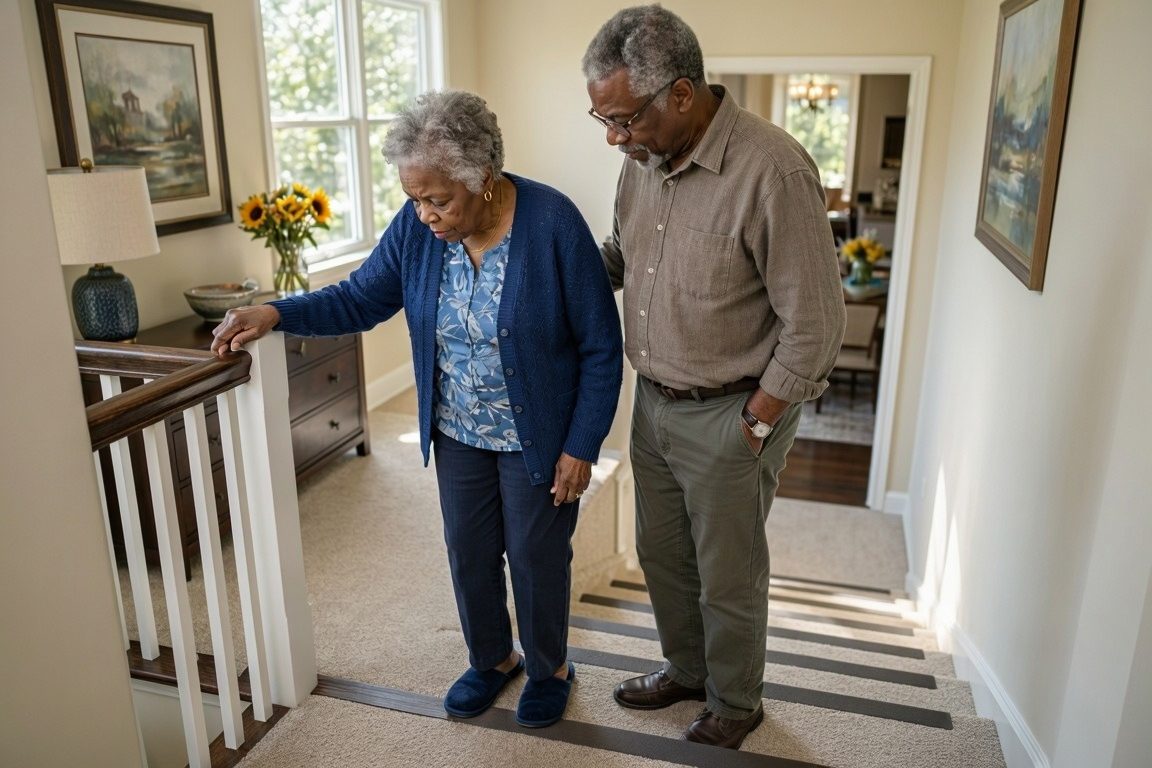
Step by step
What not to do
- Do not use busy patterns on floors, walls, or bedding. These can be misinterpreted as moving objects or holes, causing confusion and falls.Instead, use solid, neutral colors that provide clear visual boundaries.
- Do not rely on the person's own perception of depth or distance. They may not see a step or a curb even if they think they do. Always assume they need visual cues and physical support near transitions.
- Do not rearrange furniture frequently. People with PCA rely on spatial memory and consistent visual landmarks. Moving furniture can cause disorientation and increase fall risk. Keep the layout stable.
- Do not use dim or flickering lights. Poor lighting creates shadows that can be misinterpreted as obstacles. Use consistent, bright, diffused lighting throughout the home.
- Do not leave loose rugs or mats in walkways. Even if they are non-slip, the visual contrast between the rug and the floor can be confusing. Remove all area rugs from high-traffic areas.
- Do not expect the person to use a standard walking aid without training. A cane or walker may be difficult to see or coordinate. Work with an occupational therapist to find the right aid and practice using it in the home.
Key points
- PCA vision loss is a brain processing issue, not an eye problem; modify the environment to support the brain's remaining abilities.
- High contrast (e.g., yellow tape on stairs, bright door frames) is the most effective visual cue for navigation.
- Eliminate confusing patterns, clutter, and shadows that can be misinterpreted as holes or moving objects.
- Use the 'lighthouse scanning' technique to help the person systematically scan their surroundings.
- Consistency is key: keep furniture and room layouts stable to rely on spatial memory.
- Supervise during high-risk activities like stairs, bathroom use, and transitions in lighting.
Videos
 Steady Steps: Practical Strategies for Managing Falls in DementiaProvides general fall prevention strategies that can be adapted for PCA, including home modification tips and the importance of supervision.
 Posterior Cortical Atrophy Lecture Series with Karen HookstadtDirectly addresses PCA-specific visual deficits and offers practical strategies like using a lighthouse scanning technique and following a brightly colored shirt for navigation.
 How Do You Ensure Home Safety For Dementia Patients? - Dementia Help HubCovers essential home safety modifications such as removing loose rugs, installing grab bars, and using night lights, all applicable to PCA.
 Home Safety For Your Loved OnesOffers a broad overview of home safety, including tips on lighting and clutter reduction that are critical for PCA vision loss.
2 more videos
 PCALECTURE with UCSD neurologist Dr. Douglas GalaskoExplains the neurological basis of PCA and how vision loss progresses, helping caregivers understand why specific modifications are needed.
 PCA LECTURE SERIESIncludes discussion of environmental cues, visual scanning strategies, and the importance of using contrasting colors to aid navigation.
Background
What is happening with PCA vision loss?
Posterior cortical atrophy affects the back part of the brain that processes visual information. Unlike typical age-related vision changes, PCA causes the brain to misinterpret what the eyes see. A person may have 20/20 eyesight but still struggle to recognize objects, judge distances, or see where one surface ends and another begins. For example, a black-and-white checkered floor may look like a series of holes or moving patterns, and a dark rug on a light floor might appear as a drop-off. This is not a problem with the eyes themselves but with the brain's ability to make sense of visual input.
Why does this increase fall risk?
Because the brain cannot accurately process depth, contrast, and spatial relationships, a person with PCA may misjudge the location of a step, the edge of a curb, or the distance to a handrail. They may also have difficulty seeing objects in their peripheral vision, leading to collisions with furniture or walls. The brain may also interpret busy patterns or shadows as moving objects, causing startle reactions or loss of balance. Falls often happen during transitions, like going from a well-lit room to a dim hallway, or when navigating stairs where the visual cue of the railing end is missed.
Reassurance: You can adapt the environment
The good news is that many fall risks can be reduced by modifying the home to support the brain's remaining visual strengths. Using high-contrast colors, reducing clutter, improving lighting, and adding clear visual cues can help a person with PCA navigate more safely. Occupational therapists often recommend a 'lighthouse visual scanning strategy' where the person learns to scan the environment in a systematic way, like a lighthouse beam, to find landmarks and avoid obstacles. With patience and the right changes, you can create a space that feels less confusing and more secure.
Practical tools
6
High-contrast stair tape
Use 2-inch wide yellow or red tape on the edge of each step. Apply it to both the tread and the riser for maximum visibility. Replace when worn. This provides a clear visual cue for where the step ends.
Motion-sensor night lights with red bulbs
Place these along the path to the bathroom and in hallways. Red light preserves night vision and reduces glare. Choose lights that automatically turn on when movement is detected.
Lighthouse scanning practice card
Create a small card with the words 'Scan left to right like a lighthouse' and place it near frequently used doors. Practice the scanning technique together daily until it becomes a habit.
Brightly colored grab bars and toilet seat
Install grab bars that contrast with the wall color (e.g., white bars on a dark wall). Use a brightly colored raised toilet seat to make it easier to see and aim for. This reduces the visual search time and confusion.
Contrasting cutting boards and kitchen tools
Use a white cutting board for dark foods (like grapes or meat) and a dark board for light foods (like bread or cheese). This helps the person see what they are cutting and reduces the risk of cutting themselves.
Tactile floor markers at transitions
Place a textured mat or a strip of rough tape at the top and bottom of stairs, and at doorways. This gives a physical cue that the surface is changing, which can alert the person to slow down and look.
Different situations
Early-stage PCA (still able to read and recognize faces)
Focus on visual scanning training and using high-contrast cues for stairs and doorways. The person may still be able to use a smartphone with large-font settings for navigation reminders. Encourage them to practice the lighthouse scanning technique in new environments.
Late-stage PCA (unable to read, difficulty recognizing faces, may use hands to eat)
Simplify the environment even further. Remove all clutter, use only solid-colored surfaces, and rely on tactile cues (e.g., textured mats at transitions). Supervision during all mobility is essential. Consider using a gait belt or a wheelchair for safety. The person may need to eat from a plate with a dark rim to see the food.
Caregiver is a spouse vs. adult child
A spouse may need to balance safety with maintaining intimacy and independence. Involve the person with PCA in decisions about modifications. An adult child may have more authority to make changes but should approach with sensitivity. Both should consider joining a support group for PCA caregivers to share strategies.
Living in a facility (assisted living or nursing home)
Work with the facility's occupational therapist to ensure the room has high-contrast edges on furniture, a clear path to the bathroom, and consistent lighting. Request that staff use the lighthouse scanning technique when guiding the person. Bring familiar high-contrast items from home to reduce disorientation.
Limited budget or Medicaid coverage
Many modifications are low-cost: use painter's tape for stair edges, move furniture to clear paths, and use free apps on a tablet for visual scanning practice. Contact your local Area Agency on Aging or senior center for free fall prevention programs and possible funding for grab bars or ramps. Some nonprofits build ramps at reduced cost.
For the doctor
5
- Ask your doctor or occupational therapist about a formal home safety assessment to identify specific fall risks related to PCA vision loss.
- Discuss whether a walking aid (cane, walker) is appropriate and how to train the person to use it safely given their visual processing challenges.
- Ask about vision rehabilitation services or low-vision clinics that specialize in PCA. They may offer specialized training in scanning techniques and adaptive equipment.
- If the person is experiencing depression or anxiety related to vision loss, discuss treatment options. Depression can worsen cognitive symptoms and increase fall risk.
- Ask about medications that may help with PCA symptoms (e.g., Alzheimer's medications or treatments for associated conditions like Lewy body dementia) and their potential side effects on balance or vision.