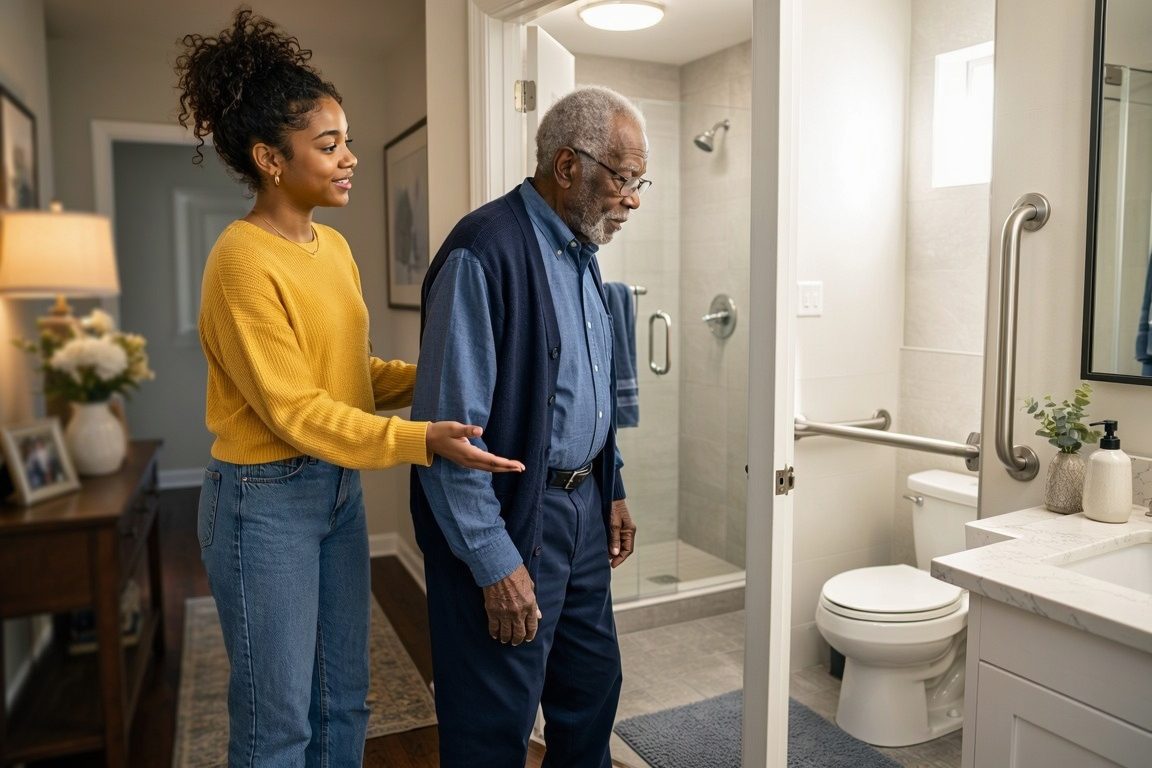
Step by step
What not to do
- Do NOT ask 'Do you need to go to the bathroom?' expecting a reliable answer. This puts the burden on a brain that can't process the question.Instead, use a scheduled routine or a gentle indirect cue like 'Let's go wash up.'
- Do NOT argue or remind them they just went. Saying 'But you just went 10 minutes ago' will only frustrate and embarrass them.Instead, simply say 'Let's go check' and guide them. Their sense of time is distorted.
- Do NOT rush or show frustration. If you are hurried or tense, they will pick up on your body language and become anxious or resistant. Take a deep breath, slow down, and use a calm, warm tone. Your calmness is contagious.
- Do NOT leave them alone in the bathroom if they are unsteady or confused. Falls are common. Stay within arm's reach, and use a commode chair or bedside toilet at night to reduce the risk of falls on the way to the bathroom.
- Do NOT use complicated instructions like 'First pull down your pants, then sit down, then wipe, then stand up and flush.' Break it into single steps: 'Pull down your pants' (wait), 'Now sit down' (wait), 'Now wipe' (wait), etc. Overloading them causes shutdown.
- Do NOT ignore signs of infection or pain. If they suddenly become more resistant to toileting, or if you notice changes in urine color, odor, or frequency, discuss with their clinician. Urinary tract infections can cause confusion and incontinence.
Key points
- Never ask 'Do you need to go?', use a scheduled routine or indirect cue like 'Let's go wash up.'
- Break instructions into single steps: 'Stand up,' then 'Walk with me,' then 'Sit down.'
- Use visual cues: open bathroom door, picture sign, nightlight.
- Stay calm and use 'we' language to reduce resistance.
- For Parkinson's, schedule toileting after medication and use raised toilet seats and grab bars.
- Track patterns with a toileting log to anticipate needs and adjust the schedule.
Videos
 Dementia Bathroom Tips: How to stop your loved one from having toileting accidentsShows practical, gentle cues and scheduling to prevent accidents.
 How to communicate with a dementia patientTeaches one-step commands and avoiding overwhelming questions.
 How to manage incontinence in dementia patientsCovers products, routines, and when to seek medical help.
 Dementia Toileting problemsAddresses resistance and how to use visual and tactile cues.
2 more videos


Background
Why 'Do you need to go?' doesn't work
For someone with dementia, especially in middle to late stages, the question 'Do you need to go to the bathroom?' is overwhelming. It requires them to recognize an internal sensation (bladder fullness), interpret it as a need, plan a multi-step journey to the toilet, and then decide to act, all while their brain is struggling with memory, sequencing, and insight. Often they simply say 'no' because they don't understand the question, or they feel criticized or rushed. The question also puts them on the spot, making them feel like they're being tested or that they've already failed. Instead of asking, you need to lead with action and invitation, not interrogation.
The real challenge: lost internal cues and initiative
As dementia progresses, the brain loses the ability to sense when the bladder is full or to initiate the trip to the bathroom. The person may not feel the urge until it's urgent, or they may not connect the feeling with the need to find a toilet. They also lose the 'executive function' to plan and sequence the steps: stand up, walk to the bathroom, turn on the light, pull down pants, sit, etc. This is why a scheduled toileting routine, taking them every 2-3 hours whether they ask or not, is so effective. You are providing the external cue their brain no longer supplies. For people with Parkinson's, the added challenge of stiffness, slow movement, and possible orthostatic hypotension (dizziness when standing) makes rushing even more dangerous, so patience and a calm pace are essential.
The power of indirect cues and 'we' language
Instead of a direct question, use a gentle, indirect approach that frames the bathroom visit as a natural part of another activity. For example, after a meal say, 'Let's go wash up before we watch our show,' and walk past the bathroom. Or say, 'Let's pop in here real quick before we head to the living room.' This avoids the 'do you need to' trap and makes the bathroom a routine stop, not a decision. Using 'we' and 'let's' language reduces opposition because it feels collaborative, not commanding. You are not asking them to admit a need; you are simply guiding them through the next step of the day. This works especially well when combined with a visual cue like an open bathroom door or a sign with a picture of a toilet.
Practical tools
6
Exact phrases to use (and avoid)
Instead of 'Do you need to go?' say: 'Let's go to the bathroom now.' 'Time to use the toilet.' 'Let's wash our hands.' 'Let's pop in here before we sit down.' 'Let's freshen up.' 'Let's go check the bathroom.' For Parkinson's, add: 'Let's take our time and walk slowly.' Avoid: 'Do you need to pee?' 'Did you have an accident?' 'You should have gone earlier.'
Visual cue: bathroom sign and open door
Place a large, simple sign on the bathroom door with a picture of a toilet (not just words). Leave the bathroom door open during the day so the toilet is visible from the hallway. At night, use a nightlight in the bathroom and a clear path. For memory care facilities, ensure the door is a contrasting color to the wall so it stands out.
Raised toilet seat and grab bars
A raised toilet seat (2-4 inches high) makes sitting and standing easier for people with Parkinson's, arthritis, or general weakness. Install grab bars on both sides of the toilet for stability. A bedside commode can be placed in the bedroom at night to reduce fall risk. Discuss with an occupational therapist for the best setup.
Moist flushable wipes and disposable gloves
Use fragrance-free, flushable wipes for cleaning after toileting. They are gentler and more effective than dry toilet paper, and they help maintain hygiene. Keep a box of disposable gloves nearby for the caregiver to use when assisting. For facility staff, ensure wipes are stocked in each bathroom.
Toileting log template
Create a simple log with columns: Time, Cue used (e.g., 'Let's go to bathroom'), Result (success/accident/refusal), Notes (e.g., 'seemed tired'). Review weekly to adjust the schedule. Example: 8:00 AM - 'Time to use toilet' - success - no notes. 10:30 AM - 'Let's wash hands' - success - walked willingly.
Calming environment checklist
Ensure the bathroom is warm (cold can cause resistance), well-lit (use 100-watt equivalent bulbs), and free of clutter. Use a non-slip bath mat. Play soft music if they are anxious. For Parkinson's, ensure there is a chair or bench in the bathroom for resting if needed.
Different situations
Middle-stage dementia (still verbal but confused)
Use more indirect cues like 'Let's go check the mail' and then walk past the bathroom. They may still respond to a schedule but need reminders. Avoid any language that implies they forgot. Use a timer to prompt you, not them.
Late-stage dementia (limited speech, needs full assistance)
Use tactile cues: gently guide them by the hand or arm. Say only one or two words: 'Bathroom' or 'Toilet.' Use a bedside commode or adult briefs (discuss with clinician). Focus on comfort and dignity. For Parkinson's, be very slow and allow extra time for stiffness.
Parkinson's disease (with dementia)
Schedule toileting after medication doses when mobility is best. Use a raised toilet seat and grab bars. Watch for orthostatic hypotension, help them stand slowly and sit immediately if dizzy. Use a commode chair in the bedroom at night. Avoid rushing at all costs.
Memory care facility setting
Coordinate with staff to ensure consistent cues and schedule. Place a sign with a picture on the resident's bathroom door. Use a 'toileting log' that travels with the resident. Train all staff on the specific phrases that work for that person. For facility-wide approach, use scheduled toileting rounds every 2 hours.
Spouse vs. adult child caregiver
Spouses may find it easier to use intimate language like 'Let's go freshen up, honey.' Adult children may need to be more formal and respectful to avoid role reversal resistance: 'Dad, let's go to the bathroom before we go for a walk.' Both should avoid any tone of criticism or impatience.
For the doctor
4
- If your person is having frequent accidents despite a toileting schedule, ask the doctor about possible urinary tract infection, constipation, or medication side effects.
- If they are resistant to all toileting cues and become aggressive, discuss with a dementia specialist or behavioral health clinician for additional strategies or medication adjustments.
- If you are considering using adult briefs (diapers) or a catheter, consult with a nurse or doctor about the best product and how to prevent skin breakdown and infections.
- If the person has Parkinson's and is experiencing freezing (sudden inability to move) on the way to the bathroom, ask a physical therapist for strategies like rhythmic cues or a laser pointer to step over.