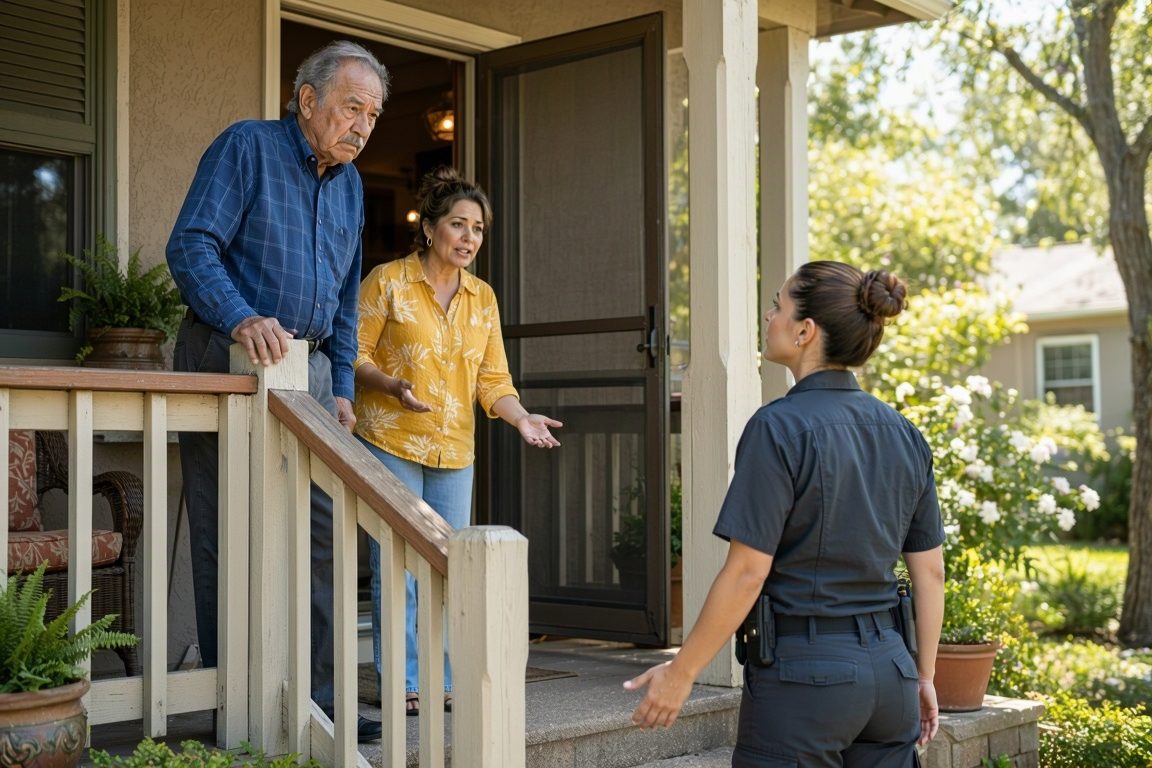
Step by step
What not to do
- Do not yell or speak loudly. A loud voice signals danger to a person with dementia, not authority.Instead, use a soft, low, and slow tone. If they cannot hear you, move closer slowly rather than raising your voice.
- Do not ask 'Do you remember me?' or 'I already told you that.' This tests their memory and makes them feel ashamed and defensive.Instead, reintroduce yourself each time: 'It's Officer Dan again. I'm still here to help.'
- Do not argue with delusions or hallucinations. Saying 'That's not real' or 'No one is there' will only increase their fear and distrust.Instead, validate the emotion: 'I can see you are frightened. I am here with you.'
- Do not initiate physical contact during an outburst. Grabbing their arm or shoulder to restrain them will escalate aggression.Instead, step back, give space, and wait for them to calm down before attempting any touch.
- Do not leave weapons, sharp objects, or medications in plain sight. If you see a gun or knife in the room, calmly and slowly move it out of reach without drawing attention. Do not make a sudden grab for it.
- Do not use complex sentences or multiple commands. Saying 'I need you to sit down, take a deep breath, and tell me what happened' is too much.Instead, say one thing at a time: 'Please sit down.' Wait. Then: 'Take a breath.'
Key points
- Slow down your approach, voice, and movements, speed signals danger to a person with dementia.
- Use gentle eye contact, a soft tone, and simple one-step commands. Never test memory or argue with delusions.
- Validate their feelings, not the facts. Say 'That sounds scary' instead of 'That is not real.'
- Check physical needs first: pain, hunger, thirst, bathroom, temperature. These are common triggers.
- If aggression escalates, step back, give space, and identify your exit. Do not initiate physical contact during an outburst.
- Build relationships with local dementia care experts and families before emergencies. A known face can prevent a crisis.
Videos
 What Are Some Common Behaviors Seen In A Person With Dementia?Helps first responders recognize common dementia behaviors like wandering, agitation, and repetition, so they can identify the condition quickly and adjust their approach.
 SUP! Creating Partnerships with First RespondersShows how to build ongoing relationships with local dementia experts and families, which is key for effective pre-planning and trust during emergencies.
 How to Deal with Aggressive Dementia Patients (4 Strategies)Provides four concrete levels of approach for aggressive behavior, from verbal de-escalation to safe physical intervention, directly applicable to first responder scenarios.
 10 Tips For Responding To Anger in DementiaOffers practical tips for responding to anger without escalating, including the importance of not taking behavior personally and using distraction techniques.
2 more videos
 How to stay safe in a dementia emergencyFocuses on safety for both the responder and the person with dementia, covering scene assessment, exit planning, and when to call for backup.
 Multimodal Comprehensive Care Communication Skills in Dementia CareTeaches how to use touch, eye contact, and simple language together to communicate effectively with someone who has dementia, even when they are distressed.
Background
Why Standard First Responder Tactics Fail in Dementia
A person with dementia is not being deliberately difficult or aggressive. Their brain is physically changing, and the part that handles reasoning, impulse control, and understanding complex language is damaged. When you arrive with lights flashing, a loud voice, and rapid commands, you are not communicating authority, you are triggering a primal fear response. The person cannot process that you are there to help. Instead, they may see a stranger who is loud, fast, and unpredictable, which can make them feel trapped, confused, and defensive. Their aggression is not a choice; it is a reaction to feeling threatened and overwhelmed.
The First Few Seconds Set the Tone
The moment you step out of your vehicle, the person with dementia is already reading your body language, tone, and speed. If you move quickly, speak loudly, or tower over them, you will escalate the situation before you say a word. The goal is to signal safety, not control. This means slowing your movements, lowering your voice, and giving the person space to see that you are not a threat. Remember: they are not giving you a hard time, they are having a hard time. Your job is to become a calming presence, not an enforcer.
What Is Really Going On Inside Their Mind
The person may be in pain, hungry, thirsty, or need to use the bathroom. They may be reacting to a shadow that looks like a person, a sound that seems like an attack, or a memory that feels like it is happening right now. They cannot tell you this in a logical way. Instead, they act out, yelling, hitting, or running. As a first responder, you must shift from asking 'what is wrong with them' to asking 'what is happening for them.' Look for clues: Are they grabbing their stomach? Pointing at a window? Trying to leave? These are not random behaviors; they are messages.
Practical tools
6
The 'I'm Listening' Script
A set of phrases to use when the person is agitated: 'I can see you are upset. I am here to help.' 'Tell me what is bothering you.' 'I am listening. You are safe now.' 'Let's figure this out together.' Repeat these slowly, with eye contact and a gentle touch if safe. This script works because it validates feelings without challenging reality.
The 'Join the Search' Technique
If the person is looking for someone or something that is not there, do not argue. Instead, say 'Let's look together.' Walk with them, look in the same direction, and say 'I don't see them right now, but I will help you look.' This reduces opposition and builds trust because you are on their team. After a few minutes, gently redirect to a different activity like offering a snack or looking at a photo album.
The 'Check the Basics' Checklist
A mental or physical card to run through:
Addressing these can resolve agitation without any verbal de-escalation.
The 'Slow Approach' Positioning
Before you speak, position yourself at eye level, at least six feet away, and slightly to the side (not directly in front). Keep your hands visible and relaxed at your sides or in your lap. Avoid crossed arms, hands on hips, or a clenched jaw. This posture signals 'I am not a threat' and gives the person time to process your presence.
The 'One-Step Command' Card
A small card you can carry that lists examples: 'Please sit.' 'Take a sip of water.' 'Look at me.' 'Breathe slowly.' Use only one command at a time. Wait at least 10 seconds for a response. If they do not respond, repeat the same command in the same tone. Do not add more words.
The 'Safe Exit' Plan
Before any interaction, note the nearest exit, any furniture you can put between you and the person, and any objects that could be used as weapons (lamps, chairs, knives). If the person escalates, you can step back and say 'I need to step outside for a moment. I’ll be nearby if you need me.' This gives you a safe way to disengage without confrontation.
Different situations
Lewy body dementia (LBD)
People with LBD often have visual hallucinations, severe sensitivity to medications (especially antipsychotics), and sudden changes in alertness. Do not assume a hallucination is a delusion, it may be very real to them. Use the 'join the search' technique. Avoid any physical restraint if possible, as they may have parkinsonism and fall easily. Never give haloperidol or other typical antipsychotics without medical consult; they can cause severe reactions.
Late-stage dementia (bedbound, minimal verbal communication)
The person may not speak or respond to words. Use gentle touch on the hand or shoulder, a soft voice, and slow movements. Check for pain by watching facial expressions (grimacing, furrowed brow) or body tension. Assume they can hear and understand more than they can express. Do not shout. Use a calm, rhythmic tone, and allow extra time for any response.
First responder arriving at a home vs. a facility
In a home, you may have family members who are also distressed. Ask them to step into another room so you can focus on the person with dementia. In a facility, ask staff for the person's baseline behavior, known triggers, and any PRN medications that have been effective. Do not assume facility staff know best, some may be undertrained. Always verify the person's identity and any medical alerts.
Person with a history of violence or known aggression
If dispatch notes a history of aggression, approach with two officers, one on each side, at a distance. Do not box the person in. Use a calm, authoritative but not threatening tone. Have a plan to retreat if needed. Do not use handcuffs unless absolutely necessary for safety, they can cause panic and injury. If restraint is needed, use the least restrictive method and monitor for breathing and circulation.
Person is also hard of hearing or visually impaired
If they wear hearing aids, ensure they are in and turned on. Face them directly so they can read your lips. If they wear glasses, make sure they are clean and on. Use a slightly louder but still calm voice if needed, but do not shout. For visual impairment, announce your presence before touching: 'I am Officer Dan. I am going to touch your arm now.'
For the doctor
4
- Ask the person's doctor or neurologist: 'Could any of their current medications (like anticholinergics, benzodiazepines, or certain antipsychotics) be causing or worsening agitation?' Do not stop or change medications without medical guidance.
- If the person has a history of seizures, stroke, or head injury, ask the clinician: 'How might these conditions affect their behavior, and what first responder protocols should we adjust?'
- For persons with Lewy body dementia, ask the clinician: 'What medications are safe for agitation and hallucinations? I know many standard drugs can be dangerous for them.'
- If the person is on anticoagulants (blood thinners), ask the clinician: 'How should we safely manage any physical restraint or transport to avoid injury?'