Step by step
What not to do
- Do not use long sentences or complex instructions. A common mistake is to say 'Honey, would you like to come over here and sit down in this chair so we can have our lunch together?' That is too many words. Their brain will only catch fragments, and they may feel overwhelmed or tune out.Instead, use three to five words: 'Sit here. Time to eat.'
- Do not use baby talk or a sing-song voice. It may feel loving, but it can feel patronizing and increase confusion. They are an adult, and they deserve an adult tone, warm, respectful, and calm. Speak to them as you would a respected friend who is having a hard day.
- Do not touch them without warning or from behind. A sudden touch can startle them and trigger a fight-or-flight response. Always approach from the front, let them see your hand coming, and announce your touch with a simple word like 'Here' or 'Okay.'
- Do not repeat the same verbal cue over and over if they do not respond. This is called 'verbal perseveration' and it can escalate frustration for both of you.Instead, pause, take a breath, and switch to a visual cue or a touch cue. Try a different approach: show them the object, or gently guide them.
- Do not assume that because they are not looking at you, they are not listening. They may be processing through their other senses. Keep your voice calm and your body language open. Do not raise your volume; speak clearly and at a normal pitch.
- Do not forget to check your own face. If you are frowning, sighing, or looking impatient, they will mirror that distress. Before you interact, consciously soften your face. A gentle smile is a powerful non-verbal cue that says 'I am safe, you are safe.'
Key points
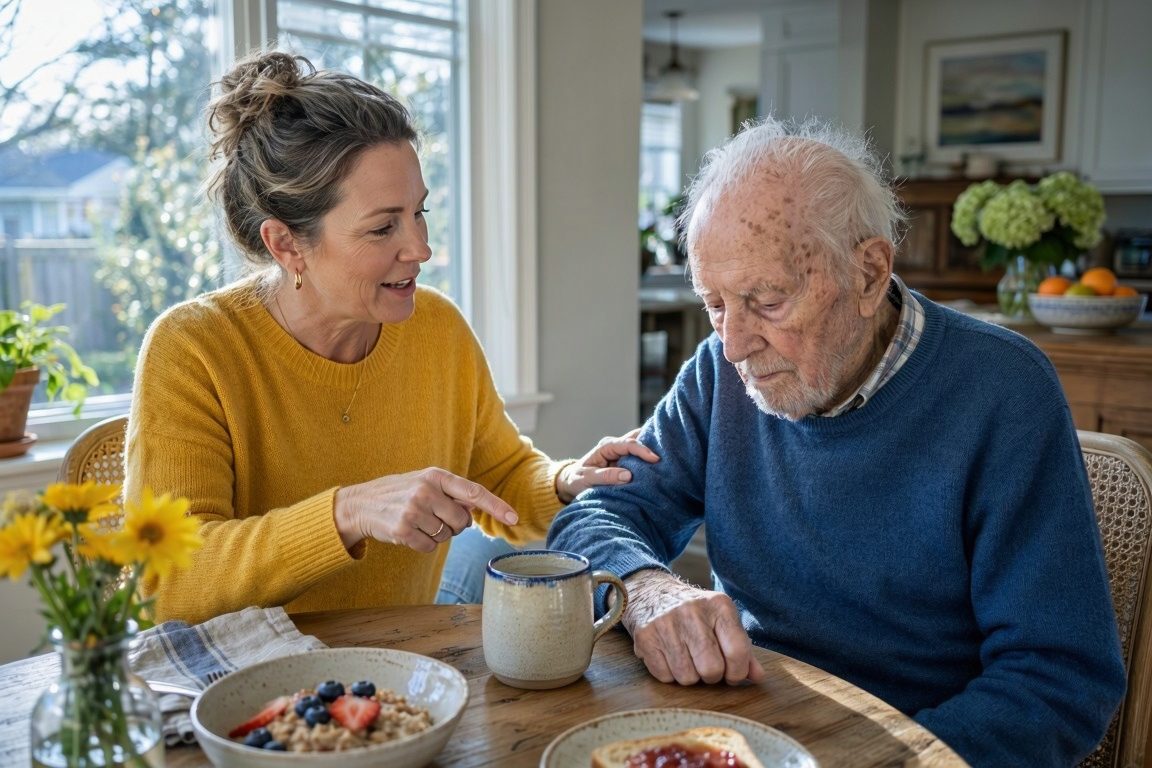
- Cue pairing means using a simple verbal cue, a clear visual gesture, and a gentle touch cue all at the same time, giving the brain three chances to understand.
- Over 90 percent of communication is non-verbal (body language and facial expression). For someone with dementia, that percentage is even higher.
- Keep verbal cues short: two to five words. Use an adult tone, not baby talk.
- Always approach from the front, at eye level, and let them see your hand before you touch.
- Use the actual object as a visual cue whenever possible (hold up the toothbrush, show the cup).
- When they are agitated, drop the words and use only touch and a calm presence. Silence plus presence is a powerful cue pair.
- Check your own face and body language before you interact. They will mirror what you project.
- Humor and laughter are powerful non-verbal connectors. Use them freely.
Videos
 PAC Live @ 5 - Verbal Cues With AmbersThis video directly addresses how to gauge how many words an Amber-stage person still has and how to pair verbal cues with touch and visual cues effectively. It is the core source for this sub-article.
 How to Use a Positive Physical Approach to Assess Abilities with Someone Living with DementiaThis video demonstrates the Positive Physical Approach (PPA), which is the foundation for safe and respectful touch cues. It shows exactly how to approach, where to touch, and how to read the person's response.
 The Baffled Brain: Demystifying Dementia Episode 13 February 20, 2021This episode explains why the brain in dementia processes sensory information differently, reinforcing why cue pairing is so effective. It provides the 'why' behind the 'how.'
 Pamela Mills Associate Director of Care Management for Corewood CarePamela Mills offers practical, real-world advice on using verbal, visual, and tactile cues together, especially for caregivers who are not trained professionals. Her tone is warm and reassuring.
2 more videos
 An Interview with Dr. Jennifer Stelter Co-Founder, CEO, & Creator of the Dementia Connection ModelDr. Stelter discusses the Dementia Connection Model, which emphasizes sensory-based communication. She explains how to use all five senses to connect, not just words.
 Alzheimer's Answers About AgingThis video breaks down the 7-38-55 rule of communication (7% words, 38% tone, 55% body language) and applies it directly to dementia care. It is a great reminder of why non-verbal cues matter so much.
Background
Why Verbal Cues Alone Stop Working
In the Amber stage, a person may still have a few words left, maybe one out of three, maybe one out of two , but it varies wildly from person to person. Someone who was a teacher or a writer might hold onto more words longer. The key is that you cannot assume your words are landing. When you say 'Good morning,' their brain might hear the words but process them as a social script that feels wrong or untrue, and that mismatch can spike their distress. They are not being difficult; their brain is simply no longer wired to decode your stream of words into meaning.
How Sensory Cues Become the Primary Language
Think of how an infant or a toddler learns about the world: through their senses, what they see, hear, smell, taste, and feel. A person in the Amber stage navigates their new world the same way. Their limbic system, which houses mood and memory, is still directly influenced by sensory input from the outside. So a gentle touch on the hand, a warm tone of voice, and a clear visual gesture (like pointing to a cup) can communicate safety, comfort, and a request far more reliably than a long sentence. Over 90 percent of communication is non-verbal anyway , 55 percent body language, 38 percent facial expression, and only 7 percent words. For someone with dementia, that non-verbal percentage becomes even more critical.
The Power of Pairing: Why Combining Cues Works Better Than One Alone
When you pair a verbal cue with a visual cue and a touch cue all at once, you are giving the brain three chances to understand. If the words do not compute, the gesture might. If the gesture is missed, the touch can guide. This is not about bombarding them; it is about redundancy with kindness. For example, instead of saying 'Please sit down here' (which is a lot of words), you say 'Sit here' (simple words), while you pat the chair (visual), and then gently guide their shoulder toward the seat (touch). Each cue reinforces the others. This approach also protects you as the caregiver because you are using your body and the environment to help, rather than relying on your words to do all the work.
Practical tools
6
The 'Show-Tell-Touch' Script
A simple three-part phrase to use for any request. Step 1: Show the object or gesture (e.g., hold up the cup). Step 2: Tell them in two to three words ('Drink water'). Step 3: Touch gently (guide their hand to the cup). Use this script for meals, dressing, bathing, and transfers.
The 'One-Step-at-a-Time' Checklist
Write down a routine (like morning care) as single steps. For each step, note
Keep this list on the bathroom mirror or in your phone. It helps you stay consistent and reduces your own cognitive load.
The 'Calm Presence' Pause
When you feel your own frustration rising, stop talking entirely. Take three slow breaths. Let your shoulders drop. Then, without words, offer a gentle touch on their arm and a soft smile. This pause resets both of your nervous systems and often de-escalates a tense moment faster than any words could.
The 'Mirror Check' Reminder
Before you enter the room, glance at your reflection in a window or mirror. Check your face:
If yes, take a moment to relax those muscles. Your face is the most powerful visual cue you have. Make it a tool of comfort, not a source of stress.
The 'Object-as-Prompt' Kit
Keep a small basket of everyday objects near where you need them:
When you need them to do something, simply pick up the object and hold it up while you say the cue. The object itself becomes the visual cue, and it is often more effective than any gesture.
The 'Laughter Bridge' Technique
Humor is a powerful non-verbal connector. If you can share a genuine laugh, at a funny memory, a silly face, or a playful moment , it can bypass the verbal struggle entirely. Laughing together releases oxytocin and lowers cortisol. Use it as a cue pair: a warm laugh plus a gentle touch on the shoulder can reset the whole interaction.
Different situations
If your loved one has Lewy body dementia
Be extra cautious with touch cues. People with Lewy body dementia can have visual hallucinations and may misinterpret a touch as a threat or a hallucination. Always approach slowly, announce your touch verbally first, and let them see your hand. Use very light touch on the arm or back, not the face or head. Visual cues should be simple and not too busy; avoid pointing at things that might be moving or flickering.
If you are an adult child caring for a parent
Your parent may have a history of being the authority figure, and they may resist being guided by you. Use touch cues that are respectful and not controlling, a light hand on the back rather than a grip on the arm. Use verbal cues that honor their autonomy: 'Let's go this way' instead of 'Come here.' You may need to use more visual cues (pointing, showing) and fewer touch cues to avoid triggering a power struggle.
If your loved one is in a facility
Staff may not know your loved one's preferred cues. Create a one-page 'Cue Card' that lists their best verbal cues (e.g., 'Time to eat,' 'Let's walk'), their favorite visual cues (e.g., pointing to the bathroom, holding up a comb), and their touch preferences (e.g., 'Likes a hand on the shoulder, not the head'). Post it in their room and give a copy to the charge nurse. Also, remind staff to use the same cues consistently so your loved one does not get confused by different approaches.
If your loved one is on Medicaid and has limited resources
You do not need expensive tools. Use everyday objects you already have: a favorite mug for drinking, a familiar towel for drying. The familiarity of the object is itself a powerful visual cue. For touch cues, use a soft cloth or a familiar blanket to guide them if they are sensitive to direct touch. Focus on the 'Calm Presence' pause, it costs nothing and is always available.
If your loved one is in the later Amber stage (very few words left)
Drop the verbal cue almost entirely. Rely on visual and touch cues. Use exaggerated, slow gestures, point, pat the chair, hold up the object. Use touch cues that are firm but gentle, like a hand under their elbow to guide. Your face and tone of voice become the primary 'verbal' cue. Speak in single words if at all: 'Sit,' 'Eat,' 'Walk.'
For the doctor
4
- If your loved one consistently flinches or pulls away from touch, ask their doctor or an occupational therapist about possible pain or sensory processing issues. Do not assume it is just the dementia.
- If you notice that certain visual cues (like pointing at a moving object) trigger agitation or hallucinations, discuss this with their neurologist or dementia specialist. It may be a sign of a specific type of dementia or a medication side effect.
- If you are using touch cues to assist with transfers (e.g., from chair to bed), ask a physical therapist to show you safe body mechanics. Incorrect touch cues during transfers can injure both of you.
- If your loved one has a history of falls, discuss with their clinician whether touch cues that involve guiding their arm or shoulder are safe, or if you need to use a gait belt or other assistive device.