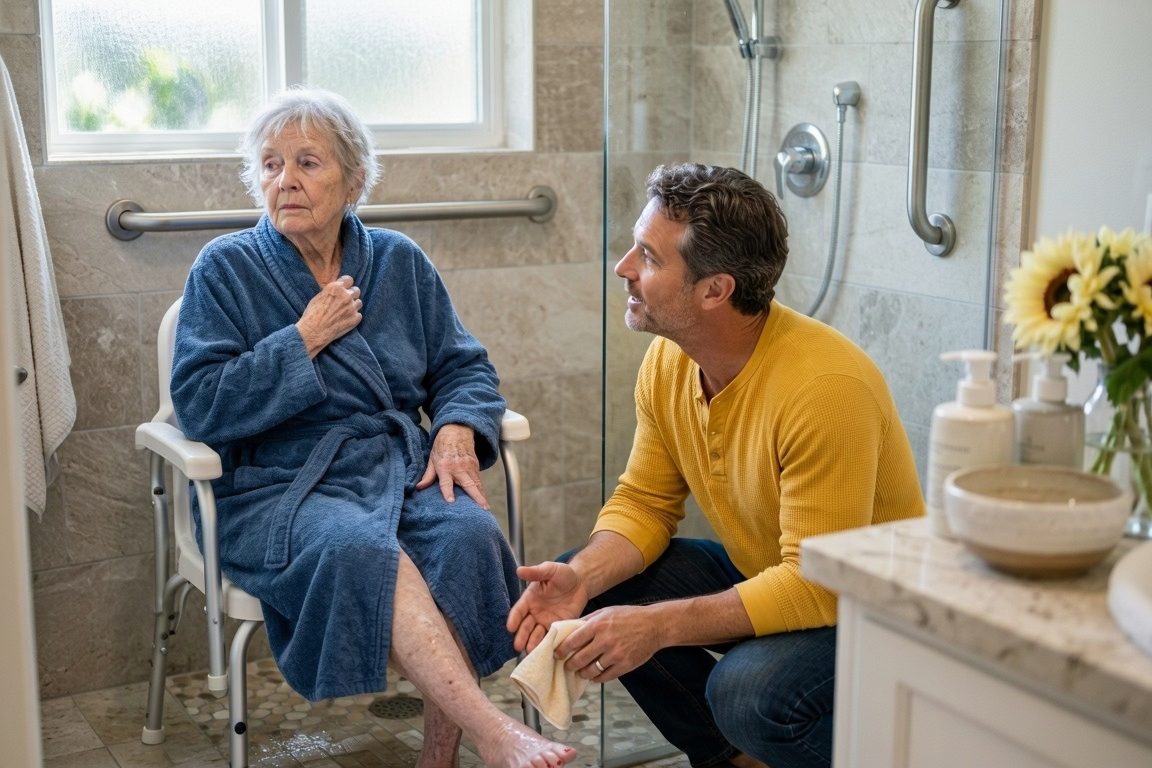
Step by step
What not to do
- Do not argue or correct. If they say something inaccurate, like 'I already ate,' do not say, 'No, you didn't.' Instead, say, 'Let's have a little snack together.' Arguing triggers defensiveness and escalates resistance.
- Do not use complex sentences or give multiple instructions at once. This overwhelms their processing ability and leads to confusion or shutdown. Keep it to one step at a time.
- Do not approach from behind or the side. This can startle them and create a negative impression. Always approach from the front, at eye level, and make sure they see you coming.
- Do not rush or show impatience. If you are in a hurry, your body language will communicate tension. They will mirror that and become more anxious. Allow extra time for each care task.
- Do not use phrases like 'calm down' or 'relax.' These can sound dismissive and trigger defensiveness.Instead, use emotional anchoring: lock eyes, touch their hand gently, and say, 'I am here with you. You are safe.'
- Do not test their memory. Avoid saying, 'I already told you that,' or 'Don't you remember?' This can feel humiliating and increase agitation. Just answer the question or repeat the instruction as if it is new.
Key points
- Resistance during care tasks is usually a sign of confusion, fear, or feeling rushed, not intentional defiance.
- Your nonverbal communication (tone, posture, touch) matters more than your words. Approach calmly, from the front, at eye level.
- Break tasks into single steps and give the person time to process each one before moving on.
- Offer limited choices to preserve dignity and a sense of control.
- Validate emotions before giving instructions: 'I see you are upset. That is okay. I am here to help.'
- If resistance escalates, stop, take a break, and try again later with a different approach.
Videos
 Is Your Aging Parent With Dementia Refusing Help? Do This!This video offers three specific strategies for handling refusal of care without power struggles, including emotional anchoring and validation techniques.
 How to communicate with a dementia patientCovers the importance of simplifying language, using gestures, and giving one-step instructions, core skills for care tasks.
 COMMUNICATION TECHNIQUES FOR DEMENTIA CAREGIVERSProvides five practical tips including positive encouragement and slowing down, directly applicable to reducing resistance during care.
 Communication & Dementia: Connecting with a Person living with Memory LossFocuses on nonverbal communication, eye contact, and gentle touch, key tools for connecting during care tasks.
2 more videos
 How To Talk To Someone With Alzheimer's Or DementiaDemonstrates how to avoid arguing, use validation, and offer choices, all of which prevent resistance in care situations.
 How To Deal With Dementia As A Caregiver?Offers strategies for managing difficult behaviors, including redirection and environmental adjustments, useful when care tasks trigger resistance.
Background
Why Resistance Happens During Care Tasks
Resistance during care tasks is not a personal rejection of you or your help. It is often a response to feeling overwhelmed, confused, or frightened. A person with dementia may not understand what you are asking them to do, especially if you use complex sentences or give multiple instructions at once. Their brain processes information more slowly, so when you rush or speak quickly, they may feel pressured and shut down. The mismatch between your intention to help and their perception of being controlled can lead to pushing back, turning away, or even verbal outbursts. Recognizing this as a neurological response, not a behavioral choice, is the first step to changing how you approach care.
The Role of Nonverbal Communication in Care Tasks
Only about 7% of communication is carried by words, the rest comes from your tone of voice, facial expressions, posture, and touch. When you approach a person with dementia with a tense face, crossed arms, or a hurried tone, they will mirror that tension and become more anxious. Conversely, a warm, open posture, a gentle hand on the shoulder, and a calm voice can signal safety and trust before you even speak. Your nonverbal cues set the emotional stage for the care task. If you are feeling frustrated or rushed, take a moment to breathe and center yourself before entering the room. Your calm presence is one of the most powerful tools you have.
The Importance of Slowing Down and Simplifying
People with dementia often have a delayed response time, called latency, when processing verbal requests. If you ask them to 'get dressed and come to breakfast,' they may only hear the first part or become overwhelmed by the two-step command. Breaking tasks into single steps, 'Let's put on your shirt', and then waiting patiently for a response gives their brain time to process. Rushing them creates anxiety, which can lead to resistance or complete withdrawal. Slowing down also means allowing extra time for the entire care routine, so you are not fighting the clock. When you are not in a hurry, you can be more present and responsive to their cues.
Practical tools
6
The 'One-Step' Script
A simple phrase you can use for any care task: 'First, we will [single action].' For example, 'First, we will sit down.' Then wait. After that, 'Now, we will lift your arm.' This breaks the task into manageable pieces and reduces overwhelm.
The 'Limited Choice' Card
Write down two acceptable options for a care task (e.g., 'Shower now or after breakfast?', 'Red shirt or blue shirt?'). Hold up the card or say the options aloud. This gives the person a sense of control while still moving forward with the task.
The 'Emotional Anchoring' Touch
Before starting any care task, place your warm hand on their shoulder or back, maintain eye contact, and say, 'I am here to help you. We will do this together.' This nonverbal signal builds trust and reduces fear. Use it whenever you see signs of anxiety or resistance.
Distraction Kit
Keep a small bag with a familiar object, a photo, or a comforting item (like a soft scarf or a stress ball) nearby. If resistance arises, hand them the object and say, 'Can you hold this for me while I help you?' This redirects their focus and can make the task feel less intrusive.
The 'Validate First' Phrase Bank
Have a set of go-to phrases ready: 'I see you are feeling upset. That is okay.' 'You are safe. I am here.' 'This is hard, I know. We will take it slow.' Saying these before you ask them to do anything can lower their defenses and open the door to cooperation.
Environmental Checklist for Care Tasks
Before starting, check:
A calm environment makes communication easier.
Different situations
Late-stage dementia (severe cognitive decline)
At this stage, verbal communication may be very limited. Rely almost entirely on nonverbal cues: gentle touch, slow movements, and a calm presence. Use demonstration rather than words. For example, if you need to help them eat, open your own mouth and then gently guide the spoon to their lips. Do not expect verbal responses; instead, watch for facial expressions or body tension that signal comfort or distress. Keep instructions to one or two words, like 'Open' or 'Sip.'
Lewy body dementia (fluctuating cognition and visual hallucinations)
People with Lewy body dementia may have days where they are very alert and other days where they are confused or have visual hallucinations. On a 'bad' day, avoid care tasks that require complex reasoning. Use simple, concrete language and be prepared to stop if they become agitated. If they see something that is not there, do not argue, validate the feeling: 'I see you are worried. Let's move to a quieter room.' Also, be aware that they may have physical symptoms like stiffness or tremors, so adjust the pace and support accordingly.
Caregiver is an adult child vs. a spouse
Adult children may need to establish a new authority dynamic, which can feel awkward. Use a respectful, collaborative tone: 'Dad, I am here to help you, just like you helped me when I was little.' Spouses may have a more intimate dynamic but also more emotional history. Avoid phrases that sound like you are parenting them. Instead, say, 'Honey, let's do this together.' Both roles benefit from using the person's preferred name and maintaining dignity.
In a care facility or hospital setting
In these settings, there may be multiple staff members and a less familiar environment. Always introduce yourself by name and role: 'Hi, I am Maria, your nurse today.' Use the same person-centered techniques, but also coordinate with the team to ensure consistency. If the person is resistant, ask if a familiar family member can be present during the task. Use the environment to your advantage: a quiet room with soft lighting can make a big difference. Also, consider using a 'communication card' that explains the person has dementia and suggests ways to interact.
Frontotemporal dementia (behavioral variant)
This type often affects behavior and personality more than memory early on. The person may be impulsive, disinhibited, or apathetic. During care tasks, they may refuse because they simply do not see the point or are easily distracted. Use very short, direct commands and immediate rewards: 'Let's wash your hands, then we will have a cookie.' Avoid lengthy explanations. If they become agitated, redirect to a preferred activity and try again later. Structure and routine are especially important here.
For the doctor
4
- If the person consistently refuses essential care like taking medication or eating, ask your doctor about possible underlying causes such as pain, infection, or medication side effects.
- If resistance is accompanied by new or worsening aggression, discuss with a neurologist or geriatric psychiatrist whether a medication adjustment or non-pharmacological intervention is appropriate.
- If the person has difficulty swallowing during meals or medication, ask for a speech therapy evaluation to ensure safe swallowing techniques and avoid aspiration.
- If you are considering using a restraint or sedative to manage resistance during care, discuss this with the care team first, these approaches can increase confusion and fall risk.