Step by step
What not to do
- Do not try to capture every single moment. This turns joy into a chore and can make you feel like you're failing if you miss something.Instead, aim for one intentional capture per day or even per week. Quality over quantity is the key.
- Do not force your loved one to pose or perform for a photo or recording. If they are tired, agitated, or not in the mood, let it go. Forcing a moment destroys the very joy you're trying to capture. Wait for a naturally occurring glimmer.
- Do not compare your captured moments to idealized images on social media or in movies. Your caregiving journey is unique. A 'perfect' moment might be a quiet hand squeeze, not a big family gathering. Honor what is real and present, not what you think it 'should' look like.
- Do not wait until 'later' to write down or record a joyful moment. Memory fades quickly, especially when you're stressed. Capture it within minutes, even a quick voice memo or a single sentence in a notes app is enough to preserve the essence.
- Do not let the hard days erase the good ones. When you're in the middle of a difficult behavior or a frustrating situation, it's easy to feel like all the joy is gone. Remind yourself that the glimmers still exist, you just have to look for them. The negative moments do not cancel out the positive ones.
- Do not keep your captured memories hidden away. Share a funny story with a friend, play a voice recording for a family member, or look at your photos together with your loved one. Joy multiplies when it is shared, and it reinforces the connection between you and your loved one.
Key points
- Joyful moments are real and present, even on hard days, you just have to train your brain to notice them.
- Capture glimmers immediately, not later. Use a notebook, voice memo, or quick photo within minutes of the moment.
- Focus on quality over quantity: one intentional capture per day or week is enough to build a meaningful collection.
- Voice recordings are especially powerful because they capture your loved one's spirit and voice for future generations.
- Share your captured memories with others, joy multiplies when it is shared and reinforces connection.
- Adapt your capturing methods to your loved one's current stage and condition. What works in early stages may not work later.
Videos
 Moments of joyThis video directly addresses the challenge of remembering joyful moments when the hard times are so vivid, and offers a framework for intentionally capturing and holding onto the good memories.
 090215Remember the JoyThis video reinforces the idea that caregivers can choose to remember the joy, not just the struggle, and gives practical encouragement for building a positive memory bank.
 When You Want to Walk Away From Dementia Caregiving (But Can’t)This video addresses the emotional exhaustion that can make it hard to see joy, and offers strategies for finding glimmers even when you feel like giving up.
 Julia Yarbough discusses How Caring for Her Mom Led to the Founding of 'Keeping it REAL Caregiving'This video shares a real caregiver's story of finding humor and joy in everyday moments, and how she turned those experiences into a resource for others.
2 more videos
 Manage dementia caregiver stress: 4 tips to cope with difficult dementia behaviorsThis video offers practical coping strategies that help you stay calm and present, which is essential for being able to notice and capture joyful moments.
 Welcome Founder of The Carefullist Katie KristoficThis video introduces the concept of creating a 'carefullist', a curated list of positive moments and resources, which directly supports the practice of capturing joyful memories.
Background
Why Joyful Moments Can Feel So Fleeting (and Why That's Normal)
As a caregiver, your brain is often in survival mode, scanning for problems, managing tasks, and bracing for the next challenge. This is a natural response to the constant demands of caregiving. Because of this, the scary, overwhelming, and lonely times can stick in your memory like burrs, while the joyful moments, the shared laugh, the gentle touch, the unexpected joke, can slip away unnoticed. One caregiver described how she remembers the feeling of joy from certain moments, but not the details of what caused it. That's because joy is an emotion, not a fact, and it's easily crowded out by stress unless we deliberately capture it.
The Science of 'Glimmers' and Why They Matter
Researchers and care experts talk about 'glimmers', tiny, everyday moments that spark a sense of peace, joy, or calm. These are not big events like vacations or holidays; they are the seconds when your loved one hums a familiar tune, smiles at a photo, or makes a silly comment about a coupon. When you intentionally notice these glimmers, your brain releases positive chemicals like serotonin and dopamine, which can help counterbalance the stress hormones that build up during difficult caregiving tasks. Over time, collecting these glimmers creates a reservoir of positive memories you can draw on, even on the hardest days.
The Difference Between 'Recording' and 'Capturing'
There is a difference between mechanically recording everything (which can feel like another chore) and thoughtfully capturing moments that matter. Capturing is about presence and intention, it's not about getting the perfect photo or video, but about pausing to notice and preserve the essence of a connection. One expert calls this 'legacy caregiving': creating small moments of dignity and connection, not perfection. Your goal is not to document every minute, but to collect a few meaningful artifacts, a voice recording, a short video, a written note, a funny story, that will remind you of the love and humor that existed alongside the challenges.
Practical tools
6
The 'Glimmer' Notebook
A small, dedicated notebook (or a simple notes app folder) that you keep in your pocket, on the kitchen counter, or by the bedside. Label it 'Glimmers' or 'Joy Log.' Each time you notice a small moment of joy, write down: the date, one sentence about what happened, and one word for how it made you feel (e.g., 'warm,' 'funny,' 'peaceful'). This becomes a tangible collection of positive memories you can flip through on hard days.
Voice Memo App (Phone or Tablet)
Use the built-in voice recorder on your phone. When your loved one is humming, telling a story, or singing, simply press record. Keep recordings under two minutes. Label them with the date and a short description (e.g., '2025-03-15 Mom singing You Are My Sunshine'). These recordings capture their voice and spirit in a way photos cannot. Play them back for them or for yourself later.
The 'One-Photo-a-Week' Album
Create a dedicated album in your phone's photo app or a physical photo album. Each week, choose one photo that represents a genuine moment of connection or joy. Add a short caption. Do not include photos of stressful or forced moments. Over months, this album becomes a curated visual timeline of the love and humor that existed alongside the challenges.
The 'Letter to My Loved One' Template
Keep a simple template in a notes app or on paper: 'Dear [Name], I remember when...' and 'One thing I love about you is...' and 'Today, you made me smile when...' Fill it in when you have a quiet moment. Read it aloud to them. The act of writing and reading creates a shared legacy moment, and the letter itself becomes a keepsake you can keep in a memory box.
The 'Humor Highlight Reel' Practice
When something funny or absurd happens, immediately say to yourself: 'This is going to be a great story later.' Then, within the hour, tell the story to a friend, write it in your glimmer notebook, or record a quick voice memo. This reframes a potentially frustrating moment into a future memory. Over time, you'll build a collection of funny caregiving stories that will make you laugh even years later.
The 'Purposeful Task' Capture Setup
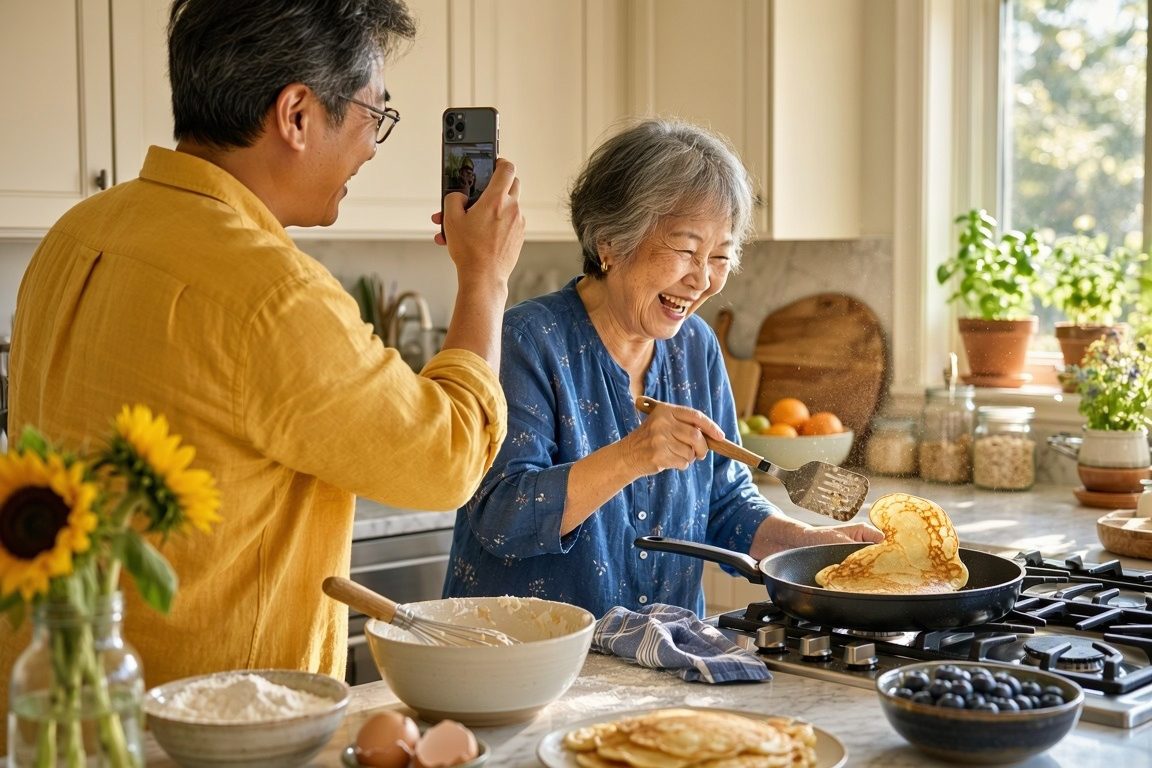
Set up a simple, meaningful task that your loved one can do with you, like folding towels, sorting socks, or watering a plant. Keep your phone nearby. When they are engaged and content, take a short video (15-30 seconds) or a photo. The task itself creates a natural moment of connection, and the capture preserves that feeling of shared purpose.
Different situations
For early-stage dementia (mild cognitive impairment)
Your loved one can still participate actively in the capturing process. Ask them to help you write down a memory or choose a photo. They may enjoy recording their own voice telling a story. This can be a shared activity that strengthens your bond and gives them a sense of agency. Focus on capturing their current personality and interests, not just their past.
For middle-stage dementia (moderate cognitive decline)
Your loved one may have difficulty initiating or sustaining a conversation. Focus on capturing non-verbal glimmers: a smile, a hand squeeze, a moment of calm while listening to music. Use short voice recordings of them humming or singing along to familiar songs. Keep all captures very brief (under one minute) to avoid overstimulation. The goal is to capture their emotional state, not factual details.
For late-stage dementia (severe cognitive decline)
Your loved one may be mostly non-verbal or bed-bound. Focus on capturing moments of physical comfort and connection: a gentle touch, a shared gaze, the sound of your own voice reading to them. Record yourself singing a lullaby or reading a short poem, this becomes a memory for you, not for them. Photos of their hands, their face at rest, or a favorite object near them can be powerful keepsakes. Do not expect them to participate actively.
For Lewy body dementia or Parkinson's disease dementia
These conditions often involve fluctuations in alertness and visual hallucinations. Capture moments during their 'good' times, when they are alert, calm, and not experiencing hallucinations. Avoid using bright lights or sudden movements when taking photos or videos, as this can trigger confusion. Voice recordings may be especially valuable because they don't rely on visual processing. Be prepared to stop immediately if they become distressed.
For adult-child caregivers vs. spousal caregivers
Adult children may find it easier to capture moments because they have a different emotional distance, they can step back and see the humor or sweetness more readily. Spousal caregivers may feel the loss more acutely and may need to be more intentional about looking for glimmers. If you are a spousal caregiver, consider asking a trusted friend or adult child to help you identify and capture joyful moments, as you may be too close to see them clearly.
For the doctor
3
- If your loved one becomes distressed or agitated when you try to take photos or record their voice, discuss with their clinician whether this is a sign of sensory overload or a specific trigger related to their condition.
- If you find that you are unable to feel or notice any joyful moments at all for several weeks, discuss this with your own healthcare provider. This could be a sign of caregiver burnout or depression, which is treatable.
- If your loved one has a history of paranoia or hallucinations (common in Lewy body dementia), ask the clinician whether using a phone or camera might trigger a negative reaction, and what alternative capturing methods might be safer.