Step by step
What not to do
- Don't assume the primary care doctor or neurologist will automatically refer you to a therapist. Many doctors don't think of therapy for dementia symptoms unless you ask.Instead, be proactive: name the symptom and the type of therapist you want.
- Don't expect the therapist to fix everything in one session. Therapy for dementia is about learning workarounds and strategies, not a cure. You must practice at home daily for it to be effective.
- Don't forget to ask the therapist about their dementia-specific training. A therapist who works mostly with stroke patients may not know how to adapt for someone with Alzheimer's. Ask directly: 'How do you adjust your approach for someone with dementia?'
- Don't stop therapy after a few sessions just because you see some improvement. Dementia is progressive, and your loved one may need to go in and out of therapy repeatedly as symptoms change. Always ask for a new referral when needed.
- Don't ignore the emotional impact on your loved one. If they resist going to therapy, try joining them in the activity instead of arguing. Say, 'Let's do this together,' and use a collaborative approach to reduce opposition.
- Don't assume that only the doctor or nurse can help with behaviors like aggression or wandering. Therapists, especially occupational therapists, can create environmental modifications and routines that reduce these behaviors without medication.
Key points
- Match the specific symptom to the right specialist: speech for communication, physical for mobility, occupational for daily tasks.
- Always ask for a referral from your doctor, don't assume they will offer one automatically.
- Ensure the therapist has specific training in dementia care; not all therapists are equally equipped.
- Attend therapy sessions and learn the exercises so you can reinforce them at home daily.
- For facility care, ask about dementia training for direct care staff, not just the nurse or salesperson.
- Therapy is not a one-time fix; expect to go in and out of therapy as symptoms change over the course of the disease.
Videos
 Who Treats Dementia Symptoms?This video explains the five key healthcare professionals involved in treating dementia symptoms, including speech, occupational, and physical therapists, and how to get a referral.
 How Do You Get Specialized Support For Mixed Dementia?This video covers how to build a team for mixed dementia (e.g., Alzheimer's plus vascular dementia), emphasizing the need for a personalized plan and regular follow-up.
 The NEW Dementia Resource You Need NowThis video introduces a new platform that connects caregivers with dementia specialists, including therapists, and explains how to use it to find the right professional.
 Dementia Care Partner TalkShow: Ep. 104 - How Can Direct Care Staff Develop New Dementia Care SkillsThis episode discusses the importance of hands-on training for direct care staff and how to evaluate a facility's dementia training program.
2 more videos
 Ep. 273: Why Practical, Hands-On Training is So ImportantThis video emphasizes the need for caregivers to learn therapy exercises themselves and practice them at home for the best outcomes.
 Podcast #38: Strategies to Get Someone to a Healthcare Provider When They Don't Want to GoThis podcast provides practical scripts and approaches for when your loved one resists going to therapy or doctor appointments.
Background
Why a Team Approach Matters for Specific Symptoms
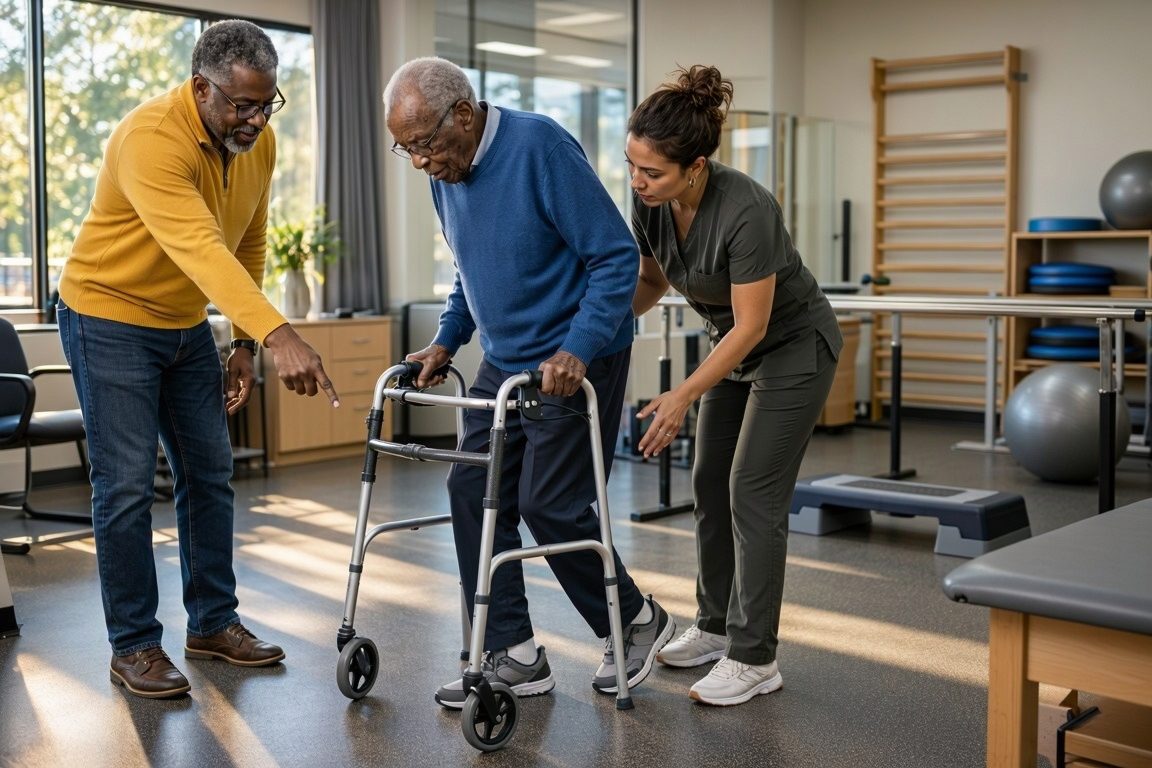
Dementia affects each person differently, and the same symptom, like difficulty finding words, can have different causes and solutions depending on the type of dementia. A speech-language pathologist (SLP) can assess whether the problem is word-finding, trouble understanding others, or jumbled speech (sometimes called 'word salad'), and then create a personalized system, like a picture book or simple cue cards, to help your loved one communicate more effectively. Similarly, an occupational therapist (OT) can address challenges with daily tasks like dressing or bathing, while a physical therapist (PT) can help with balance and walking. The key is to match the symptom to the right professional, not just rely on the primary care doctor or neurologist alone.
The Hidden Experts: Therapists Who Specialize in Dementia
Many caregivers don't realize that speech, occupational, and physical therapists can be deeply involved in dementia care, and that their expertise is most effective when they have specific training in dementia. As one expert notes, 'speech therapy can be really helpful early on in a course of disease, especially if their caregiver goes and speech therapy at that point isn't so much curative but to help with workarounds, like the families learn workarounds for FTD or aphasia.' For physical therapy, especially for Parkinson's or Lewy body dementia, there is strong evidence that it helps maintain mobility and reduce falls. The key is to ask for a referral from your doctor and then ensure the therapist has experience working with people with dementia.
How to Get the Referral and Make It Stick
Getting a referral is only the first step. As one care expert emphasizes, 'you as the caregiver or care partner need to learn those exercises and those strategies so you can start doing them at home, reinforcing them. It's not you just take them to the doctor and leave; you need to learn those exercises too so you can continue to reinforce them.' This means attending therapy sessions with your loved one, asking the therapist to show you the techniques, and practicing them daily. Over the course of the disease, your loved one may go in and out of therapy repeatedly, so it's always worth asking for a new referral when symptoms change.
Practical tools
6
The Symptom-Specialist Matching Checklist
Print this list and bring it to your next doctor's appointment:
The 'Let's Look Together' Script for Resistance
When your loved one resists going to therapy or doing exercises, use this collaborative approach: Instead of saying 'You have to go to therapy,' say 'Let's look together at what might help.' If they are exit-seeking, say 'Let's go for a walk together.' If they refuse to bathe, say 'Let's see if the water feels nice today.' This reduces the 'me versus you' stance and builds connection.
The Therapy Session Observation Log
Create a simple notebook with three columns: (1) Date, (2) What the therapist did, (3) What I can do at home. After each session, write down one or two exercises or strategies the therapist showed you. Practice them daily and note any changes. Bring this log to each follow-up appointment.
The 'Ask About Training' Question for Facilities
When evaluating a facility, ask: '
' If the salesperson knows the answers, ask if the aides also know these techniques.
The Picture Communication Book (for Speech Therapy)
Ask the speech-language pathologist to help you create a small book or laminated card set with pictures of common objects, people, and activities your loved one needs to communicate about. For example: pictures of a glass of water, the bathroom, a favorite snack, or a family member. Your loved one can point to the picture when they can't find the words.
The 'Reinforce at Home' Routine
Set aside 10–15 minutes each day to practice the exercises the therapist gave you. For physical therapy, this might mean walking a short distance or doing seated leg lifts. For speech therapy, it might mean looking at the picture book together. For occupational therapy, it might mean practicing buttoning a shirt or using a special utensil. Consistency is more important than duration.
Different situations
For Lewy body dementia or Parkinson's disease dementia
Physical therapy is especially important and has strong evidence for maintaining mobility and reducing falls. Ask for a PT who specializes in Parkinson's or Lewy body. Speech therapy may also be needed early for voice changes or swallowing problems. Occupational therapy can help with visual hallucinations by modifying the environment (e.g., reducing clutter, improving lighting).
For frontotemporal dementia (FTD) or primary progressive aphasia
Speech-language pathology is critical early on, focusing on communication workarounds and strategies for the family. The therapist can help with word-finding, understanding, and using alternative communication methods like gestures or writing. Behavioral symptoms may require an occupational therapist or behavioral specialist who can create routines and environmental cues.
For late-stage dementia
The focus shifts to comfort and safety. Physical therapy may focus on maintaining the ability to sit up or transfer from bed to chair. Speech therapy may focus on safe swallowing and preventing aspiration. Occupational therapy can help with positioning in bed or a wheelchair to prevent pressure sores. The caregiver should learn all exercises and strategies to do at home, as the person may not be able to travel to a clinic.
For a spouse caregiver vs. an adult child caregiver
Spouse caregivers may need more help with emotional support and may benefit from a social worker or counselor who specializes in dementia. Adult child caregivers may need more help with practical coordination and may benefit from a care manager who can schedule appointments and communicate with therapists. Both should attend therapy sessions to learn the strategies.
For a person living in a facility
The facility should have therapists on staff or on contract. Ask the director of nursing or activities director to coordinate therapy sessions. Also ask about the dementia training for direct care staff (aides, housekeeping, dietary, activities). The staff who have the most contact with your loved one should know how to use the strategies the therapist recommends. If they don't, ask for a care plan meeting to train them.
For the doctor
5
- Ask your doctor: 'Given my loved one's specific type of dementia and stage, which therapy (speech, occupational, physical) would be most beneficial right now?'
- Ask your doctor: 'Are there any medications or medical conditions that could be causing or worsening the symptom we're trying to address with therapy?'
- Ask your doctor: 'How often should we reassess the need for therapy? Are there any signs that would indicate we need a new referral?'
- Ask your doctor: 'If my loved one has trouble swallowing, what are the signs of aspiration, and when should we seek emergency care?'
- Ask your doctor: 'Are there any community resources, like support groups or respite care, that can help me as a caregiver while we pursue these therapies?'