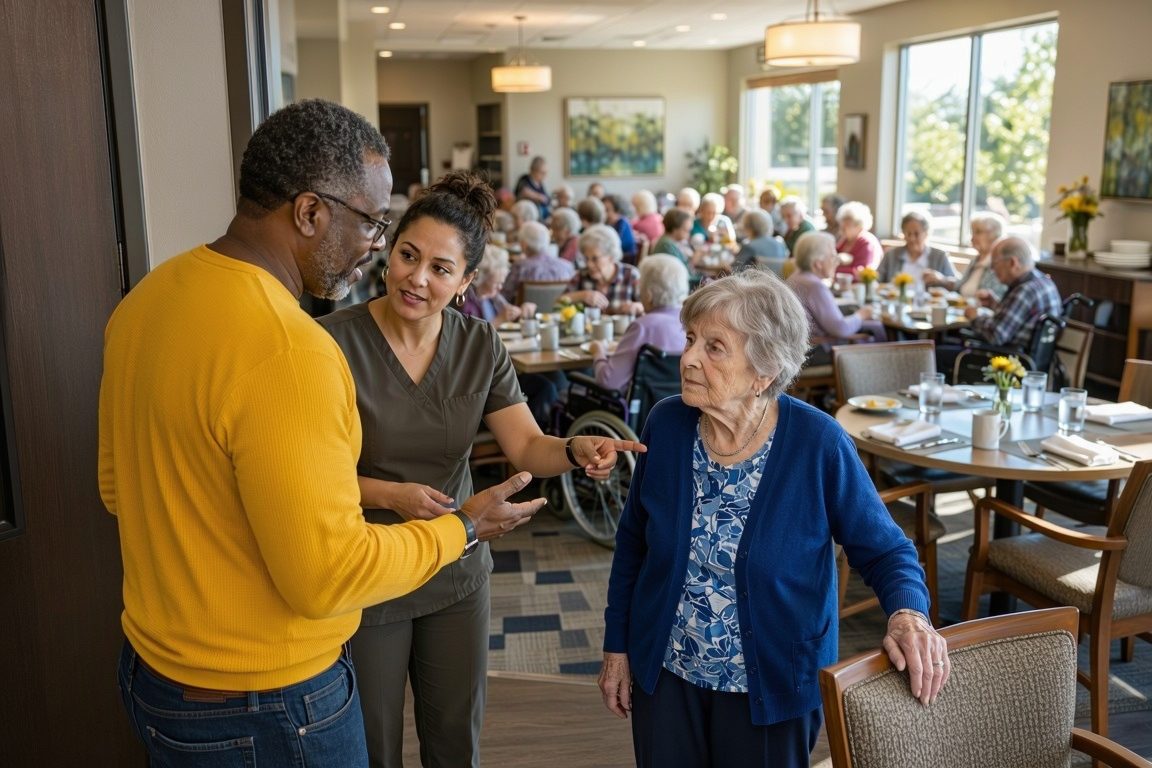
Step by step
Key points
- You are your loved one’s most powerful advocate because you know them best and care the most.
- Approach staff and leadership as partners, not adversaries. Small, respectful suggestions can lead to big changes.
- Focus on one concrete improvement at a time, like larger name tags or a simple daily activity using household items.
- Offer free training resources to the facility; many professionals want to learn but lack access to dementia-specific education.
- Document behaviors and what helps. Share this log at care meetings to support your requests.
- Join or start a family council to amplify your voice and build a community of advocates.
Videos
 Help Us Make Assisted Living Facilities Better for People With Dementia #dementiaThis video shows that facility owners are open to learning how to improve dementia care. It reinforces that your advocacy can be welcomed.
 Kitty Norton Director of 'Wine, Women, & Dementia'Kitty Norton discusses the missing piece in dementia care: early education and resources. This can inspire you to ask facilities to provide better information to families at diagnosis.
 The Future of Dementia EducationThis video highlights the need for better training for professionals. Use it as a resource to suggest to facility leadership.
 The ONE Person Who Cares The Most in Dementia CareThis video reminds you that as a family caregiver, you are the one who cares most. It validates your role as the primary advocate.
2 more videos
 Professional Alzheimer's & Dementia Training & TipsThis video is designed for professionals but is also useful for families. Share it with staff as a free training tool.
 Caregiver Guilt - Memory & Alzheimer's DiseaseThis video addresses caregiver guilt, which often arises when a loved one is in a facility. It helps you manage your own emotions so you can advocate more effectively.
Background
Why Facilities Often Fall Short on Dementia Care
Many care facilities are designed for safety and efficiency, not for the unique needs of people living with dementia. Staff may lack specialized training in dementia, relying instead on routines, medications, and locked doors to manage behaviors (source 18). This can lead to an 'us versus them' mindset where the person with dementia is seen as the problem rather than someone whose needs are not being met (source 9). The result is care that focuses on controlling symptoms instead of improving quality of life.
Your Role as a Family Advocate
As a family caregiver, you are the one person who knows your loved one’s history, preferences, and personality. You are also the person who cares most about their well-being (source 6). This gives you a unique power: you can be the bridge between the person with dementia and the care team. Your goal is not to confront or blame, but to educate, collaborate, and offer solutions. Even small suggestions, like making staff name tags bigger so residents can read them, can lead to positive changes (source 7).
The Power of Partnership Over Confrontation
Facility owners and administrators are often open to learning how to serve people with dementia better (source 1). When you approach them as a partner who wants to help them succeed, you are more likely to be heard. Many professionals in senior living genuinely want to improve but may not know how. Your insights, offered with respect, can help shift the culture from one of control to one of understanding and flexibility (source 9).
Practical tools
1
One-Page 'All About Me' Sheet
A concise, single-page document listing the person's preferred name, life history, favorite music, foods, and calming routines, to orient staff and support personalized care.
Different situations
If your loved one has Lewy body dementia
Focus advocacy on the need for flexibility. People with Lewy body dementia have fluctuating cognition and may be highly sensitive to medications. Ask staff to avoid rigid routines and to watch for sudden changes in alertness. Suggest that staff receive training on the unique symptoms of Lewy body dementia, including visual hallucinations and movement issues.
If your loved one is in late-stage dementia
Advocate for comfort and dignity over engagement. Ask for a care plan that prioritizes pain management, gentle touch, favorite music, and familiar scents. Suggest that staff speak in a calm, low voice and avoid rushing. Your role becomes monitoring for signs of discomfort and ensuring staff respond with compassion.
If you are an adult child advocating for a parent
You may be seen as less authoritative than a spouse. Counter this by being prepared with specific observations and a collaborative tone. Use phrases like, 'I know you care about my mom. Here’s what I’ve noticed helps her.' Build relationships with multiple staff members so you have allies at different levels.
If your loved one is on Medicaid
Facilities may have fewer resources for residents on Medicaid. Focus your advocacy on low-cost or no-cost changes: better communication, meaningful activities using everyday items, and staff training using free online resources. Emphasize that these changes benefit all residents and reduce staff burnout.
If your loved one has a history of aggression or resistance
Help staff understand that behaviors are often a form of communication. Ask them to try the 'Positive Approach to Care' method: slow down, approach from the front, use a calm voice, and offer a simple choice. Suggest that the facility adopt a policy of trying non-pharmacologic interventions first (source 16).
For the doctor
4
- Ask your loved one’s doctor if any current medications could be contributing to agitation or confusion, and whether a medication review is appropriate.
- Discuss with the facility’s medical director whether a geriatric psychiatry consultation could help with complex behavioral symptoms.
- Ask the care team about the facility’s policy on antipsychotic medications and whether they follow guidelines to use them only as a last resort.
- If your loved one has frequent falls or injuries, ask the doctor whether a physical therapy evaluation or equipment change (like a bed alarm or hip protectors) might help.