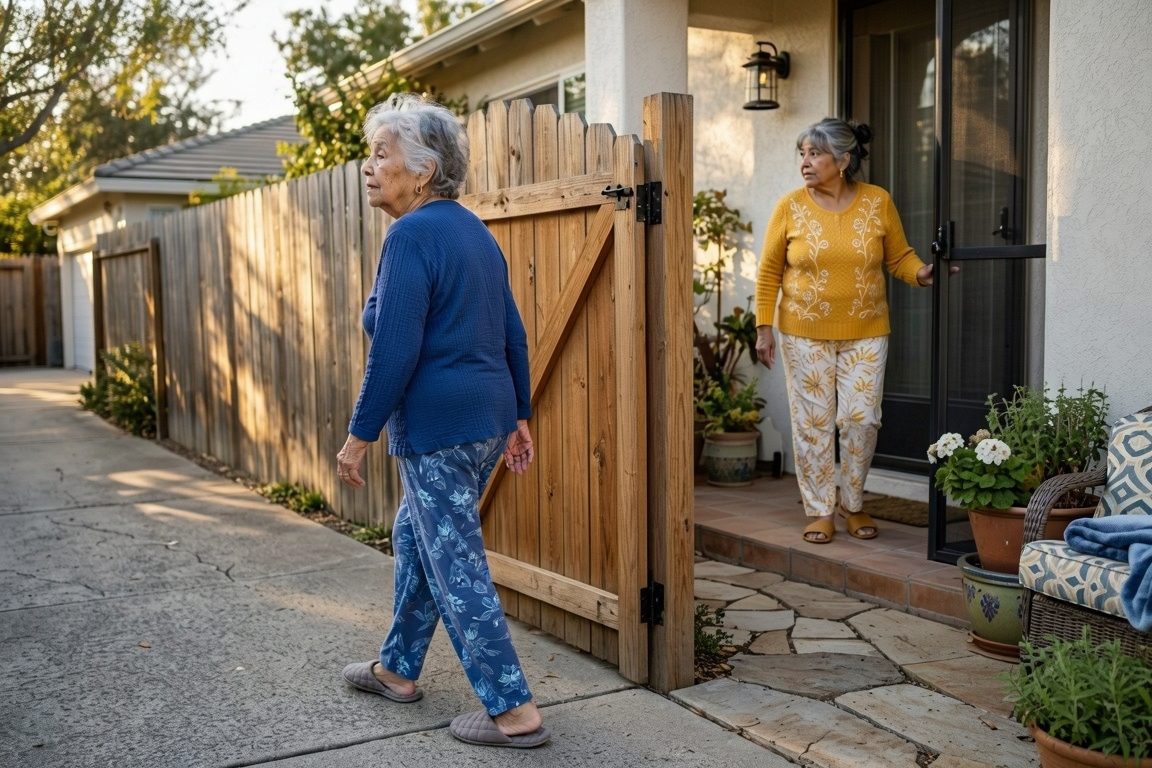
Step by step
What not to do
- Don't argue, correct, or reason, saying 'This is your home' heightens confusion; validate the feeling and redirect instead.
- Don't grab, block, or physically restrain, this can trigger fight-or-flight; step aside, lower yourself, and use a calm tone to guide them elsewhere.
- Don't leave them alone, even briefly, disorientation can occur quickly; always have someone with them.
- Don't rely only on locks or alarms, most will wander eventually; keep a recent photo, list of familiar places, and emergency contacts ready.
Key points
- Wandering is a symptom of unmet needs or a memory from the past, not a behavior problem. Always look for the need behind the action.
- Six out of ten people with dementia will wander at some point. It is common and can happen even with the best supervision.
- Do not argue or correct. Validate the feeling and redirect to a safe, meaningful activity.
- Make your home safer with high locks, door alarms, and GPS trackers. Remove visual cues like coats and keys near the door.
- Inform neighbors and local police about your loved one’s condition. Have a recent photo and emergency plan ready.
- If your loved one goes missing, call 911 within 15 minutes and tell them the person has dementia and may be disoriented.
Videos
 Dementia Wandering: Prevention + What to Do If They Go Missing | Dr. Khushboo VermaThis video explains the unmet need behind wandering and gives clear steps for prevention and emergency response.
 Caregiver Training: Wandering | UCLA Alzheimer's and Dementia Care ProgramA practical demonstration of how to approach a loved one who is trying to leave, with exact phrases to use.
 What Do You Do When A Dementia Patient Starts Wandering?Covers the difference between pacing and wandering, and offers strategies for both home and facility settings.
 Why Do Dementia Patients Keep Saying They Want To Go Home?Explores the emotional and memory-based reasons behind the common phrase 'I want to go home' and how to respond.
2 more videos
 Top 3 Signs Your Loved One Needs Nursing Home CareHelps caregivers recognize when wandering and other behaviors have become too dangerous to manage at home.
 Alzheimer's and Wandering - Professional Caregiver WebinarA comprehensive webinar covering triggers, prevention, and safety planning from a professional caregiver perspective.
Background
Wandering Is a Communication, Not a Behavior Problem
When your loved one with dementia tries to leave the house or paces restlessly, it is easy to feel frustrated or scared. But experts agree that wandering is rarely a deliberate act of defiance. Instead, it is a way of expressing a need that the person can no longer put into words. They might be hungry, thirsty, bored, anxious, or in pain. They might need to use the bathroom and cannot find it. Or they might be reliving a memory from decades ago, believing they need to go to work, pick up children from school, or return to a home they lived in long ago. This is called time-traveling, and it happens because the brain’s ability to understand the present moment is breaking down. The person genuinely believes they are somewhere else and must go somewhere familiar. Understanding this changes everything: your job is not to argue with them, but to meet the need behind the action.
The Brain Loses Its Internal GPS
Dementia damages the hippocampus, the part of the brain responsible for learning, memory, and wayfinding. This means your loved one can become disoriented even in their own home. They might get lost walking from the bedroom to the kitchen, or they might step outside and not recognize their own street. This disorientation often starts subtly: getting lost while driving a familiar route, not remembering where they parked, or putting items in the wrong cabinets. Over time, it progresses to wandering out the front door and being unable to find their way back. This is not a choice; it is a symptom of the disease. Knowing this helps you respond with compassion instead of anger, and it guides you to make the home safer rather than trying to reason with a brain that cannot reason back.
Common Triggers for Wandering
Certain situations make wandering more likely. Seeing a front door, a coat rack, a purse, or car keys can trigger the idea of leaving. Sundowning, or increased confusion in the late afternoon and evening, often leads to restlessness and exit-seeking. A new environment, such as a hospital or a relative’s home, can cause anxiety and a desire to go back to a place that feels safe. Even simple boredom or lack of activity can lead to pacing and wandering. According to the Alzheimer’s Association, five common triggers include: feeling lost in a new or changed environment, acting as if doing a chore but nothing gets done, asking about past friends and family, becoming nervous in crowded places, and appearing lost in familiar settings. Recognizing these triggers allows you to intervene early, before your loved one even reaches the door.
Practical tools
7
Validation and Redirect Script
When they say 'I want to go home': (1) Validate, 'I hear you, you want to go home.' (2) Ask gently , 'What do you miss about home?' (3) Redirect , 'Let's look at photos of the old house while I make us a snack.' Meets the emotional need without arguing.
Door Alarm and Motion Sensor Kit
A wireless door alarm that chimes when opened, plus a motion sensor near each exit. Gives critical seconds to redirect. Test batteries weekly.
GPS Tracking Device
A watch or clip-on GPS tracker with geofence alerts to your phone. Discuss with their clinician whether it's appropriate and if they'll tolerate wearing it.
Safe Walking Path Setup
Neighbor Notification Card
A wallet-sized card with photo, first name, 'has dementia, may be lost,' and your phone number. Distribute to neighbors, police non-emergency, and local shops; ask about voluntary vulnerable-adult registries.
Emergency Go-Bag
A bag by the door with:
Grab it when searching or calling 911.
Medical ID Bracelet
Engraved stainless-steel or silicone bracelet: 'Dementia, may be disoriented,' first name, your phone number. First responders and good Samaritans are trained to check for it. Choose a secure snap closure.
Different situations
Early-stage dementia (mild cognitive impairment)
In early stages, wandering is more about disorientation than purposeful exit-seeking. Your loved one may get lost while driving or walking a familiar route. Focus on driving assessments with their doctor, and consider a GPS tracker for the car. Use a calendar and routine to reduce confusion. Do not restrict their freedom entirely, but have a plan in place for when they get turned around.
Middle-stage dementia (moderate Alzheimer’s or vascular dementia)
This is when wandering becomes most common and dangerous. Your loved one may try to leave with a clear purpose, like going to work or visiting a parent. Use all the environmental tools: high locks, door alarms, and GPS devices. Create a structured daily routine with meaningful activities to reduce boredom and anxiety. Inform neighbors and local police. Consider enrolling in the Alzheimer’s Association Safe Return program.
Late-stage dementia (severe cognitive decline)
In late stages, purposeful wandering often decreases, but pacing and restlessness may continue. Focus on comfort and safety. Use a pressure-sensitive mat on the bed or chair to alert you when they get up. Keep the environment calm and familiar. If they are in a facility, ensure staff are trained in wandering prevention and that the unit is locked. Discuss with the care team whether a bed alarm or low bed is needed to prevent falls.
Lewy body dementia or Parkinson’s dementia
These types often involve visual hallucinations and fluctuating cognition. Wandering may be triggered by seeing things that are not there, such as people or animals. Do not argue about what they see. Instead, say, ‘I see you are concerned. Let’s check the room together.’ Use nightlights to reduce shadows that may cause fear. Be extra cautious with medications, as some can worsen confusion. Always discuss any new wandering behavior with the neurologist.
Spouse caregiver vs. adult child caregiver
Spouse caregivers often have a harder time accepting that their partner needs constant supervision. They may feel guilty about using locks or alarms. It helps to frame these tools as safety measures, not imprisonment. Adult children may need to gently insist on safety changes, even if the parent resists. In both cases, join a caregiver support group to share strategies and reduce isolation. If wandering becomes unmanageable, discuss with your clinician whether a memory care facility is needed.
For the doctor
5
- Ask your doctor if your loved one’s wandering could be related to a medication side effect, such as a new drug that increases confusion or agitation.
- Discuss whether a sleep study is needed if wandering happens mostly at night, as sleep disorders like REM sleep behavior disorder can cause walking during dreams.
- Ask about non-pharmacological interventions first, but if wandering is severe and dangerous, ask whether any medications might help reduce agitation or anxiety. Never start or stop medications without medical guidance.
- If your loved one has a history of falls or fractures, ask the clinician about a home safety evaluation by an occupational therapist to prevent injury during wandering.
- Discuss the possibility of a dementia-specific driving evaluation if your loved one still has access to a car and shows signs of getting lost while driving.