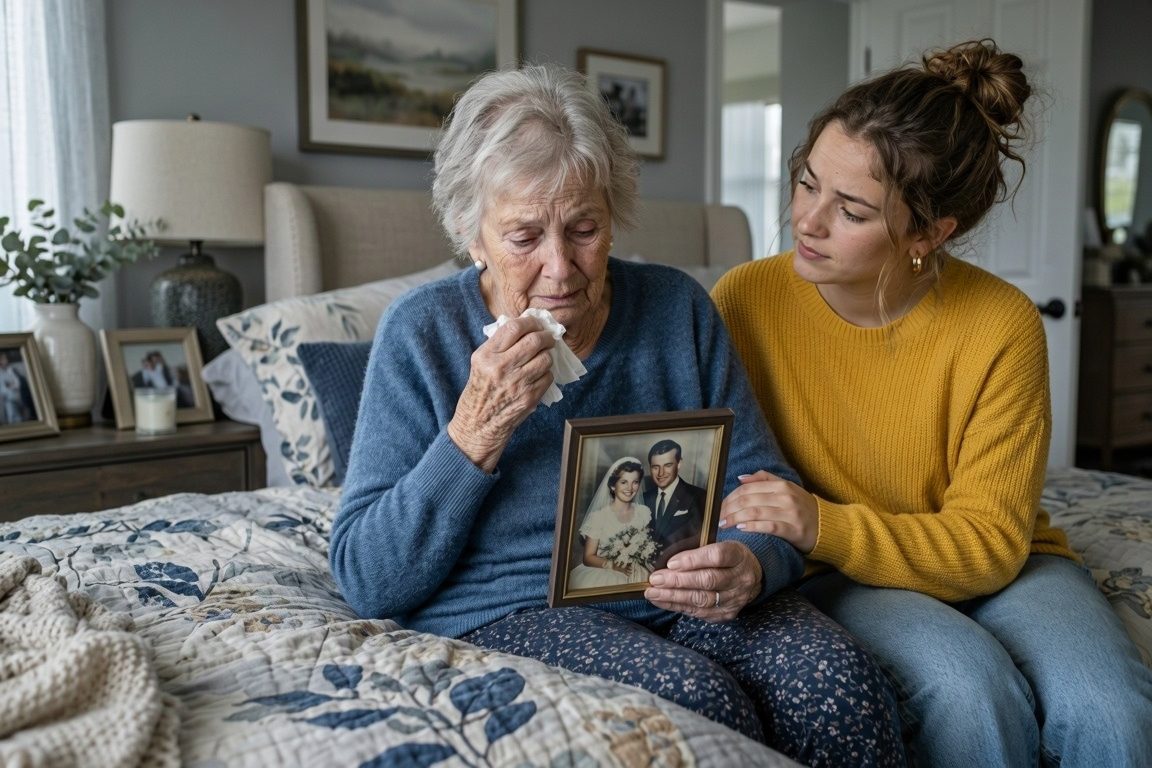
Step by step
What not to do
- Do not correct them or repeat the death.
- Do not give elaborate explanations.
- Do not argue or try to make them remember.
Key points
- Your loved one's repeated grief is not a memory problem you can fix; it is a feeling you can comfort.
- Validate the emotion first, then gently redirect. Do not correct or remind them of the death.
- Use simple, honest phrases like 'I know you miss them' instead of euphemisms or detailed explanations.
- Create a memory box or visual cue to shift focus from absence to loving memories.
- Take care of your own grief and seek support. You cannot pour from an empty cup.
- Consistency and calm presence are your most powerful tools. Write down your go-to responses.
Videos
 When someone with dementia remembers someone is deadThis video directly addresses the moment your loved one remembers a death and how to respond with compassion rather than correction.
 TELLING A PARENT WITH DEMENTIA ABOUT A DEATHOffers practical guidance on whether and how to tell a parent with dementia about a spouse's death, including the role of hospice professionals.
 Losing Your Spouse Twice: The Truth About Dementia and MarriageExplores the caregiver's experience of ambiguous loss and grief, helping you understand your own feelings as you support your loved one.
 Dementia and Ambiguous Loss with Dr. Natalee Oliver, DSW April 20 23Provides a professional perspective on ambiguous loss and how to navigate the emotional maze of dementia caregiving.
2 more videos
 How to Cope With the Grief and Loss When You Love Someone with DementiaFocuses on caregiver coping strategies, including honoring the person your loved one was while managing your own grief.
 Should I Tell or Remind My Person with Dementia of a Death in the FamilyDirectly answers the question of whether to remind or not, with clear examples and a recommended approach.
Background
Why This Happens: Memory Loss and the Brain's Loop
This situation is sometimes called 'ambiguous loss' for you, the caregiver. You are losing your loved one twice: first to the disease, and later to physical death. But for your loved one, the loss of their spouse is also ambiguous because they cannot hold onto the reality of it. Understanding this can help you shift from trying to 'fix' their grief to simply being present with them in it. Your role is not to remind them of the death, but to comfort the feeling of loss that is very real to them in that moment.
Practical tools
1
Consistent response script
Write down your chosen phrases (validation, truth without death, redirection) and use them each time to reduce your own stress and provide predictability.
Different situations
Lewy body dementia or Parkinson's dementia
These conditions often involve visual hallucinations and fluctuating cognition. Your loved one may see or sense their spouse in the room. Do not argue about the hallucination. Instead, say, 'I see you are feeling [spouse] nearby. That must be comforting.' If they become distressed, gently redirect to a different room or activity. The grief may be more intense during 'off' periods of lucidity.
Late-stage dementia (unable to speak or understand much)
Your loved one may not be able to ask about their spouse, but they may show grief through crying, agitation, or restlessness. Focus on non-verbal comfort: gentle touch, soft music, a familiar scent (like the spouse's cologne or perfume), or sitting quietly together. Do not try to explain. Your calm presence is the best medicine.
Adult child caregiver (not the spouse)
You may feel caught between honoring your parent's grief and protecting them from pain. It is okay to say, 'I miss Dad too, Mom. Let's look at his photo together.' You do not have to be the one to deliver the news of death. If your other parent is still alive and can visit, coordinate with them to provide comfort. Take care of your own grief separately; you are losing both parents in different ways.
Loved one lives in a facility
Staff may need to be trained on how to respond. Provide them with a written 'comfort script' and a memory box. Ask them to call you if your loved one becomes very distressed. You can also schedule regular video calls where you can offer comfort remotely. Ensure the facility knows not to repeatedly remind your loved one of the death.
Spouse is still alive but in hospice or long-term care
If the spouse is dying or has recently died, you may be tempted to hide the truth to spare your loved one pain. Experts recommend involving a hospice chaplain or social worker to help tell the news gently, once, with support. After that, use the same comfort-and-redirect approach. Your loved one has a right to grieve, even if they cannot remember.
For the doctor
4
- If your loved one's grief leads to refusal to eat, drink, or take medications, discuss with their doctor whether a short-term medication adjustment or a referral to a dementia behavioral specialist might help.
- If the repeated grief is accompanied by new physical symptoms like falls, weight loss, or increased confusion, ask the clinician to rule out a urinary tract infection or other medical issue that can worsen dementia symptoms.
- If you are struggling with your own depression, anxiety, or overwhelming guilt, talk to your own doctor or a therapist. Caregiver burnout is real and treatable.
- If your loved one has a history of severe depression or anxiety, discuss with their clinician whether a referral to a geriatric psychiatrist or counselor experienced in dementia grief is appropriate.