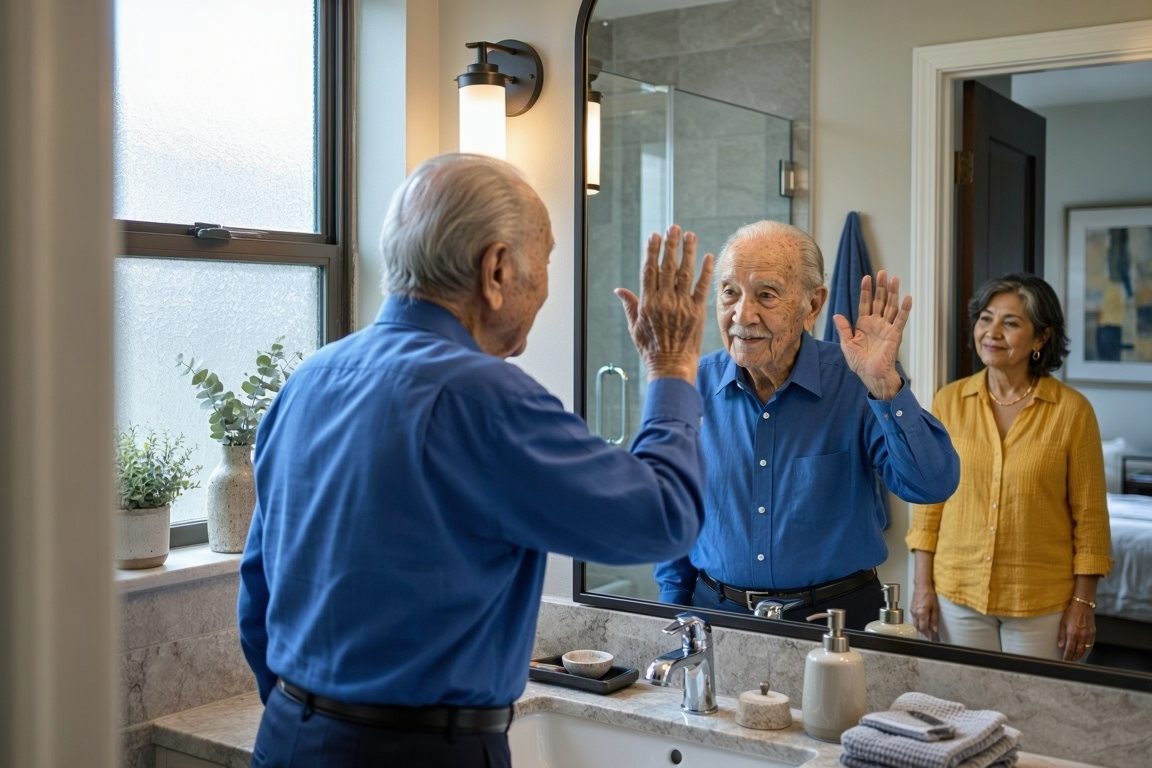
Step by step
What not to do
- Don't force them to look in the mirror or insist 'That's you, you're just older.' This increases fear and agitation, their brain cannot process the information.
- Don't laugh or make jokes about the confusion. Even if not shown, this can feel humiliating and frightening.
- Don't leave them alone in a room with a mirror if already distressed. Confusion can escalate into panic or a fall as they try to escape the 'stranger.'
- Don't dismiss a sudden onset as 'just dementia.' A rapid change can signal delirium (e.g., from infection or medication), a treatable medical emergency.
Key points
- Mirror confusion is common in dementia and happens because the brain cannot recognize the reflection as self.
- Never argue or force reality, validate their feeling and redirect to a different activity or room.
- Cover or remove mirrors in areas where confusion occurs; this is the simplest and most effective solution.
- A sudden worsening of mirror confusion over hours or days may be a medical emergency (delirium), call the doctor.
- Use familiar photos and consistent routines to reinforce identity without relying on mirrors.
- Take care of yourself, caregiver stress can affect how you respond. You are doing a hard job, and small changes can make a big difference.
Videos
 Why Mirrors Confuse People with Dementia (And How to Fix It!)This video directly addresses the topic of mirror confusion, explains why it happens, and gives practical steps to reduce distress.
 Surprising Symptoms of Dementia! Part 3Covers other perceptual changes like not recognizing people on TV, which helps you see mirror confusion as part of a bigger pattern.
 Dementia Got Worse Overnight? Think Delirium (Act Fast) | Dr. Khushboo VermaEssential for understanding when a sudden change in confusion might be a medical emergency, not just dementia progression.
 Dementia Progression: What I Wish Caregivers Were ToldProvides broader context on how dementia changes over time, helping you set realistic expectations for symptoms like mirror confusion.
2 more videos
 Should You Force a Loved One with Dementia to Bathe?Offers gentle approaches to bathing that can be adapted to avoid mirror-related distress in the bathroom.
 Why Dementia Behavior Is Worst With You (And Not Others)Explains why your loved one may act out more with you, which is especially relevant when mirror confusion triggers fear or anger directed at you.
Background
Why the Brain Gets Confused by Reflections
When dementia damages the parts of the brain that handle perception and self-recognition, a mirror no longer shows a familiar face. Instead, your loved one may see a stranger staring back at them, and that can be terrifying. As one dementia expert explains, people with dementia ‘literally might not realize that their reflection in the mirror is actually them’ (source 1). This isn't stubbornness or a trick; it's a real change in how their brain interprets visual information. The person looking back may seem like an intruder, a lost older person, or even a threatening figure, especially if the person with dementia still feels young inside. As another source notes, when they look in the mirror they see an old person and think, ‘Why is this old person in my house and in my bathroom?’ (source 11).
The Role of Time Shifting and Lost Identity
Mirror confusion is also tied to something called time shifting, the brain’s inability to accurately place the self in the present moment. A person with dementia may feel they are still 40 years younger, so when they see an aged face in the mirror, it doesn’t match their internal self-image. This mismatch can cause fear, anger, or even grief as they sense a loss of who they were. Dementia affects the brain’s ability to remember, think clearly, and even recognize familiar faces or places, leading to a ‘receding of the known self’ (source 12). The mirror becomes a daily reminder of a self they no longer recognize, and that can be deeply unsettling.
How This Connects to Other Confusions (TV, Windows, Photos)
This same perceptual problem can show up in other ways. Your loved one might talk to people on TV as if they are in the room, or try to shake hands with a person on a video call (source 2). They may also mistake a reflection in a window or a shiny surface for another person. Understanding this pattern helps you see that the mirror issue is not isolated, it’s part of a broader change in how the brain processes images and reality. Knowing this can help you respond with patience rather than frustration.
Practical tools
4
Mirror Cover or Removable Film
Use a plain, non-reflective cloth, cardboard, or removable mirror privacy film (available online). Keep it on the mirror except during supervised grooming. Simplest and most effective fix.
Bathroom Routine Checklist
Photo-Based Identity Anchor
Create a small 'memory board' with 3-5 clear, happy photos of your loved one from younger years plus a current photo. Place where they see it often (e.g., by their favorite chair). Occasionally point and say 'There you are, so happy.'
Delirium Quick Check
If mirror confusion appears suddenly or worsens over hours, check for:
Ask: 'Did this start after a new medication, fall, or possible infection?' If yes, call doctor or go to ER.
Different situations
Lewy body dementia
People with Lewy body dementia are more prone to visual hallucinations and delusions, so mirror confusion may be more intense and frequent. They may also have more difficulty with visual perception overall. Cover mirrors permanently in rooms they use often. Also be alert for sudden changes that could indicate delirium, which is common in Lewy body dementia (source 8).
Late-stage dementia
In late stages, the person may no longer react to mirrors at all, or they may become very agitated. Focus on comfort: keep mirrors covered at all times, use soft lighting, and avoid any confrontation. The goal is a calm, low-stimulation environment. You may also need to assist with grooming using a wet washcloth rather than a sink and mirror.
Spouse vs. adult child caregiver
If you are a spouse, you may feel hurt or rejected when your partner doesn’t recognize themselves or you. Remember that this is the disease, not a personal rejection. If you are an adult child, you may feel frustrated that your parent seems ‘stubborn.’ Both roles benefit from education and self-care, caregiver depression and anxiety are common and can affect how you respond (source 9, 10). Take breaks, join a support group, and practice the redirecting phrases until they feel natural.
Living in a facility
In a care facility, mirrors are often part of the room design. Ask staff to cover or remove the mirror if it causes distress. Provide a photo board for the room. Advocate for consistent staff who know your loved one’s triggers. If the facility uses a shared bathroom with mirrors, request a specific time slot when the mirror can be covered.
For the doctor
3
- If mirror confusion appears suddenly or worsens over hours to days, ask the doctor: ‘Could this be delirium? Should we check for a urinary tract infection, medication side effect, or other medical cause?’
- If your loved one becomes aggressive or extremely fearful around mirrors, ask: ‘Are there medications that could help reduce anxiety or agitation in this situation? What are the risks and benefits?’
- If you notice other visual hallucinations (seeing people or animals that aren’t there), ask: ‘Could this be related to Lewy body dementia or a different type of dementia? Should we adjust the care plan?’