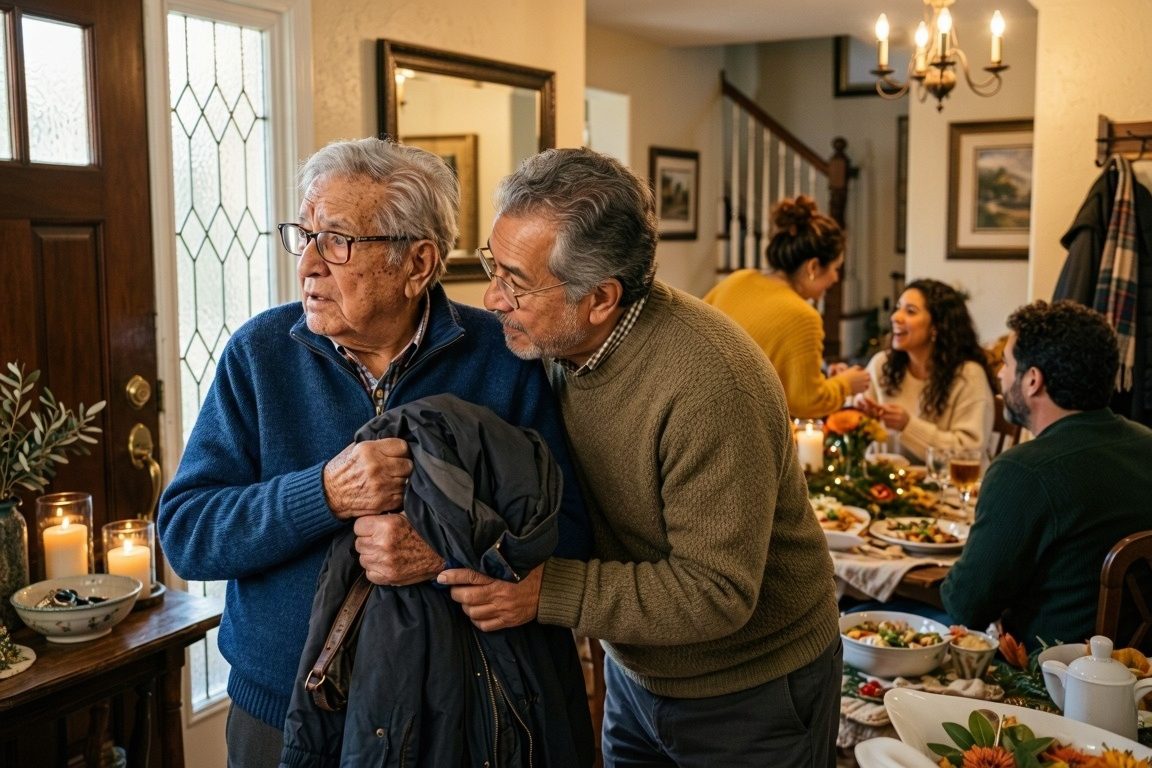
Step by step
What not to do
- Do NOT argue or try to convince them they are already home. Saying 'This IS your home!' will only escalate their distress. Their brain cannot process that logic.Instead, validate the feeling and redirect.
- Do NOT use negative consequences like 'If you can't behave, we're leaving.' This is a childlike punishment that will create hurt feelings and make the situation worse. As one expert warns, 'these statements change nothing except they create hurt feelings.' Instead, use a gentle, positive excuse to leave.
- Do NOT force them to stay in the gathering if they are clearly agitated. Pushing them to 'just sit down and enjoy it' will increase their anxiety and may lead to a meltdown. It is better to leave early and preserve everyone's dignity.
- Do NOT take their behavior personally. They are not trying to ruin your holiday. Their brain is overwhelmed. Remind yourself that this is a symptom of the disease, not a personal attack.
- Do NOT try to explain the situation with long, detailed reasons. A person with dementia cannot process complex explanations when they are distressed. Keep your responses short, simple, and reassuring. As one expert advises, 'keep things as short and simple as possible.'
- Do NOT leave them unattended near the front door or with access to car keys. If the urge to leave is strong, they may try to leave unsupervised, which is dangerous. Remove keys from sight and consider using a sign on the door that says 'STOP' or 'CAUTION' as a visual deterrent.
Key points
- The 'I want to go home' cry is about a feeling of safety, not a physical location. Validate the feeling, do not argue.
- Use the 'delay and redirect' technique: validate, offer a simple delay (snack, restroom), then redirect to a calming activity.
- End the gathering on a positive note if needed. Use a gentle excuse, not blame.
- Control the environment: reduce noise, limit guests, remove visual cues like coats and keys.
- Take care of yourself. The behavior is not a personal rejection. You are doing a hard job with love.
- Plan ahead: know your loved one's best time of day, have a quiet room ready, and have an exit strategy.
Videos
 Ep. 127: Holidays and People Living with DementiaThis video directly addresses the emotional triggers of the holiday season and offers practical strategies for managing the 'want to go home' behavior, including the importance of keeping gatherings small and being willing to change plans.
 Dementia and The HolidaysThis video provides a compassionate overview of why holidays are challenging for people with dementia and gives concrete tips for adjusting traditions to reduce stress and agitation.
 Is It Good To Take People With Dementia Or Alzheimer's Out?This video helps you weigh the pros and cons of taking your loved one to a holiday gathering, with advice on how to assess their readiness and how to handle a situation where they want to leave.
 Dementia Wandering: Prevention + What to Do If They Go Missing | Dr. Khushboo VermaThis video covers the safety aspects of the urge to leave, including how to prevent wandering and what to do if your loved one does leave unsupervised. Essential for holiday safety planning.
2 more videos
 How to survive the holidays as a dementia caregiverThis video focuses on the caregiver's own survival, offering strategies for managing stress, setting boundaries, and letting go of perfectionism during the holidays.
 When someone with dementia wants to leave the houseThis video provides a step-by-step walkthrough of how to respond when the person is actively trying to leave, including specific phrases to use and how to redirect them safely.
Background
The 'Home' They Are Searching For Is a Feeling, Not a Place
When your loved one says they want to go home during a holiday gathering, they are not arguing about geography. They are expressing a powerful emotional need. The dementia has damaged the parts of the brain that process new environments and manage emotions, so a room full of relatives, holiday music, and unfamiliar decorations can feel overwhelming and disorienting. As one expert explains, 'home is our safe haven... our sanctuary.' The person is feeling lost, anxious, and disconnected, and their brain is telling them to flee to the one place that feels safe: the memory of 'home.' This is not a logical choice; it is a survival instinct.
Why the Holidays Are a Perfect Storm for This Behavior
The holiday gathering is a recipe for this kind of distress. The routine that provides comfort is broken. The house is full of extra people, noise, and activity. The person may be tired from the day's events, and as the evening wears on, their ability to cope diminishes. This is especially true if the gathering happens during their usual rest time or in the late afternoon/evening when 'sundowning' can make agitation worse. Additionally, the emotional weight of the holidays, reminiscing about past traditions, missing loved ones who have passed, can stir up old, primitive emotions. As Teepa Snow notes, 'old emotions primitive brain emotions can come up and then suddenly i feel lost and disconnected.' The urge to leave is a direct result of this sensory and emotional overload.
It Is Not About You or the Party
It is crucial to separate your feelings from their behavior. You may feel hurt, embarrassed, or frustrated that they want to leave the gathering you worked so hard to create. But their brain is not capable of appreciating your effort in that moment. They are in distress. The behavior is a symptom of the disease, not a rejection of you or the holiday. Understanding this allows you to respond with compassion instead of anger, and to take the practical steps that will actually help them feel better.
Practical tools
6
The 'Validation and Redirect' Script
Keep this simple script in your pocket. When they say 'I want to go home,' say: 'Oh, I hear you. You miss home. It's so nice there. Let's just have a little snack first, and then we'll figure it out.' This validates the feeling and offers a simple, non-threatening delay.
The 'Gentle Excuse' Exit Strategy
Have a pre-planned, positive excuse to leave the gathering if needed. Examples: 'Oh, I just remembered I have a hair appointment,' or 'I promised a friend I would watch her kids so she could go visit somebody.' This allows you to leave without blaming the person with dementia.
The 'Sensory Soother' Kit
Prepare a small bag with items that provide comfort and familiarity:
When the urge to leave arises, offer one of these items to help ground them in the present moment.
The 'Visual Cue' Door Sign
Place a sign on the front door that says 'STOP' or 'CAUTION' in large, red letters. This can serve as a visual reminder that discourages the person from trying to leave. This is a simple, non-confrontational environmental modification.
The 'Pre-Gathering' Routine Check
Before the gathering, ensure your loved one has had enough rest, a good meal, and some exercise. A tired, hungry person is much more likely to become agitated. Also, try to schedule the gathering at a time of day when they are typically at their best (e.g., morning or early afternoon, not evening).
The 'Post-Gathering' Debrief for Yourself
After the event, take 10 minutes to write down what worked and what didn't. Note the time of day, the number of people, the noise level, and the person's mood. This will help you plan a better experience next time. You are learning and adapting, and that is a sign of a good caregiver.
Different situations
For someone in early-stage dementia (still living at home, mild cognitive changes)
You may be able to have a brief, calm conversation about the feeling. Say, 'I know this is a lot of people. Let's go sit in the quiet room for a bit.' They may still be able to rejoin the gathering after a short break. The key is to offer a sensory break before the urge to leave becomes overwhelming.
For someone in middle-stage dementia (more confusion, frequent wandering)
The 'delay and redirect' technique is your best tool. Do not engage in lengthy explanations. Use the 'gentle excuse' to leave early if needed. The environment should be carefully controlled: keep the gathering small (no more than 4-6 people), keep noise low, and have a quiet room available. As Teepa Snow advises, 'keep it small so we can enjoy'.
For someone in late-stage dementia (limited communication, high agitation risk)
The goal is to minimize any distress. A holiday gathering may not be appropriate at all. Consider a very short visit (15-30 minutes) from one or two close family members at a time, in a quiet, familiar room. The person may not recognize anyone, and the noise and activity will be overwhelming. Prioritize their comfort over tradition. As one expert says, 'if it's not working be willing to let it go'.
For a spouse caregiver vs. an adult child caregiver
A spouse may feel a deeper personal rejection when their partner wants to 'go home.' It is important for the spouse to remember that the partner is not rejecting them, but rather the overwhelming environment. An adult child may feel pressure to 'host the perfect holiday' for their parent. Let go of that pressure. The goal is connection, not perfection. Both caregivers should have a backup plan and a support person to talk to afterward.
For someone with Lewy body dementia (fluctuating cognition, visual hallucinations, sensitivity to noise)
This person is especially sensitive to sensory overload. The holiday lights, music, and crowd can trigger hallucinations or extreme anxiety. Keep the environment very simple: dim lights, no music, and only one or two visitors at a time. The urge to 'go home' may come on suddenly and be accompanied by confusion or fear. Use a very calm, slow voice and offer a familiar object (like a favorite hat or scarf) to help ground them.
For the doctor
3
- If the urge to leave is accompanied by aggressive behavior (hitting, pushing, yelling) that you cannot manage safely, discuss with your clinician whether a medication adjustment or a referral to a behavioral health specialist is appropriate.
- If your loved one has a history of wandering and has gotten lost or injured in the past, ask your clinician about a personal GPS tracker or a MedicAlert® + Alzheimer's Association Safe Return® bracelet.
- If the person is taking medication for anxiety or agitation, ask your clinician if the timing of the holiday gathering could be adjusted to coincide with the medication's peak effectiveness.