What not to do
- Do not rely on reasoning or memory to explain things or ask questions.
- Do not rush through care tasks or use a hurried tone.
- Do not use unfamiliar music, loud noises, or sudden changes in routine.
Key points
- The deep limbic system (emotions, survival instincts, physical needs) often remains functional long after memory and planning areas are damaged.
- Your approach matters more than your words: a calm tone, gentle touch, and warm facial expression signal safety to the emotional brain.
- Focus on what remains: sensory connections (touch, music, familiar scents) are powerful tools for connection, especially in later stages.
- Simplify everything: one-step instructions, visual cues, and a predictable daily routine reduce confusion and distress.
- When your loved one is upset, check physical needs first (hunger, thirst, bathroom, pain, temperature) before trying to calm them emotionally.
- Never argue or try to reason with a delusion. Validate the feeling behind the statement and redirect to a comforting activity.
Videos
 Brain Changes and DementiaThis video visually explains which brain parts are affected and which remain, helping you understand the 'why' behind the behaviors you see.
 Dementia Progression: What I Wish Caregivers Were ToldOffers a candid look at what caregivers are not told about the emotional and practical journey, reinforcing the importance of focusing on remaining abilities.
 Waiting Months for a Dementia Specialist? Do These 8 Things Now | Dr. Khushboo VermaProvides immediate, actionable steps you can take while waiting for a specialist, including strategies that work with the brain's remaining functions.
 Teepa for Ten | Medical Providers, What Would Be Helpful After You Give a Diagnosis?Teepa Snow explains how to use the Positive Approach to Care, which is built on understanding what brain parts still work and how to connect through them.
2 more videos
 What is Sundowning?Explains why the brain's fatigue in late afternoon triggers agitation and how to use sensory and routine strategies to prevent it.
 The Vitamin Deficiency that Mimics Dementia - Dr. BergHighlights that some dementia-like symptoms can be caused by reversible vitamin deficiencies or medication side effects, which is important to discuss with a clinician.
Background
The Brain's Two Main Systems: What Stays and What Goes
Your brain has two major groupings. Deep in the center is the limbic system, the first system to develop. It's the part that says 'thrive to survive' and handles core functions like hunger, thirst, elimination, wake-sleep cycles, temperature control, and the ability to know whether you like or dislike something. This system also manages emotions and impulses. In dementia, this deep part often remains functional for a long time, which is why your loved one can still feel fear, comfort, pleasure, or irritation even when they can't explain why. The outer parts of the brain, especially the hippocampus and frontal lobes, are usually damaged first. The hippocampus is critical for forming new memories, and the frontal lobes handle planning, judgment, and social behavior. That's why your loved one may forget what you just said but still react to your tone of voice or a gentle touch.
Why This Matters for Your Daily Care
Because the limbic system stays active, your loved one is still responding to the emotional and sensory world around them. They may not remember your words, but they will remember how you made them feel. This is why a calm, warm approach can soothe agitation, while a rushed or frustrated tone can trigger alarm. The brain also has distinct regions for language, movement, vision, and hearing. In dementia, some of these areas may be more affected than others. For example, the occipital cortex (vision) might still work well, while the auditory cortex (hearing) is compromised. This means your loved one might see your face clearly but struggle to understand your words. Knowing this helps you adjust: use visual cues, gestures, and a calm facial expression rather than relying only on spoken instructions.
What Remains: A Focus on Abilities, Not Losses
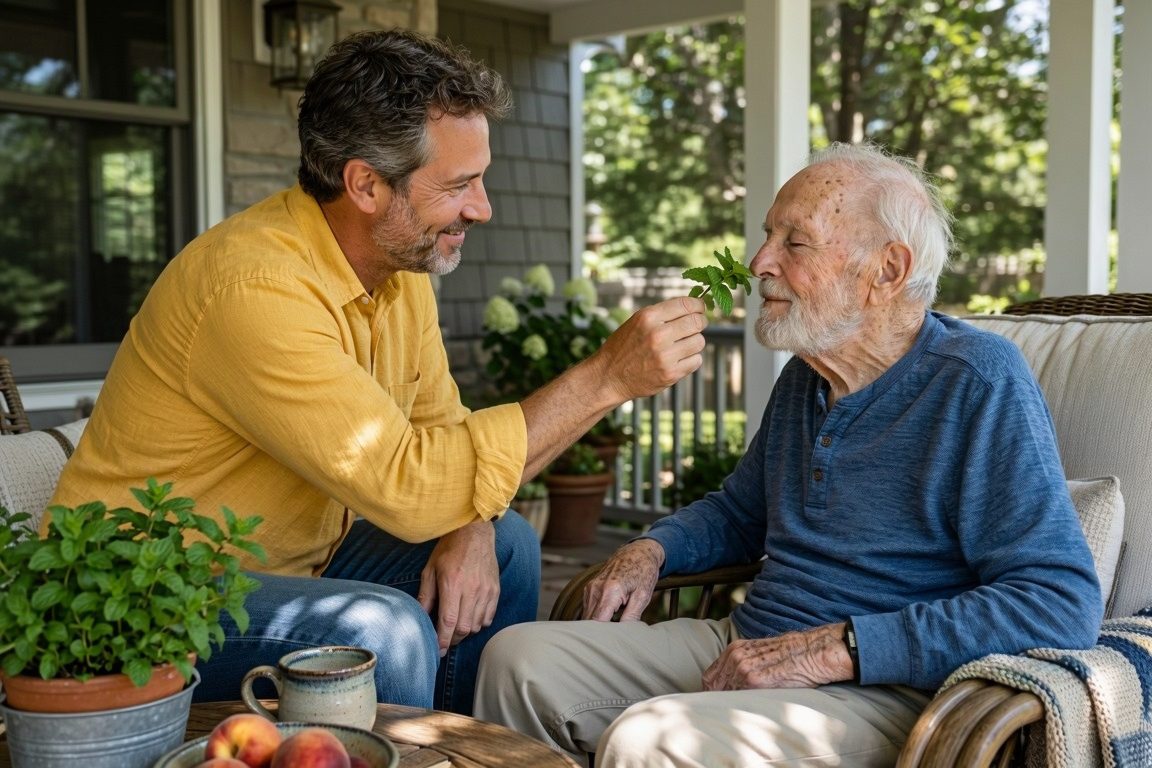
Even in later stages, certain abilities often remain. The tactile sense stays strong, so touch can be a powerful way to connect. The person can still feel a warm hand, a soft blanket, or the comfort of a hug. They can still connect auditorially through familiar music or a soothing voice, and visually through familiar faces or objects. In late stages, when verbal communication is very limited, these sensory connections become the primary way to reach them. By focusing on what remains rather than what is lost, you can create moments of genuine connection. This is not about pretending the losses aren't there, but about working with the brain they still have.
Practical tools
4
Calm voice technique
Use a slow, warm, predictable tone throughout all care interactions; avoid sharp or hurried speech.
Tactile comfort items
Soft blankets, hand lotion, or a weighted lap pad can provide grounding through intact touch sense.
Familiar music playlist
Prepare a short list of songs from the person’s young adulthood (ages 15-25) that they know well; play during agitation or care transitions.
Routine schedule chart
Post a simple visual schedule (e.g., breakfast → bath → walk → lunch) to cue both caregiver and person; stick to exact times daily.
Different situations
Lewy body dementia
In Lewy body dementia, the visual processing areas are often affected early, causing hallucinations and visual-spatial problems. Rely less on visual cues and more on auditory and tactile ones. Also, balance and movement issues are more prominent, so safety around falls is critical. The person may have fluctuating attention, so be patient and repeat instructions when they seem 'present.'
Late stage dementia
In late stages, verbal communication is very limited. Focus entirely on sensory connection: gentle touch, soft music, familiar scents. Use the 'Sensory Comfort Kit' extensively. The person may not respond verbally but may show a change in breathing, a slight smile, or relaxation. Your calm presence is the most important tool. Simplify the environment to reduce any stimulation that could cause distress.
Spouse vs. adult child caregiver
As a spouse, you have a deep history of shared memories. Use this: talk about old times, play 'your song,' look at photo albums. Your emotional bond is a powerful tool. As an adult child, you may need to step into a role reversal. Be gentle with yourself and your parent. Use the validation phrases often, and remember that your parent may see you as a figure from their past. Go with that rather than correcting them.
In a facility
In a facility, the environment is not under your control, but you can still use these strategies during visits. Bring familiar objects from home, use the same calm approach, and share a simple activity like looking at a magazine or listening to music together. Advocate for a consistent routine with staff. If your loved one is agitated, ask staff to check physical needs first and to reduce stimulation in the room.
Frontotemporal dementia (FTD)
In FTD, the frontal and temporal lobes are affected early, causing changes in personality, social behavior, and language. The limbic system may be less affected initially, so emotions are still strong, but the person may lose empathy or impulse control. Use very simple, direct language and avoid reasoning. Focus on redirecting to a safe activity. The 'Calm Approach' is essential because they may react strongly to frustration or perceived threat.
For the doctor
5
- Ask your doctor if any of your loved one's medications (antacids, bladder control meds, sleep aids, antidepressants, anxiety meds, statins, blood pressure meds, or corticosteroids) could be contributing to or worsening dementia symptoms. Some medications can mimic or accelerate cognitive decline.
- If you notice new or worsening swallowing difficulties, coughing or choking with food or drink, or weight loss, discuss a swallowing evaluation with a speech-language pathologist. This is a safety issue that requires professional assessment.
- If your loved one has a history of heart disease, diabetes, stroke, high blood pressure, or high cholesterol, work with their doctor to manage these conditions. Vascular health directly affects brain health, and untreated vascular issues can worsen dementia symptoms.
- If your loved one has sudden changes in behavior, confusion, or physical symptoms, ask the doctor to rule out reversible causes like infection (especially urinary tract infection), dehydration, electrolyte imbalance, or vitamin deficiencies (such as B12 or vitamin D). These can mimic or worsen dementia.
- Discuss with the doctor whether a referral to a neurologist or neuropsychologist would be helpful for a more detailed assessment of which brain functions are affected and what specific strategies might help. This can guide your care plan.