
Step by step
What not to do
- Do not say 'Put your bib on for dinner.' This word is strongly associated with babies and can feel humiliating.Instead, say 'Let's put this cover on to keep your shirt nice.'
- Do not say 'You forgot to take your pills.' This points out a failure and will not help them remember tomorrow; it only upsets everyone.Instead, simply hand them the pills and say 'Here you go, Mom.' If they say they already took them, make up a gentle excuse like 'No biggie, maybe you were distracted, here you go.'
- Do not say 'Calm down.' This almost always makes agitation worse because it invalidates the person's feelings.Instead, say 'I can see you're upset. I'm here with you. We'll work through this together.'
- Do not say 'Don't cry' or 'Quit crying.' This dismisses their sadness and can increase distress.Instead, say 'I see you're sad. That's okay. I'm right here.' Then gently redirect to a pleasant memory or activity.
- Do not argue or correct delusions. If your loved one says something untrue, like 'You're having an affair,' do not say 'That's not true.' This escalates tension.Instead, validate the emotion: 'I can see you're worried. I'm here with you. Let's sit down and talk.'
- Do not use a loud or bossy tone, even if you are stressed. A raised voice can trigger a fight-or-flight response.Instead, use a calm, even tone, and speak as you always would, they are still picking up on your emotional 'vibrations.'
Key points
- Always ask yourself before speaking: 'Will this help or hurt their self-esteem?' If it points out a failure or infantilizes, rephrase.
- Replace 'diaper' with 'brief' or 'protective underwear', unless your loved one prefers the word 'diaper,' in which case use that.
- Replace 'bib' with 'apron' or 'cover' to avoid baby associations.
- Never say 'calm down' or 'don't cry'; instead validate the emotion and offer partnership.
- Give a timely warning before any care task and ask for permission to preserve control.
- Use distraction and redirection with a calm tone and gentle touch to de-escalate without confrontation.
Videos
 DO NOT Say CALM DOWN! (What to Say Instead!) 'What *NOT* To Do in Dementia'This video directly addresses the trigger phrase 'calm down' and offers specific alternative phrases to use instead, which is the core of this sub-article.
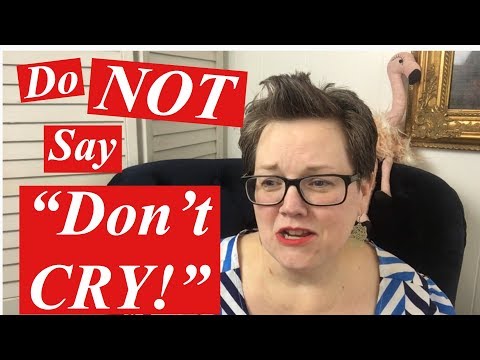 DO NOT Say 'DON'T CRY!' (What to Say Instead) 'What *NOT* To Do in Dementia'This video covers another common trigger phrase ('don't cry') and provides respectful alternatives, expanding the caregiver's toolkit for emotional situations.
 Caregiver Training: Aggressive Language/Behavior | UCLA Alzheimer's and Dementia Care ProgramThis video demonstrates how to respond to aggressive language and behavior with calm, simple instructions and distraction techniques, which complements the language-shift strategies in this article.
 Ep. 196: Dementia Does Not Rob a Person of Their Dignity...This episode reinforces the central message that dignity can be preserved through our response, which is the foundation of using respectful alternative phrasing.
2 more videos
 How Does Dementia Affect Communication Skills?This video explains the brain changes behind communication difficulties, helping caregivers understand why trigger words are so impactful and why alternative phrasing works.
 How Dementia Affects Language SkillsThis video deepens understanding of how dementia affects language processing, which is key to choosing words that are both respectful and effective.
Practical tools
6
The 'Brief' vs. 'Diaper' Phrase Bank
Keep a mental list of alternatives: 'protective underwear,' 'brief,' 'undergarment,' 'incontinence pad.' When speaking to your loved one, say: 'Let's get you into a fresh brief so you feel comfortable.' If they use a different word themselves, use that word, their comfort is the priority.
The 'Apron' or 'Cover' Reframe
Instead of 'bib,' say 'apron,' 'cover,' or 'napkin.' For example: 'Here's your apron to keep your shirt clean while we eat.' This turns a potentially embarrassing item into a practical, adult accessory.
The 'I'm Here' Script for Emotional Distress
When your loved one is upset, use this script: 'I can see you're feeling [emotion]. That's okay. I'm here with you. We'll figure this out together.' This validates without demanding change and offers partnership.
The 'Timely Warning' Technique
Before any care task, give a brief heads-up: 'In a few minutes, I'm going to help you change your clothes. Is that okay?' This reduces startle and gives the person a sense of control. Follow with a calm, gentle approach.
The 'Distraction Toolkit'
Keep a small basket of items handy: a soft photo album, a favorite snack, a familiar object like a stuffed animal or a smooth stone. When resistance or agitation arises, offer one of these and say, 'Look at this, remember when we...' This redirects attention without confrontation.
The 'Hands Busy' Strategy for Toileting
During toileting or changing, give your loved something to hold, a washcloth, a book, a small pillow. This keeps their hands occupied and reduces the urge to grab or resist. Say: 'Here, hold this for me while I help you.'
Different situations
For Lewy Body Dementia
People with Lewy body dementia are especially sensitive to tone and sudden movements. Use an even, calm voice and avoid any loud or abrupt language. The 'timely warning' is critical here because they may startle easily. Also, be aware that visual hallucinations are common; if they mention something you don't see, validate the emotion: 'That sounds scary. I'm here with you.'
Late Stage Dementia
In late stages, the person may not understand words but will still pick up on your tone and body language. Use a soft, rhythmic voice and gentle touch. Instead of complex phrases, use simple, loving words: 'Time to get comfy, sweetheart.' The goal is to convey safety and warmth, not specific meaning.
Spouse vs. Adult Child Caregiver
A spouse may find it harder to use 'dignity language' because of the history and intimacy. It can feel awkward to say 'protective underwear' to a partner you've known for decades. If your spouse prefers 'diapers,' use that word, it's what they understand. For an adult child, the parent may feel more shame about needing help; use extra gentle language like 'Let me help you freshen up' and offer choices to preserve their sense of authority.
In a Care Facility
In a facility, staff may use trigger words out of habit. As a family caregiver, you can advocate by modeling respectful language. Say to staff: 'My mom prefers we call them briefs, not diapers. Could you please use that word?' You can also post a small sign near the bed with preferred terms. Consistency across all caregivers reduces confusion and preserves dignity.
For Frontotemporal Dementia (FTD)
FTD often affects language and behavior early. The person may be more sensitive to perceived criticism. Avoid any phrasing that sounds like a command or correction. Use collaborative language: 'Let's do this together' instead of 'I need you to...' Also, be prepared for them to use blunt or inappropriate language themselves, do not react with shock or correction. Stay calm and redirect.
For the doctor
3
- If your loved one becomes physically aggressive during care tasks despite using respectful language, discuss with a doctor or occupational therapist about possible pain, infection, or medication side effects.
- If incontinence products cause skin breakdown or rashes, ask a nurse or doctor about the best type of brief or pad for your loved one's skin health.
- If your loved one refuses all care and becomes severely agitated, talk to a dementia care specialist about whether a medication adjustment or a different care approach might help.