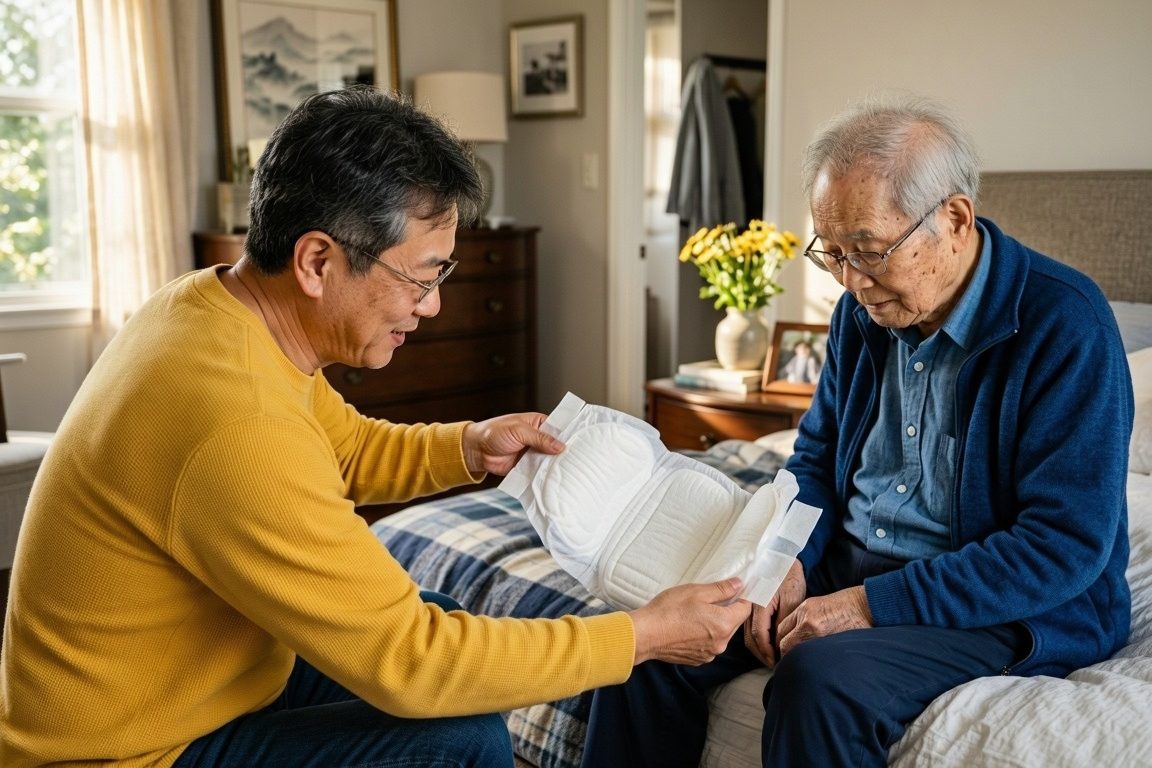
Step by step
What not to do
- Do not use during an active UTI without consulting a clinician; watch for cloudy/foul urine, fever, sudden confusion, or agitation.
- Do not leave wrap on for more than 8–12 hours; check every 2–4 hours during day and at least once overnight.
- Do not assume wrap contains stool, it is for urine only; use a full brief or pad for bowel incontinence and change both after a bowel movement.
- Do not force the wrap on an agitated or combative person; pause, use a calm tone, and offer a small choice to ease resistance.
- Do not skip skin checks at every change; look for redness, rash, or broken skin, stop use on affected area, and contact clinician if signs of infection appear.
Key points
- The QuickChange Wrap is an external urinary management system for men that keeps skin drier than traditional briefs, reducing the risk of rashes and UTIs.
- It is designed for urine only, if the person has bowel incontinence, you will still need a brief or pad.
- The wrap is one size but can be adjusted for different body types, including men with scrotal edema.
- Change the wrap every 2-4 hours during the day and at least once at night to prevent skin breakdown.
- Always clean and dry the skin thoroughly before applying a new wrap, and use barrier cream if recommended.
- Insurance coverage may be available through Medicare Part B, commercial insurance, or the VA, ask the manufacturer or a clinician for help with prior authorization.
Videos
 Kimberly Anderson Shares How the QuickChange Wrap is Making a Difference in People's LivesThis video features the director of business development at UI Medical, the makers of the QuickChange Wrap. She explains how the product works, addresses different body types (including scrotal edema), and discusses insurance coverage options. It's the most direct source of information on the product itself.
 Time with Teepa: How to Help Males Living with Brain Change Manage IncontinenceTeepa Snow demonstrates a hands-on approach to male incontinence care, including the use of external catheters. She emphasizes the importance of empathy, proper technique, and understanding the person's experience. This video is invaluable for learning how to approach changes with dignity and calm.
 The Truth about Incontinence and Waste VolumeThis video explains how much urine a typical adult produces and how different products handle volume. It helps caregivers understand why frequent changes are necessary and how the QuickChange Wrap's absorbent pad works to keep moisture away from the skin.
 Urinary Tract Infections in Dementia: What Caregivers Need to KnowUTIs are a major concern for men with dementia and incontinence. This video covers signs, prevention, and when to seek medical help. It reinforces why keeping the skin dry, as the QuickChange Wrap aims to do, is so important.

Background
What the QuickChange Wrap Is and How It Works
The QuickChange Wrap is an external urinary management system for men. Unlike a traditional condom catheter that uses adhesive to stick directly to the penis, which can be painful to remove, especially if it catches on pubic hair, the QuickChange Wrap uses a wrap-around design that holds a soft, absorbent pad against the body. It's not a catheter that goes inside the body; it's an external collection device. The wrap itself is one size, but it comes with usage guides that address different body types and challenges, including scrotal edema (swelling of the testicles). For men with scrotal edema, the wrap can help separate the skin, contain urine, and elevate the scrotum to reduce chafing and infection risk when the person is lying down. The key feature is that it keeps moisture away from the skin, the center area of the pad dries out quickly after absorbing liquid, which helps prevent rashes and fungal growth.
Why It Matters for Men with Dementia and Incontinence
Incontinence is common in middle and late stages of Alzheimer's and other dementias. For men, managing urine can be especially tricky because of anatomy, mobility issues, and the person's ability to cooperate. Traditional adult briefs (diapers) can hold a lot of urine, but if they're not changed frequently, the moisture against the skin can lead to skin breakdown, yeast infections, and urinary tract infections (UTIs). UTIs are particularly dangerous for people with dementia because they can cause sudden confusion, agitation, or a decline in function. The QuickChange Wrap offers an alternative that can be changed more easily and keeps the skin drier. It's also less bulky than a full brief, which can be more comfortable for a man who is bedbound or in a wheelchair. However, it's important to note that this product is designed for urine only, it does not contain stool. If the person has bowel incontinence, you'll still need a brief or pad to manage that.
How It Differs from Other Products
A common question is how the QuickChange Wrap compares to pull-up disposable underwear or tab-style briefs. Pull-ups are designed for people who can stand and pull them up themselves, they have less absorption and are not ideal for someone who is bedbound or needs full assistance. Tab-style briefs (like adult diapers with side tabs) have more absorption and are easier to change when the person is lying down. The QuickChange Wrap is a different category: it's an external catheter system that doesn't require the person to be undressed completely. It can be used alone for urine, or it can be used inside a brief for extra protection. For men who are resistant to wearing a full brief, the wrap may feel less intrusive. But it does require the person to be still during application, which can be challenging if the person with dementia is agitated or confused.
Practical tools
3
QuickChange Wrap Positioning Guide for Scrotal Edema
If the man has scrotal edema, adjust the wrap to lift the scrotum away from the thighs to reduce chafing and prevent skin breakdown. Fit snugly but not tightly; consult manufacturer's guide for the specific adjustment technique.
Nighttime Change Strategy
Change and Skin Observation Log
Record date/time of each change, skin condition (redness, rash, breakdown), urine appearance and amount, and signs of discomfort. Use a notebook or notes app to track patterns and share accurate information with clinicians.
Different situations
Late-stage Alzheimer's or dementia with limited mobility
In late stages, the person is likely bedbound or in a wheelchair. The QuickChange Wrap can be used with a bedside drainage bag for continuous collection. Check the wrap every 2-3 hours to prevent skin breakdown. If the person is unable to communicate discomfort, watch for signs like grimacing, restlessness, or pulling at the wrap. Use a waterproof mattress cover and absorbent bed pads to protect the bed. Consider using a tab-style brief underneath the wrap for bowel incontinence.
Lewy body dementia (LBD)
People with LBD are more sensitive to medications and may have urinary incontinence due to anticholinergic side effects of some drugs. Discuss with the clinician whether any medications can be adjusted. LBD also causes fluctuations in cognition and alertness, so the person may be more cooperative at some times than others. Try to do changes when the person is most alert. Be aware that LBD can cause visual hallucinations, so the person may be frightened by the wrap or tubing. Use a calm, reassuring voice and explain what you're doing in simple terms.
Spouse caregiver vs. adult child caregiver
A spouse may feel more comfortable with intimate care but may also be more emotionally distressed by the role reversal. An adult child may feel awkward or embarrassed. In either case, use the same calm, matter-of-fact approach. If you are an adult child, remind yourself that this is a medical task, not a violation of privacy. If the person is resistant, try to involve them in the process: 'Can you hold this for me?' or 'Let's do this together.' If you feel overwhelmed, reach out to a support group or consider hiring a home care aide for some shifts.
In a long-term care or hospice setting
In a facility, the QuickChange Wrap may be used by professional staff. Make sure the staff is trained on the specific product and knows how to adjust it for scrotal edema or other issues. In hospice, the focus is on comfort. The wrap can help keep the person dry and reduce the need for full bed changes, which can be disruptive. However, if the person is near the end of life and has minimal urine output, a simple pad may be sufficient. Discuss with the hospice team what is most appropriate.
For veterans using VA benefits
The VA may cover the QuickChange Wrap as durable medical equipment if it is prescribed by a VA clinician. Contact the VA prosthetics department or the person's primary care provider to start the process. You may need a prior authorization form and a statement of medical necessity. The VA also offers caregiver support programs that can provide training and respite. Ask about the Program of Comprehensive Assistance for Family Caregivers (PCAFC) if the veteran has a service-connected disability.
For the doctor
6
- Ask the doctor or urologist if the QuickChange Wrap is appropriate for the person's specific anatomy and incontinence pattern. Some men may need a different size or type of external catheter.
- Discuss any skin issues, such as rashes, redness, or fungal infections, before using the wrap. The clinician may recommend a specific barrier cream or antifungal treatment.
- If the person has a history of recurrent UTIs, ask whether the wrap could help reduce infection risk by keeping the skin drier, or whether it might increase risk if not changed frequently enough.
- Ask about the best schedule for changes, every 2-4 hours during the day, and whether a nighttime change is necessary to prevent skin breakdown or infection.
- If the person has scrotal edema, ask the clinician for specific guidance on positioning the wrap to avoid pressure or discomfort.
- Discuss any medications that may affect urinary function, such as diuretics, anticholinergics, or cholinesterase inhibitors. Some medications can worsen incontinence or cause constipation, which can affect the fit of the wrap.