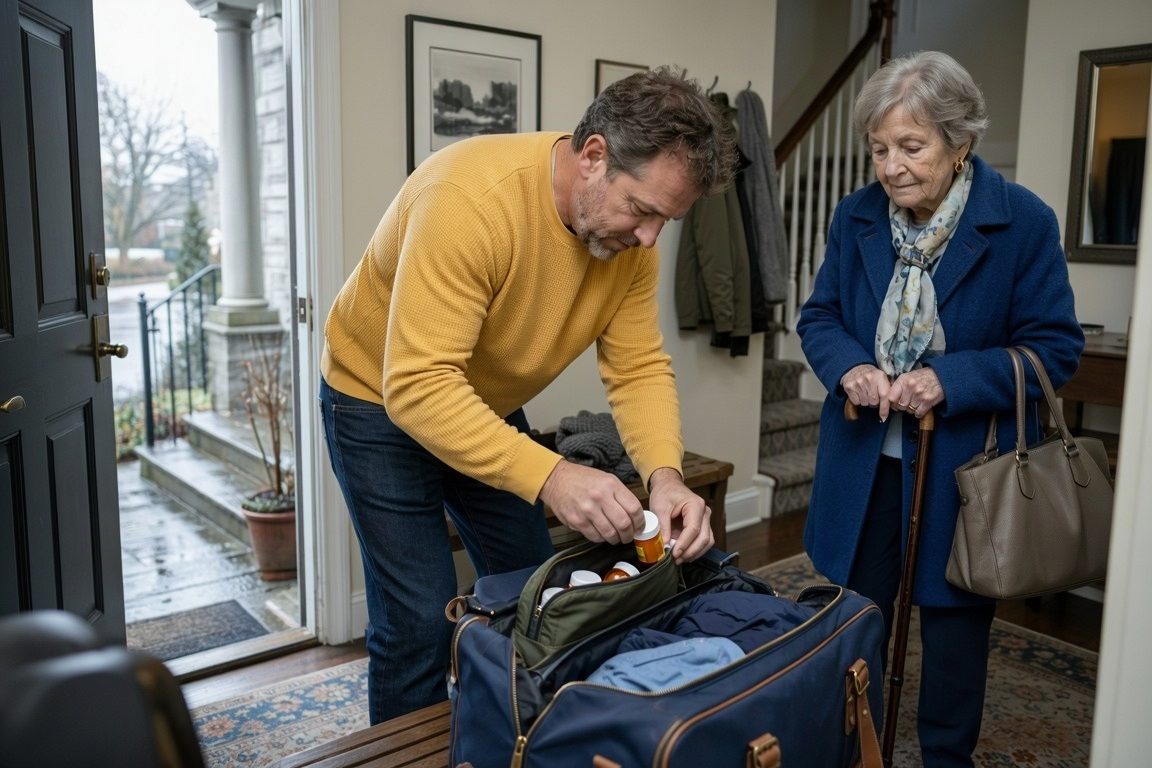
Step by step
What not to do
- Do not store medications in a single mixed container (e.g., all pills in one bottle). This makes it impossible to identify doses and can lead to dangerous errors.Instead, keep each medication in its original labeled bottle.
- Do not wait until an emergency to think about medications. If you are caught off guard, you may forget critical items or grab the wrong ones.Instead, prepare the go-bag now and update it regularly.
- Do not assume your loved one will cooperate during an evacuation. They may resist or become agitated.Instead, practice the routine and use calming items (like their favorite music or a familiar blanket) to reduce distress.
- Do not leave medications in the bathroom or on a nightstand where they can be forgotten or mixed up.Instead, keep the go-bag in a central, visible location (e.g., by the front door) and store daily medications in a locked cabinet or drawer.
- Do not forget to include a backup plan for medications that require refrigeration (e.g., insulin or certain liquid antibiotics).Instead, pack an insulated bag with a reusable ice pack and label it clearly so it is not thrown away.
- Do not rely solely on your memory. Even if you think you know the dosages, stress can cause you to forget.Instead, always have a written list in the go-bag and a digital copy on your phone.
Key points
- Prepare a dedicated go-bag with a 7-day supply of all medications in original bottles, a current medication list, and a MAR sheet for backup caregivers.
- Store a copy of the medication list on your refrigerator and a digital copy on your phone for easy access by emergency responders.
- Update your go-bag at least every season or whenever a medication changes, set a phone reminder.
- Include comfort items (favorite blanket, music, snacks) to reduce your loved one's distress during evacuation.
- Practice a monthly 'fire drill' to make the routine familiar and reduce anxiety for both of you.
- Personalize the plan for your loved one's dementia type and stage, and always discuss medication changes with your clinician.
Videos
 Dementia Emergency PlanningThis video covers the essentials of creating an emergency kit and plan for a person with dementia, including medication organization and backup caregiver instructions.
 5 Tips for Managing Medications in Alzheimer’s DiseaseProvides practical tips for establishing a medication routine and using visual cues, which can be adapted for emergency preparedness.
 Dr. Catie Chung 'You Don't Know What You Don't Know' with Senior CareDiscusses the importance of having a care notebook and emergency contacts readily available, which complements the medication go-bag concept.
 Home Safety and Dementia: Module 3Covers home safety modifications and storage of medications to prevent accidents, relevant to organizing for evacuation.
2 more videos
 Terminal Agitation: Empowering Caregivers in End-of-Life SupportWhile focused on end-of-life, it provides insights on managing agitation and using comfort medications, which can be useful in high-stress evacuation scenarios.
 Michele Bolton Founder and CEO of MY911, IncDiscusses emergency preparedness for seniors, including medication management and the importance of a go-bag.
Background
Why Medication Organization Matters in an Emergency
In a dementia emergency, your loved one may become confused, agitated, or unable to communicate. Medications are often critical for managing symptoms like anxiety, agitation, pain, or underlying health conditions. If you have to evacuate quickly, you might forget a bottle, grab the wrong one, or leave behind a medication that is essential for your loved one's stability. The stress of the situation can also make it harder for you to think clearly, so having a pre-packed system reduces the cognitive load on you and ensures nothing is missed.
The Unique Challenges of Dementia in Evacuations
People with dementia may resist leaving home, become distressed by unfamiliar environments, or have difficulty understanding why they need to take medications. They might also have swallowing difficulties, sundowning symptoms, or specific medication timing needs (e.g., medications that must be taken with food or at night). Additionally, if you are the primary caregiver, you may need to hand off care to a neighbor or family member during an evacuation, so your system must be clear enough for someone else to use. The goal is to create a system that is simple, portable, and foolproof, so that even if you are not the one administering the medications, your loved one stays safe.
Practical tools
6
The 'Go-Bag' Checklist
A pre-printed checklist you can tape to the inside of your go-bag lid. Include:
Medication List Template
Create a simple table with columns:
Print multiple copies: one in the go-bag, one on the fridge, one in your wallet, and one in your car glove compartment. Update it every time a medication changes.
Pill Organizer with Labels
Use a weekly pill organizer with large, clear labels for each day and time (e.g., 'AM' and 'PM'). This is helpful for daily use, but always keep the original bottles in the go-bag as backup. For evacuation, you can grab the organizer if you have time, but the bottles are safer.
Insulated Medication Bag
A small, soft-sided cooler bag (e.g., from a pharmacy or outdoor store) with a reusable ice pack. Use it for refrigerated medications. Write 'REFRIGERATED MEDS' on the outside and include a note: 'Keep cool, do not freeze.'
Care Notebook (Physical or Digital)
A binder or a secure cloud document (e.g., Google Doc) that contains:
Share access with a trusted backup caregiver.
Pharmacy Contact Card
A small card with the phone number and address of your loved one's pharmacy, plus the phone number of a 24-hour pharmacy chain. Keep one in your wallet and one in the go-bag. In an evacuation, you can call ahead to have a short-term supply ready.
Different situations
Lewy body dementia (LBD) or Parkinson's disease dementia
These individuals are often very sensitive to medications, especially antipsychotics. Include a note in the go-bag: 'Avoid haloperidol (Haldol) and other typical antipsychotics, can cause severe rigidity and confusion.' Also, they may have swallowing difficulties, so pack liquid or dissolvable forms if available. Discuss with your clinician which medications are safe to crush or mix with food.
Late-stage dementia (severe cognitive decline, bedbound)
Focus on comfort medications (e.g., pain relievers, anti-anxiety meds) and medications for swallowing or bowel issues. Include a 'comfort kit' with sublingual (under-the-tongue) or transdermal (patch) forms. Also pack a suction machine or oral care supplies if needed. The go-bag should be small enough to fit in a wheelchair or stretcher.
Spouse caregiver vs. adult child caregiver
If you are a spouse, you may be the only person who knows the medication routine. In an evacuation, you might be separated. Include a detailed MAR sheet and a list of 'what to say to calm Mom/Dad' (e.g., 'Let's go for a ride,' 'We're going to see the grandkids'). If you are an adult child, you may need to coordinate with siblings or a facility. Keep a digital copy of all documents shared with siblings via a secure app.
Living in a facility (assisted living or memory care)
The facility should have its own emergency plan, but you should still have a personal go-bag. Include a copy of the medication list, a letter from the doctor authorizing you to pick up medications, and a list of the facility's emergency contacts. If you evacuate with your loved one, you may need to administer medications yourself, so bring the MAR sheet.
Medicaid or limited financial resources
If you cannot afford a 7-day supply of all medications, prioritize the most critical ones (e.g., heart medications, antipsychotics, seizure meds). Contact your local Area Agency on Aging or the Alzheimer's Association for help with emergency medication assistance programs. Also, ask your pharmacy if they can provide a 3-day emergency supply at no cost.
For the doctor
5
- Ask your doctor or pharmacist: 'Which of my loved one's medications are time-critical and cannot be skipped even for a day?'
- Ask: 'Is it safe to crush any of these medications if my loved one has trouble swallowing during an evacuation?'
- Ask: 'Can any of these medications be given in a different form (liquid, patch, injection) for easier administration in an emergency?'
- Ask: 'What is the best way to store medications that need refrigeration if I lose power for several days?'
- Ask: 'If we have to evacuate to a different state, will our prescriptions be valid there? Do I need a special letter from you?'