Step by step
What not to do
- Do not explain the disaster (e.g., 'There is a hurricane coming').
- Do not raise your voice or show panic on your face.
- Do not grab or physically force them to move quickly.
- Do not bring up or discuss the disaster once you are in a safer location.
Key points
- Your calm is contagious. Breathe slowly, speak softly, and move gently. Your loved one will mirror you.
- Validate the feeling, not the fact. Say 'I know this is scary' instead of 'There is nothing to be afraid of.'
- Do not use logic or long explanations. Use short sentences, one step at a time.
- Repetitive tasks (folding towels, sorting objects) soothe the dementia-affected brain. Keep a small basket of these items in your emergency kit.
- Create a quiet corner in any space. Use familiar music, a blanket, and your body to block chaos.
- Prepare a comfort kit ahead of time. Practice a low-key drill when there is no emergency.
Videos
 Dementia Emergency Preparedness: How to make sure your loved one stays safe in an emergencyThis video directly addresses disaster planning for dementia, including how to prepare a go-bag and what to expect in a shelter.
 Aggressive Behavior in People with Dementia | Linda Ercoli, PhD | UCLAMDChatDr. Ercoli explains why aggression happens and gives specific de-escalation techniques, including how to avoid physical contact and when to step away.
 10 Tips For Responding To Anger in DementiaPractical, step-by-step tips for responding to anger without escalating the situation, directly applicable to disaster-related agitation.
 What Stage of Alzheimer's is Anger?Helps you understand when anger typically appears in the disease course, so you can anticipate and prepare for it during a crisis.
2 more videos
 At What Stage Do Alzheimer's Patients Become Aggressive?Clarifies the stages where aggression is most likely, helping you tailor your disaster response to your loved one's current stage.
 What Stage Of Dementia Is Sundowning?Sundowning can spike during disasters due to disrupted routines and lighting changes. This video explains how to manage it.
Background
Why Disasters Are So Upsetting for Dementia
A person with dementia lives in the here and now, and they rely on familiar routines, familiar faces, and familiar spaces to feel safe. A disaster rips all of that away. Sirens, alarms, flashing lights, and the sudden appearance of emergency workers or neighbors can feel like an invasion. Their brain cannot process the 'why' behind the noise or the urgency. Instead, they feel a raw, wordless threat. This is not them being difficult; it is their brain trying to protect itself from something it cannot understand.
Your Emotions Are Contagious
Your loved one with dementia is a master at reading your face and your tone, even if they cannot follow your words. If you look panicked, they will feel panicked. If your voice is sharp, they will feel attacked. The source passages repeatedly stress that your anxiety can make their agitation worse. This is not about blaming you, it is about giving you a powerful lever. When you deliberately slow down, soften your voice, and relax your shoulders, you send a signal that says, 'We are safe. I am here.' That signal can short-circuit their rising fear.
They Cannot Reason Their Way Out of Fear
In dementia, the part of the brain that handles logic and reasoning is damaged. Telling them 'There is a hurricane coming, we have to go to the shelter' will not compute. They may become more frightened because they sense your urgency but cannot make sense of the reason. Instead of explaining, you must work with their emotions. Validate their feeling ('I know this is scary') and then redirect to something soothing or familiar. This is not lying; it is meeting them where they are.
Practical tools
2
Pre-packed 'go-bag' with familiar items
Include a comfort object (favorite blanket, photo, music player with headphones) plus spare clothes and medication.
Emergency ID bracelet
A bracelet with the person's name, dementia diagnosis, and your contact number so strangers can correctly approach and reassure them.
Different situations
Lewy body dementia or Parkinson's disease dementia
These types often come with visual hallucinations and extreme sensitivity to noise and light. During a disaster, the flashing lights of emergency vehicles or the sound of alarms may trigger vivid hallucinations or panic. Use the 'Quiet Corner Setup' aggressively, dim lights, soft music, and avoid any strobe-like effects. Validate any hallucinations without arguing: 'I see you are seeing something scary. I am here to keep you safe.' Do not try to convince them it is not real.
Late-stage dementia (bedbound, minimal verbal communication)
Your loved one may not be able to express fear verbally, but they will feel it in their body. Watch for signs: tense muscles, rapid breathing, grimacing, or crying. Use a very soft, rhythmic voice and gentle touch (if they tolerate it). Play familiar music at a low volume. Keep their body warm and covered. Do not move them quickly or without warning. Explain each step before you do it: 'I am going to lift your arm now.' Your calm tone is their main comfort.
Spouse caregiver vs. adult child caregiver
A spouse may have decades of shared history and can use inside jokes, pet names, or familiar routines ('Remember how we used to sit on the porch during storms?') to anchor their partner. An adult child may need to step into a more authoritative role, which can feel unnatural. If you are the adult child, practice saying, 'Mom, I am going to take care of you now. Let us do this together.' Use a warm but confident tone. Do not slip into a childlike or pleading voice, which can confuse them.
In a disaster shelter (unfamiliar environment, many strangers)
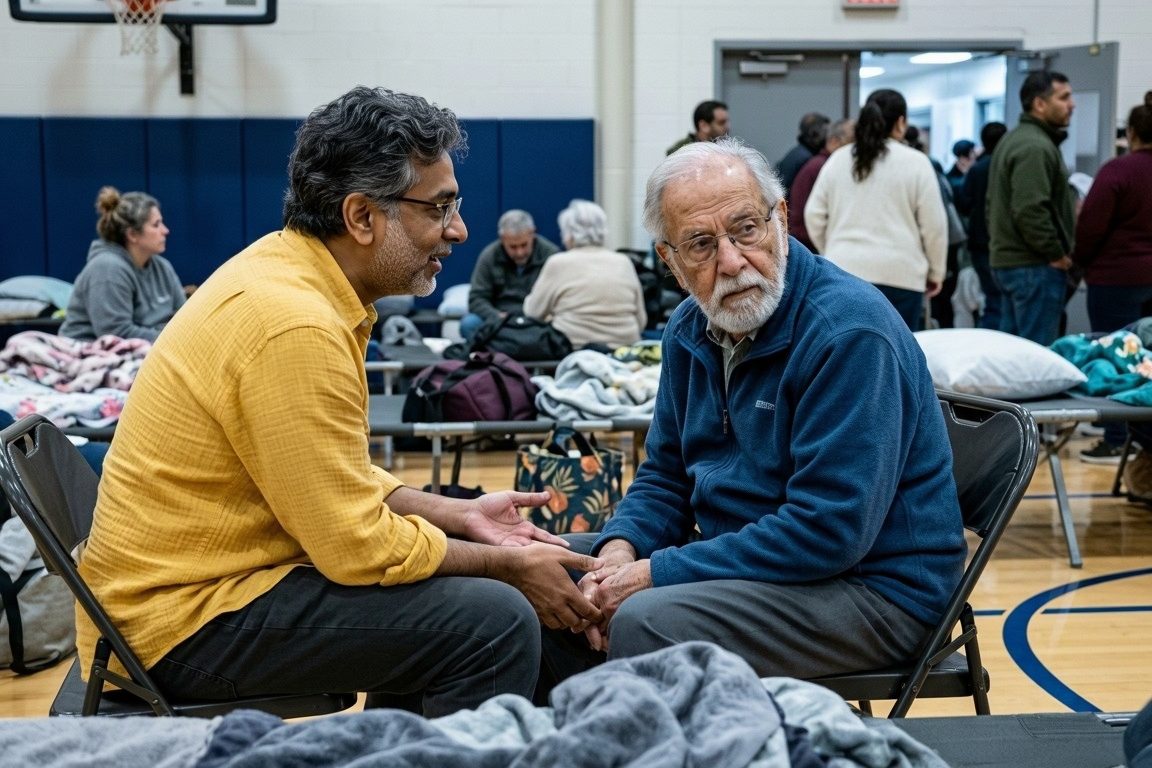
The shelter will be overwhelming. Find a spot against a wall, away from doors and loudspeakers. Use your body to block visual chaos. Keep your loved one facing you, not the crowd. Offer the 'Repetitive Task Basket' or a familiar object. Do not force them to interact with strangers. If they ask to go home, do not correct them. Say, 'We will go home soon. Right now, let us sit here and listen to this music.' Keep your voice low and steady.
Early-stage dementia (still verbal and somewhat aware)
They may understand there is a disaster but feel overwhelmed by decision-making. Offer simple, limited choices: 'Do you want to put on your jacket or your sweater?' Do not ask open-ended questions like 'What should we do?' Give them a role: 'Can you hold this bag for me?' This restores a sense of control. Validate their fear: 'This is scary for everyone. I am glad we are together.'
For the doctor
4
- Ask your doctor about a short-term anti-anxiety medication that can be used only during emergencies or evacuations. Discuss the dose, timing, and potential side effects before you need it.
- If your loved one has a history of aggression or wandering, ask the doctor or a social worker about a medical alert bracelet or a GPS tracking device. Discuss how to use it during a disaster.
- If your loved one is on any sedative or antipsychotic medication, ask the doctor how to adjust the dose or timing during a high-stress event like an evacuation. Do not change medications on your own.
- Ask the doctor or a dementia care specialist for a written 'emergency care plan' that includes your loved one's diagnosis, medications, allergies, and a brief description of calming strategies that work. Keep it in your wallet and in the comfort kit.