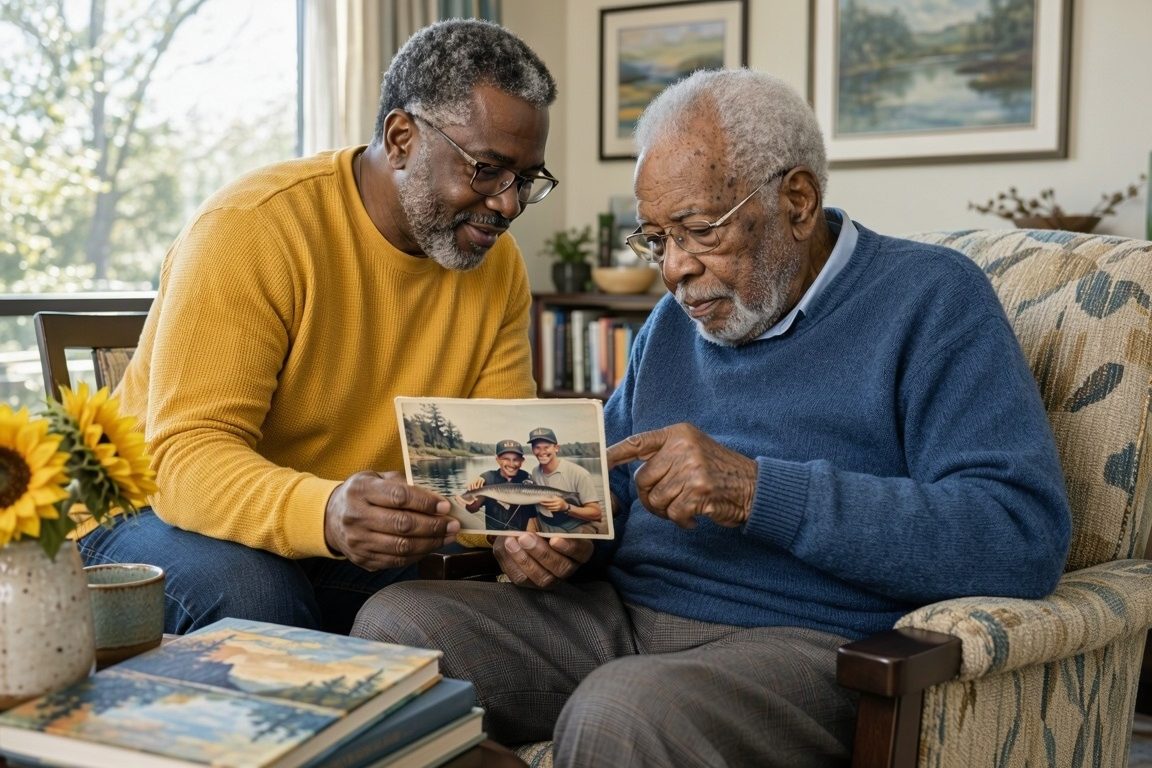
Step by step
What not to do
- Do not quiz the person on memory or correct their version of reality; questions like 'Do you remember me?' or correcting mistaken facts cause distress.
- Do not use a babyish, sing-song tone or speak loudly; use a normal voice, slightly slower and softer.
- Do not visit when you are irritable, rushed, or exhausted; a short positive visit is better than a long tense one.
- Do not overlook staff as partners; inform them of your visit, ask about the person's current state, and get their feedback afterward.
Key points
- Your loved one may not remember your visit, but they will remember the feeling you created, make it warm and positive.
- Always reintroduce yourself by name and relationship; never test their memory by asking ‘Do you remember me?’
- Keep language simple: short sentences, one idea at a time, spoken slowly and warmly.
- Bring a simple, age-appropriate activity to do together, adult coloring books, photo albums, or soft fabrics work well.
- Do not correct or argue; validate the feeling behind their words and redirect to something soothing.
- Keep visits short (15–30 minutes) and leave while things are still going well.
Videos
 How To Visit Someone With Alzheimer's & DementiaThis video walks you through the entire visit process from start to finish, including what to say and what to avoid.
 How Often Should You Visit Someone With Dementia In A Care Home?Helps you think about visit frequency and quality, and how to balance your own needs with your loved one’s.
 The Do's and Don'ts of Visiting a Loved One with DementiaA clear, practical list of what works and what backfires during visits.
 Dementia Care Partner Talkshow: 102-Tips for Re-Introducing Old Friends to Someone Living w/DementiaGreat for when you want to bring a friend or another family member along on a visit.
2 more videos
 Holidays and Celebrations | Holidays and Celebrations (Teepa's Clips)Applies the same positive visit principles to holiday gatherings, which can be especially stressful.
 What Do I Do When VISITING a Person with Dementia? ABCs of Dementia FAQs: VA straightforward answer to the exact question you are asking, with concrete examples.
Background
Why Visits Can Be Hard and What’s Really Going On
When you walk into a memory care facility, your loved one may not recognize you right away, or they might seem confused, agitated, or withdrawn. This is not a personal rejection, it’s the dementia changing how their brain processes faces, voices, and context. Alzheimer’s damages the parts of the brain that store recent memories and recognize familiar people. Your loved one may feel anxious because they don’t understand where they are or why you’re there. They might also be tired, overstimulated by the facility’s noise, or in pain they can’t express. Understanding that their behavior comes from the disease, not from a lack of love for you, is the first step to a better visit.
The Emotion of the Visit Matters More Than the Memory
Research shows that people with dementia retain the emotional tone of an interaction even when they forget the details. A warm, calm, and encouraging visit can lift their mood for hours or even the whole day, affecting how they interact with staff and other residents. Conversely, a visit that feels tense, rushed, or corrective can leave them feeling upset or agitated long after you’ve gone. This means your goal is not to make them remember your visit, but to create a feeling of safety, connection, and pleasure in the moment. Even if they can’t recall your name or that you came, the positive emotion you generate is a real and lasting gift.
Your Own Mood Sets the Tone
Before you even enter the facility, check in with yourself. If you are feeling anxious, irritable, tired, or ambivalent, your loved one will pick up on those feelings. People with dementia are especially sensitive to nonverbal cues like body language, tone of voice, and facial expressions. If you are stressed, they may become stressed too, and the visit can spiral. It is okay to delay a visit if you are not in a good place, a short, positive visit is far better than a long, tense one. Take a few deep breaths in the car, remind yourself that your job is to connect, not to fix anything, and walk in with a relaxed, open posture.
Practical tools
5
Labeled photo album
Small album with familiar faces and names written beneath each photo for gentle reminiscence and grounding.
Adult coloring book or simple art activity
Book with thick, clear lines (not children's design) for age-appropriate, low-pressure shared activity.
Soft fabric or scarf
Pleasant-textured item to hold and touch, providing calm sensory engagement.
Simple large-piece puzzle
Puzzle with a few large pieces for collaborative, non-verbal interaction.
Familiar music playlist
Short list of songs from the person's earlier life to evoke positive emotional memory.
Different situations
Early-stage Alzheimer’s (still verbal and somewhat aware)
In early stages, your loved one may still recognize you and be able to hold a conversation. Use this time to talk about shared memories, but keep it positive. Avoid asking ‘Do you remember?’ Instead, say ‘I was thinking about that time we…’ and see if they join in. They may still enjoy simple games like card matching or looking through a magazine. Be prepared for them to become frustrated if they cannot find words, offer gentle help without finishing their sentences. Keep visits a bit longer, but watch for fatigue.
Middle-stage Alzheimer’s (more confusion, possible agitation, less verbal)
At this stage, your loved one may not always know who you are. Reintroduce yourself every time without making it a big deal. Focus on sensory activities: touching a soft blanket, listening to familiar music, looking at simple pictures. Keep visits short, 15–20 minutes. If they become agitated, do not take it personally. Use the redirect and validate phrases. Let staff know if you see signs of pain or discomfort. Your main goal is to create a calm, pleasant moment, not to have a conversation.
Late-stage Alzheimer’s (limited verbal ability, mostly nonverbal)
In late stages, your loved one may not speak or respond much. Your presence and gentle touch still matter. Sit close, hold their hand, speak in a soft, slow voice. Talk about what you see around you or describe a memory in a simple way: ‘The sun is shining today. It reminds me of when we used to sit in the garden.’ Play familiar music softly. Do not expect a response, just be there. Keep visits very short, 10–15 minutes. Your calm, loving presence is the gift.
Visiting as a spouse vs. as an adult child
If you are the spouse, your loved one may have a deeper emotional bond with you, but they may also be more likely to show frustration or sadness because they feel safest with you. Expect that they might say hurtful things, remember it is the disease. Use the same scripts, but you can also use more intimate touch, like a hug or holding hands. If you are an adult child, you may feel a role reversal. Avoid falling into a ‘parenting’ tone. Stay warm and respectful. You can also coordinate with siblings to take turns visiting so no one person feels the burden.
Visiting in a memory care facility vs. at home
In a facility, the environment is not under your control. Use the staff as allies, ask them for the best times, and let them know when you are visiting. Bring familiar items from home, like a favorite blanket or a small framed photo, to make the room feel more personal. If the common area is noisy, ask if you can use a quiet room or the person’s own room. At home, you have more control over distractions, turn off the TV, put away phones, and create a calm space. In both settings, the same principles of warm approach, simple language, and no testing apply.
Common questions
7
Why should I stop pointing out mistakes and offer compliments instead?
Pointing out mistakes can confuse or upset your loved one, while compliments build a warm, positive feeling that lasts long after you leave. Offer simple praise like 'You look so nice today' or 'I love how you smiled just now' to keep the visit calm and connected.
How do I plan visits that go well in a care facility, including after aphasia or a move?
Plan visits during their best time of day, usually mid-morning after breakfast, and bring a simple activity like a photo album or soft scarf to share. After a move or aphasia, keep visits to 15–20 minutes, speak slowly with short sentences, and always reintroduce yourself by name.
What are the different kinds of home visits and why should a physician do them?
The guide focuses on memory care visits, not home visits or physician roles, so I can't provide a practical answer from this context. For reliable guidance on those topics, please check with the care facility social worker or the person's doctor directly.
Is it worth visiting if my loved one won't remember the visit?
Yes, it's worth visiting, even if your loved one won't remember the visit, they will feel the warmth and comfort you create during that time. A positive feeling can soothe them for hours or even days after you leave, which is a gift in itself.
How do I know a visit went well when my loved one doesn't recognize me?
When your loved one doesn't recognize you but remains calm, smiles, or engages with an activity you brought, the visit went well. Look for relaxed body language, a soft voice, or any positive emotion, those are the signs that your warmth got through.
What are the signs that a visit to the former home will lead to refusal to return?
If your loved one becomes agitated, confused, or keeps asking to leave soon after arriving at the former home, those are signs they may refuse to return. Trust their discomfort, plan for shorter, neutral visits in a familiar care setting instead.
What do I say when relatives think the person is fine because they 'showtimed' a visit?
Gently explain that people with dementia often 'showtime', putting on a bright face for short periods, while hiding their real struggles. Thank the relative for their care and suggest they visit at different times to see the fuller picture.
For the doctor
4
- If your loved one becomes very agitated or aggressive during visits, ask the facility’s nurse or doctor if there might be an underlying medical issue like pain, infection, or medication side effects.
- If your loved one is on medications for mood or behavior, ask the doctor if the timing of the medication might affect the best time for visits.
- If you notice a sudden change in your loved one’s ability to recognize you or in their mood, discuss this with the clinician, it could signal a new health problem.
- If you feel overwhelmed or depressed after visits, talk to your own doctor or a counselor. Caregiver burnout is real, and your health matters too.