Step by step
What not to do
- Do not visit only when you feel guilty or obligated. Inconsistent, unpredictable visits can increase your loved one's anxiety because they never know when you will come.Instead, set a regular schedule and stick to it, even if it means visiting less often but more reliably.
- Do not spend the whole visit correcting their reality or giving them a 'reality check.' If they say they want to go home, do not say 'You are in a nursing home now.' This will only increase their fear and confusion.Instead, validate their feeling: 'It sounds like you miss home. Tell me about your favorite room there.' Then gently redirect to something pleasant in the present moment.
- Do not try to force them to participate in activities or socialize if they are having a bad day. Forcing it will only frustrate both of you. As one expert advises, if it is just not going to happen on that day, simply sit with them, hold their hand, smile, and nod. Sometimes just being present is enough (source 5).
- Do not take their anger or withdrawal personally. When a person with dementia is lonely or scared, they may lash out at the person they feel safest with, you. This is not a reflection of your efforts. If they become angry, give them space. Face them away from you or leave the room for a few minutes if they can be left safely alone. Come back when everyone is calmer (source 3).
- Do not neglect your own emotional needs. If you are feeling isolated or overwhelmed, seek peer support. Connecting with other caregivers who understand your situation can reduce your own loneliness and give you fresh ideas for helping your loved one (source 7). You cannot pour from an empty cup.
- Do not assume the facility will handle all social needs. Even the best facilities have limited staff and resources. Your active, ongoing involvement is essential to combat your loved one's loneliness. Be their advocate, their connection to the outside world, and their reminder that they are still deeply loved.
Key points
- Loneliness in long-term care is rooted in fear and a sense of abandonment; your consistent, loving presence is the most powerful remedy.
- Build a 'special friend' relationship with a staff member to ensure daily moments of connection for your loved one.
- Use anchor rituals, consistent visit times, small meaningful items, and simple routines , to create comfort and predictability.
- Focus on emotional connection during visits, not tasks or corrections. Validate their feelings, even if they are not based in reality.
- Take care of yourself. Respite, peer support, and permission to step back are not selfish, they are essential for you to be able to show up with love.
- Advocate for your loved one's social needs in care plan meetings and by bringing outside resources into the facility.
Videos
 When You Want to Walk Away From Dementia Caregiving (But Can’t)This video addresses the emotional exhaustion that can make you want to pull away. It offers tools to stay connected even when it feels impossible, which is directly relevant to coping with your loved one's loneliness.
 Supporting a Loved One with DementiaThis video provides general strategies for emotional support, which you can adapt to the long-term care setting. It reinforces the importance of connection and validation.
 Dementia and Anger Outbursts (3 Mistakes That You're Making)Loneliness can trigger anger. This video helps you avoid common mistakes that escalate the situation, so you can respond in a way that soothes rather than aggravates.
 How to cope with dementia caregiver stress: 4 ideasYour own stress directly affects your ability to help your loved one. This video gives practical coping ideas that will help you show up more calmly and consistently.
2 more videos
- 5 TIPS FOR TALKING TO YOUR LOVED ONE WITH DEMENTIACommunication is key to reducing loneliness. This video offers specific phrases and techniques that make your loved one feel heard and connected.
 How to get someone with dementia to accept help from others: 5 tips (plus bonus)If your loved one resists staff or new people, this video provides strategies to help them accept help, which is essential for building a social network in the facility.
Background
Why Loneliness Hits So Hard in Long-Term Care
For a person with dementia, moving into a facility often feels like losing everything familiar, their home, their routines, their independence. They may not understand why they are there, and they can feel abandoned by the very people they trust most. This is not just sadness; it is a deep, primal fear. As one expert notes, most people with dementia are fearful and feel abandoned; if we can comfort them and make them feel safe, we have done our job (source 17). The loneliness is compounded by the fact that they may struggle to form new connections or even remember who visits them.
The Emotional Toll on Your Loved One
Loneliness in dementia often shows up as agitation, withdrawal, or even anger. They might lash out at staff or refuse to participate in activities. This is not a personal rejection of the facility or of you, it is a symptom of their unmet emotional need for connection. When a person with dementia feels safe and connected, they are much less likely to exhibit challenging behaviors (source 17). Your role as a family caregiver is to be the bridge between their old life and this new one, bringing familiarity and love into an unfamiliar setting.
Why This Is Different from General Caregiver Isolation
While the parent article 'finding support as a caregiver' focuses on your own need for peer support and respite, this sub-article zeroes in on your loved one's loneliness inside the facility. You are no longer the daily hands-on caregiver, but you are still the emotional anchor. Your visits, your calls, and your advocacy can transform their experience from one of abandonment to one of belonging. The goal is not to replace the facility's care, but to layer your unique, irreplaceable connection on top of it.
Practical tools
6
The 'Special Friend' Request
A simple script to use with a staff member: 'Hi [staff name], I notice my mom really lights up when you are around. Would you be willing to be her special friend? I brought you this small gift as a thank you. Could you check in on her for just a couple minutes each day, even if it is just to say hello and ask how she is doing? It would mean so much to her and to me.' This small ask can create a daily moment of connection for your loved one.
The Anchor Ritual
Create a simple, repeatable ritual for every visit. For example:
This predictability becomes a comfort anchor, even if they cannot remember the details.
The 'Five-Minute Visit' Video Call
If you cannot visit in person, schedule a five-minute video call at the same time each week. Ask a staff member to help set it up. Keep it simple: smile, wave, say 'I love you,' and share one positive thing from your day. Do not quiz them or expect them to remember things. The goal is just to see your face and hear your voice.
The Memory Box
Prepare a small box or bag of items that are meaningful to your loved one:
Leave it in their room and bring it out during visits. Let them touch, smell, and explore each item. This can spark conversation and bring comfort long after you leave.
The Care Plan Ask
At the next care plan meeting, say: 'I would like to add a goal for social connection. Specifically, I would like staff to help my loved one connect with one other resident who shares an interest in [gardening/music/faith]. Could we also schedule a weekly one-on-one visit from a volunteer or activities staff member?' Write this down and follow up.
The 'Legacy Caregiving' Project
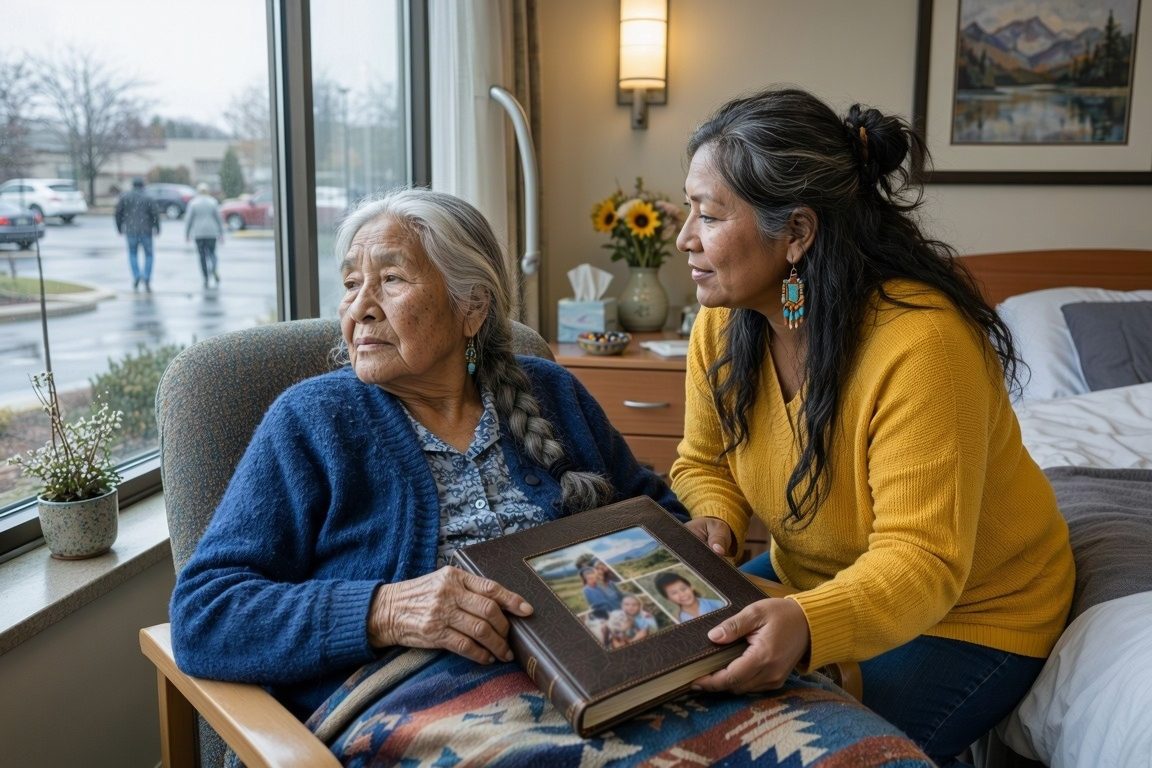
Choose a simple project to do together during visits: look through a photo album and write down the stories behind each picture, record a short video of them talking about their childhood, or create a family tree on a large piece of paper. This gives your visits purpose and reinforces their identity and value.
Different situations
Lewy body dementia (LBD)
People with LBD are often more sensitive to visual and auditory stimuli. Keep visits calm and quiet. Avoid bringing too many items or playing loud music. They may also have fluctuating attention, one day they are engaged, the next they are not. Be flexible and do not take it personally. Also, they may have visual hallucinations; if they mention seeing something, do not argue. Instead, say 'That must be unsettling. I am here with you.'
Late-stage dementia
In late stages, your loved one may not be able to speak or recognize you. Your presence is still vital. Sit close, hold their hand, speak softly, and play familiar music. Use gentle touch like stroking their arm or brushing their hair. Even if they cannot respond, they can feel your love. Do not expect conversation; just be there. Your calm, loving presence is the most powerful antidote to loneliness at this stage.
Spouse vs. adult child caregiver
If you are the spouse, your visits may carry a different emotional weight. Your loved one may feel more abandoned by you than by an adult child. Reassure them often: 'I am still your husband/wife. I am not leaving you. I am here.' Bring a small token of your marriage, like a wedding photo or a favorite shirt that smells like you. If you are an adult child, you may need to work harder to build a new 'adult-to-adult' connection that is not parent-child. Ask about their life before you were born, and listen with genuine curiosity.
In a facility with limited resources
If the facility is understaffed or has few activities, you will need to be more proactive. Bring in outside volunteers (with facility permission), a teenager from a local church, a pet therapy dog, a music therapist. Advocate to the administration for more social programming. You can also organize a small group of family caregivers to pool resources and create a weekly 'family hour' in the common room.
Medicaid-funded facility
Medicaid facilities often have fewer resources and higher staff turnover. Your advocacy is even more critical. Build relationships with multiple staff members so that if one leaves, another knows your loved one. Bring extra comfort items from home since the facility may not provide them. Attend every care plan meeting and be politely persistent about your loved one's social needs. You may need to be the 'squeaky wheel' to get attention.
For the doctor
3
- Ask the facility's doctor or nurse practitioner: 'Could my loved one's loneliness or withdrawal be a sign of depression? Are there any medications or therapies that might help?'
- Ask the social worker: 'Are there any volunteer programs or community groups that can provide one-on-one companionship for my loved one?'
- Ask the activities director: 'Can you help me create a personalized activity plan that addresses my loved one's specific interests and cognitive level?'