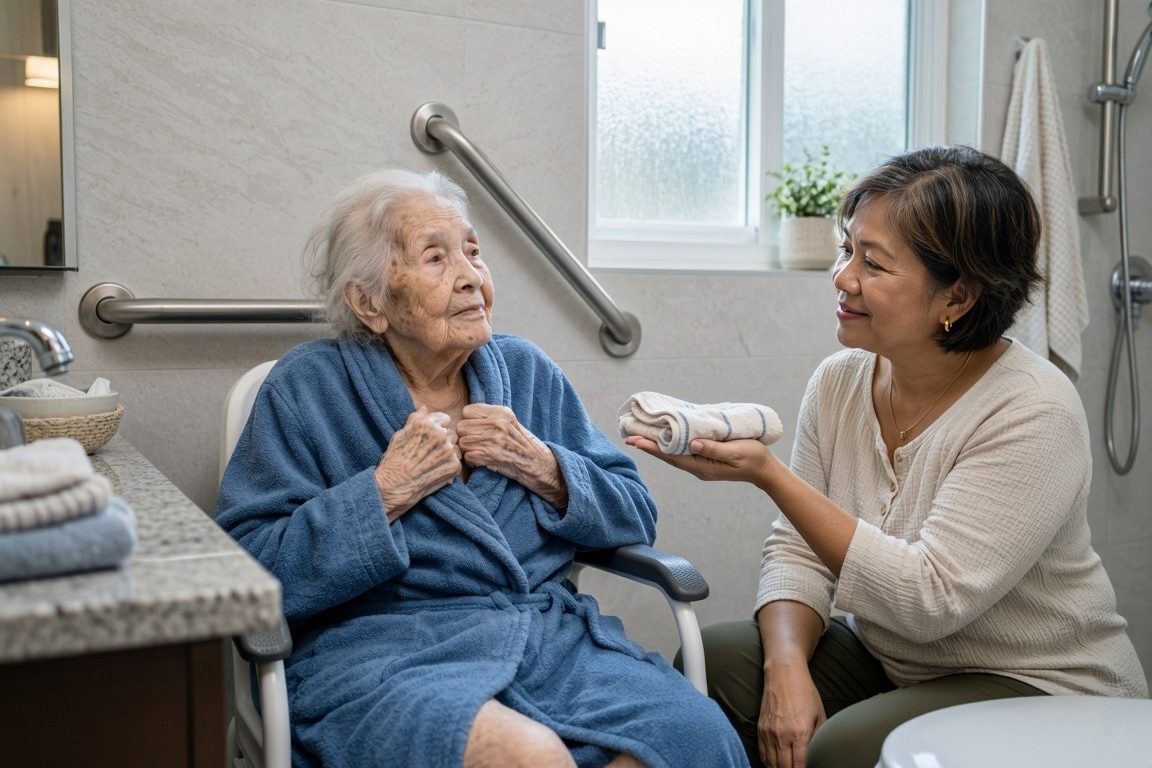
Step by step
What not to do
- Do not argue or try to convince them they have dementia. This will only increase their agitation and resistance.Instead, validate their reality and redirect. For example, if they say 'I don't need help,' say 'I know you are capable. I just need a hand with this myself.'
- Do not rush or show frustration. Rushing increases anxiety for both of you and can trigger a fight-or-flight response. Slow down, take a breath, and use a gentle tone. If you feel rushed, postpone the task if possible.
- Do not use commands or demands like 'You have to take a shower now.' This strips them of autonomy and invites rebellion.Instead, use collaborative language: 'Let's get ready for the day together.'
- Do not take resistance personally. It is the disease, not a rejection of you. Remind yourself that their brain is struggling, and your role is to be a calm, supportive partner. This mindset shift can reduce your own stress.
- Do not try to do everything yourself. Delegate tasks to others, including hired help, family, or friends. You cannot pour from an empty cup. Accepting help for yourself models acceptance for your loved one.
Key points
- Resistance is not personal; it is a symptom of the disease. Your calm, patient approach is the most powerful tool.
- Ask for their help instead of offering yours. This preserves their dignity and sense of control.
- Use one-step instructions, slow pace, and positive encouragement. Rushing triggers anxiety and resistance.
- Offer limited choices to guide behavior while respecting autonomy.
- Consider introducing a new caregiver or a uniformed helper for intimate tasks.
- Take care of yourself first. A rested, supported caregiver is far more effective.
Videos
 How to Help Someone With Dementia Accept HelpThis video directly addresses the core challenge of getting a loved one to accept help with intimate care tasks, offering practical scripts and mindset shifts.
 How to get someone with dementia to accept help from others: 5 tips (plus bonus)This video focuses on the specific challenge of introducing outside caregivers, which is a common need as the disease progresses.
 5 Surprising Reasons Your Loved One With Dementia Resists HelpUnderstanding the 'why' behind resistance is crucial for choosing the right strategy. This video explains the brain-based reasons.
 What Communication Skills Help With Repetitive Questions In Dementia Care? - TestWhile focused on repetitive questions, the communication skills (validation, redirection, calm tone) are directly applicable to care acceptance.
2 more videos
 The Baffled Brain: Demystifying Dementia Episode 22 April 24 ,2021This episode likely explores the cognitive changes that make accepting help difficult, providing a deeper understanding to inform your approach.
 How Do Healthcare Providers Address Caregiver Burnout in Dementia Care? | TestCaregiver burnout directly impacts your ability to use these strategies. This video offers support for your own well-being.
Background
Why They Resist: The Brain and the Person
Resistance to care is not stubbornness; it is a natural response to a brain that no longer processes information the way it used to. The person with dementia may not recognize they need help because their brain has lost the ability to accurately assess their own abilities. They may also lack awareness of their diagnosis, a condition called anosognosia, making it feel insulting or confusing when you offer assistance with tasks they have done independently for decades. This is especially true for intimate care like bathing, toileting, or dressing, which are deeply personal and tied to a sense of adulthood and privacy.
The Emotional Core: Control, Dignity, and Identity
At its heart, resistance is about preserving identity. When you step in to help, the person may feel infantilized, embarrassed, or that you are taking over their life. They may also feel a loss of purpose and usefulness. The key is to shift from 'I am here to help you' to 'We are doing this together.' This reframe honors their need for control and contribution. Remember, their brain is wired to protect their sense of self, and your approach must work with that wiring, not against it.
The Caregiver's Role: Your Emotions Matter Too
Your own frustration, exhaustion, or sense of urgency can unintentionally escalate resistance. When you are stressed, your tone, body language, and pace change, and the person with dementia picks up on that anxiety. Managing your own emotions is not selfish; it is a caregiving tool. Taking a deep breath, slowing down, and approaching with genuine warmth can dramatically shift the outcome. Research shows that caregivers who feel less burdened are better able to use positive strategies, which in turn makes care more acceptable to their loved one.
Practical tools
6
The 'Help Me' Script
A simple phrase to reframe care: 'I could really use your help with [task]. Would you mind?' For example, 'I could really use your help folding these towels. Would you mind?' or 'I need your opinion on which shirt looks better. Can you help me decide?' This turns a care task into a collaborative, empowering moment.
The Two-Choice Menu
Prepare two acceptable options for any care task. For bathing: 'Do you want to shower now or after your coffee?' For dressing: 'Do you want the blue sweater or the red one?' For meals: 'Do you want eggs or oatmeal?' This gives the person a sense of control while keeping the outcome within safe bounds.
The 'Uniform' Strategy
If your loved one resists care from you, consider hiring a professional caregiver or asking a friend to wear a simple uniform (like a polo shirt with a logo). Many people with dementia respond more cooperatively to someone who looks like a nurse or aide. Introduce them as 'a helper who is here to assist us both.'
The Visual Routine Board
Create a simple, picture-based schedule for the day (e.g., a picture of a toothbrush for brushing teeth, a shower icon, a breakfast plate). Place it in a visible spot. Point to it when guiding them through tasks: 'Look, it's time for our morning routine. First, we brush our teeth.' This reduces verbal demands and provides structure.
The 'One Step at a Time' Checklist
For complex tasks like dressing, break it down into a written or picture checklist:
Hand them the list or point to each step. This reduces overwhelm and gives a sense of accomplishment with each step.
The 'Praise and Redirect' Phrase
When they resist, first praise something they are doing well: 'You are doing such a great job sitting still. Thank you.' Then gently redirect: 'Now, let's just get this shirt on. You are almost done.' This keeps the interaction positive and reduces defensiveness.
Different situations
Lewy body dementia (LBD) or Parkinson's disease dementia
In LBD, fluctuations in cognition and alertness are common. Resistance may be worse during 'off' periods. Schedule care tasks during times of higher alertness. Also, LBD often involves visual hallucinations; avoid arguing about what they see. Instead, validate: 'I see you are concerned about something. Let's take a break and come back to this.'
Frontotemporal dementia (FTD)
FTD often affects personality and social awareness early. The person may not care about hygiene or social norms. Use direct, simple language and avoid emotional appeals. For example, 'It's time to shower. Let's go.' Do not expect them to care about your feelings. Use routines and environmental cues (like a timer) rather than persuasion.
Late-stage dementia (severe cognitive decline)
In late stages, the person may be nonverbal or bedbound. Focus on comfort and safety. Use gentle touch, soft music, and a calm voice. Accept that full cooperation may not be possible. Prioritize tasks that prevent pain or infection (e.g., incontinence care) and let go of non-essential routines. Use the 'uniform' strategy with a professional caregiver if needed.
Spouse vs. adult child caregiver
Spouses often have a long history of equality, so the role reversal is especially hard. Use the 'help me' script frequently. Adult children may need to step into an authority role, which can feel unnatural. Introduce yourself as a partner, not a parent. For both, consider having a third party (like a home health aide) handle intimate care to preserve the relationship.
In a facility (nursing home or assisted living)
In a facility, the person may resist care from staff because they feel lost or scared. Visit during care times to provide comfort. Bring familiar items (a favorite blanket, music). Ask staff to use the same strategies: slow pace, choices, and praise. If resistance is severe, discuss with the facility's dementia care specialist or a geriatric psychiatrist.
For the doctor
4
- If your loved one's resistance leads to aggressive behavior (hitting, biting, kicking) that puts you or them at risk, discuss with a doctor whether medication or a referral to a behavioral health specialist is appropriate.
- If resistance to eating or drinking leads to significant weight loss or dehydration, consult a doctor or a speech-language pathologist for a swallowing assessment and feeding strategies.
- If resistance to medication (e.g., refusing pills) is a recurring issue, ask the pharmacist or doctor about alternative forms (liquid, patch, dissolvable tablets).
- If your loved one has a history of falls and resists help with mobility, discuss with a physical therapist about safe transfer techniques and equipment (e.g., a gait belt).