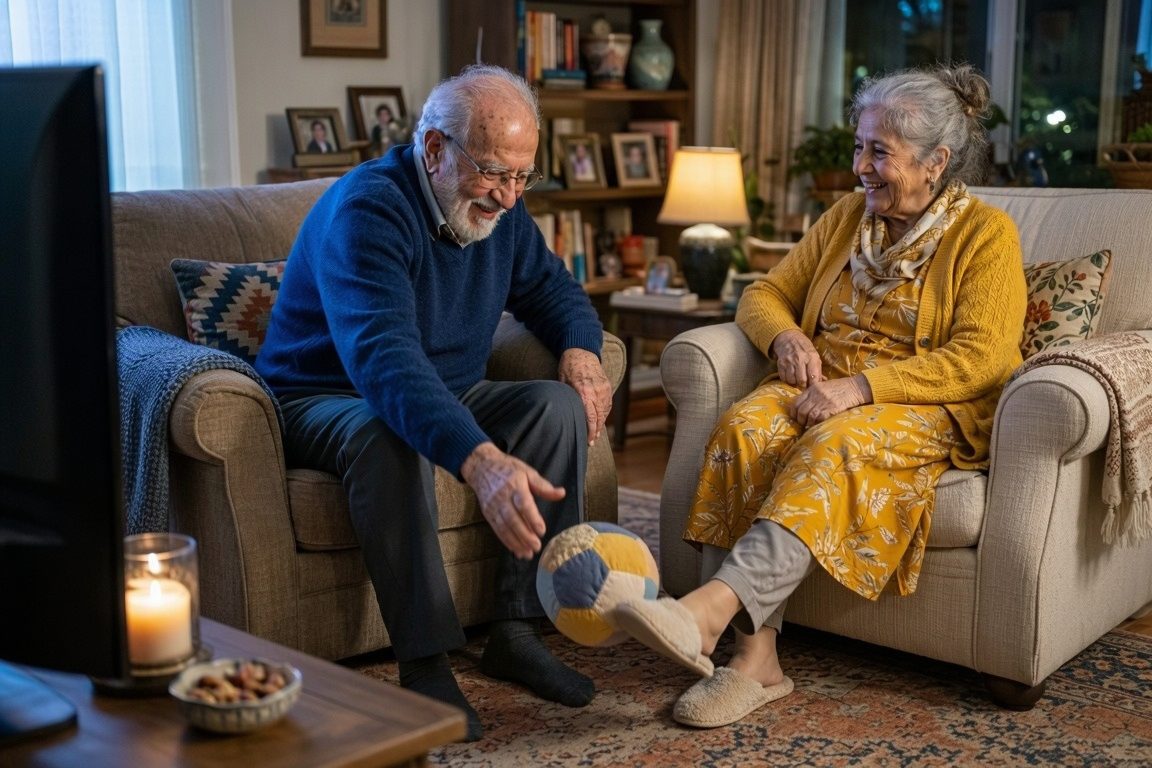
What not to do
- Do not ask 'What do you want to do?' – this causes anxiety.
- Do not correct hallucinations or delusions during engagement.
- Do not play a movie or TV show for more than 10 continuous minutes.
- Do not touch or move them without first stating what you are doing.
- Do not continue any activity if they show signs of distress or withdrawal.
Key points
- Engagement is active participation using brain and body; entertainment is passive watching. Aim for engagement, even for just 3 minutes.
- People with Lewy body dementia often cannot start activities on their own. You must initiate for them, one step at a time.
- Match the activity to their current ability level, not their past. A 25-piece puzzle may work when a 500-piece one overwhelms.
- Stop immediately if they show frustration, freezing, or loss of interest. The goal is connection, not completion.
- Use their life story to make activities personally meaningful, it boosts cooperation and dignity.
- Engagement reduces distressing behaviors because the brain cannot be both engaged and agitated at the same time.
Videos
 Ep. 217: Tips for Using Music and Activities to Create EngagementThis video offers practical, real-world tips for using music and simple activities to spark genuine engagement, especially helpful for Lewy body dementia where music can bypass cognitive barriers.
 Dementia Care Partner Talk Show Podcast: Ep. 88 - How to Engage with Someone in a Meaningful WayTeepa Snow explains the core difference between activity and engagement, providing the foundational understanding you need to shift your approach.
 How to keep someone with dementia active when they don't want to do anythingDirectly addresses the common challenge of apathy and resistance, offering specific strategies to gently initiate engagement without force.
 Dementia Communication Tips for strange behaviorHelps you interpret unusual behaviors as communication, so you can choose the right engagement approach rather than reacting with frustration.

Background
What Is Engagement, Really?
Engagement is not the same as an activity. An activity is something happening outside your loved one, a TV show playing, a puzzle on the table, a ball being tossed their way. Engagement is what they choose to do with what's happening inside them and around them. It is an active, willing participation that involves their brain, their body, and their emotions. As Teepa Snow explains, engagement is 'what I choose to do with you or maybe without you, but in regard to how I want to spend my time, how I want to spend my life : I want to use my brain and my body.' This means a person with Lewy body dementia can be engaged even in a simple task like folding a towel, if they are mentally and physically involved in the process, rather than just being a passive recipient of care.
Why Lewy Body Dementia Makes Engagement Different
Lewy body dementia (LBD) brings unique challenges that make engagement both more critical and more delicate. Fluctuations in attention, visual hallucinations, and movement difficulties (parkinsonism) mean that a person may be alert and interactive one moment and confused or rigid the next. They often cannot initiate activities on their own, not because they lack ability, but because the brain's 'start button' is impaired. As one source notes, 'it's not that they cannot do things, it's that they cannot initiate doing things.' This is a huge difference. If you wait for them to show interest, you may wait all day. Instead, you must gently initiate for them, offering one step at a time. Also, because LBD affects visual processing and executive function, activities that are too complex (like a 500-piece puzzle) can overwhelm and frustrate, while simpler versions (like a 25-piece puzzle) may invite participation. The goal is never completion , it is the moment of shared experience.
The Cost of Entertainment Without Engagement
When a person with dementia is only entertained, for example, left to watch TV for hours , their dementia can progress faster. As one expert puts it, 'when you're not engaging someone, their dementia is going to progress faster.' This is because the brain needs active use to maintain existing connections. Entertainment is passive: it does not require the person to think, decide, or move. Over time, this passivity can lead to increased apathy, more frequent sundowning behaviors, and a loss of skills that might otherwise be preserved. On the flip side, engagement , even for three minutes , can reduce distressing behaviors because 'when your loved one is engaged in a pleasant activity, they can't also be engaged in a distressing behavior at the same time.' Engagement is not just nice; it is therapeutic.
Practical tools
2
Sensory cue cards
Simple cards (index size) with one word and a picture: 'SOFT', 'SMELL', 'SIGHT'. Show one card before starting to cue which sense you’ll use.
Two-option visual board
A small dry-erase board with two pre-drawn symbols (e.g., a spoon and a cloth). Point to each while naming it aloud, then let them point or touch.
Different situations
Lewy body dementia with visual hallucinations
If your loved one is seeing things that aren't there, do not argue or try to convince them it's not real. Instead, validate the feeling: 'That must be scary for you.' Then redirect to a concrete, tactile activity that grounds them in the present, like holding a cold cloth or squeezing a stress ball. Avoid activities with complex visual patterns (like busy puzzles) that might feed into hallucinations. Stick to simple, high-contrast items.
Late-stage Lewy body dementia (limited mobility or speech)
Engagement may look very different. Focus on sensory experiences: gentle hand massage with scented lotion, playing a familiar song and holding their hand, or brushing their hair. Expect engagement to last only 1-3 minutes. Watch for subtle signs of participation: a slight turn of the head, a change in breathing, a squeeze of your hand. These are victories. Do not expect verbal responses.
Spouse caregiver vs. adult child caregiver
Spouses often have a deeper history of shared activities. Use that: 'Remember how we used to garden together? Let's just look at these seed packets.' Adult children may need to be more creative: 'Dad, I'm trying to learn how to fold laundry the way you used to. Can you show me?' The key is to position yourself as the learner, not the teacher, which preserves their dignity and invites cooperation.
In a memory care facility
Work with the activities director to ensure your loved one is in small-group or one-on-one engagements, not large-group entertainment. Ask for activities that match their current ability level, not their diagnosis. For example, if they can no longer play bingo, ask for a simple 'sorting' station. Visit during activity times and model engagement for staff: show them how you initiate with one step at a time. Bring in a Geri-Gadget or a personal photo album to use during your visits.
Medicaid-funded facility with limited staff
Staff may rely on TV or group movies to keep residents occupied. Advocate gently: 'I know you're busy, but my mom really perks up when someone sits with her and hands her one thing at a time. Could you try that for 5 minutes after lunch?' Offer to bring in simple, no-prep tools like a basket of scarves to fold or a box of large wooden beads to string. These require no staff training and can be done bedside.
For the doctor
3
- If your loved one becomes agitated or aggressive during engagement attempts, discuss with their doctor whether medication adjustments or a referral to an occupational therapist might help.
- If you notice a sudden change in their ability to engage (e.g., they were folding towels last week and now cannot hold a cloth), report this to their clinician, it could signal an infection, medication side effect, or progression of the disease.
- For Lewy body dementia specifically, ask the doctor about the best times of day for engagement based on their medication schedule (e.g., carbidopa-levodopa for movement symptoms). Timing can make a big difference in their ability to participate.