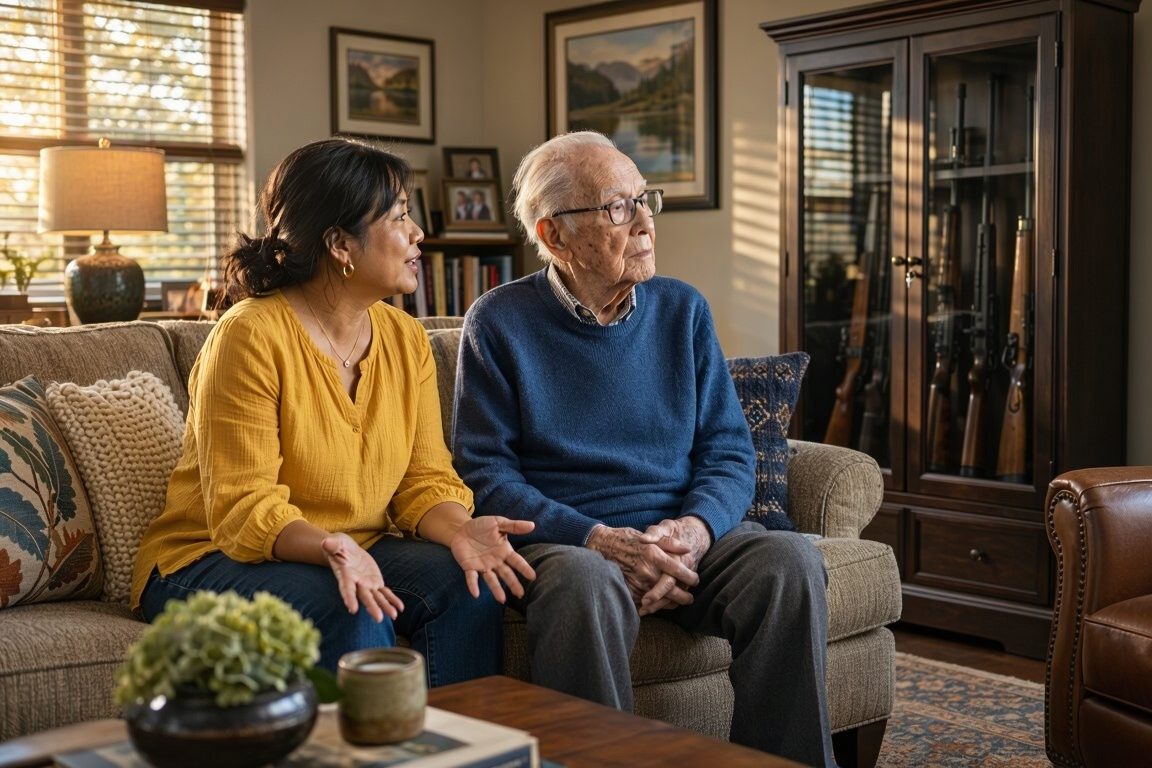
Step by step
What not to do
- Do not confront, accuse, or try to reason with the person about why they cannot have a gun. Dementia impairs logic, and arguing deepens distress. Use gentle reframing or distraction.
- Do not leave a gun in the home even if hidden. People with dementia can find firearms in closets, drawers, or under beds. Removal is the only safe option.
- Do not assume someone with no history of depression is automatically safe. Dementia itself raises the risk of depression and suicidal ideation, and the combination with firearm access is dangerous.
- Do not try to physically take a gun from an agitated person. Step away and call for professional help.
- Do not wait for a crisis. Begin planning early to remove guns gently rather than under pressure.
- Do not overlook other dangerous items, sharp knives, tools, medications, cleaning supplies, especially in garages and basements.
Key points
- Dementia impairs judgment, memory, and recognition, making firearms extremely dangerous even for long-time responsible owners.
- People with dementia are at higher risk for depression and suicide, and a gun in the home multiplies that risk.
- Remove guns gently using distraction and a calm, non-confrontational approach, do not argue or force the issue.
- Store guns and ammunition separately in locked locations that the person cannot access, or remove them from the home entirely.
- If the person becomes violent or you feel unsafe, call for help from law enforcement or a dementia crisis team immediately.
- Transition the person to a different outdoor activity like fishing or gardening to preserve their sense of purpose without the risk of a firearm.
Videos
 How do I know if my loved one with dementia is safe to have a gun: Part IThis video helps you recognize the warning signs that a person with dementia is no longer safe to handle a firearm, such as confusion, not recognizing family, or forgetting how to use the safety.
 Aggressive Behavior in People with Dementia | Linda Ercoli, PhD | UCLAMDChatThis video explains how to handle aggressive behavior in dementia, including the importance of not confronting or initiating physical contact, which is crucial when discussing gun removal.
 What should you do if your loved one with dementia is not safe to have a gun.This video provides direct, practical advice on what to do when you decide to remove a gun, including how to approach the conversation and what to do if the person resists.
 FAQ Dementia: Taking Away Keys, Guns | Bathing | Eating | Disrobing | FB Live ReplayThis video covers common caregiver questions about taking away keys and guns, offering strategies for handling these sensitive topics without causing distress.
2 more videos
 How Do You Ensure Home Safety For Dementia Patients? - Dementia Help HubThis video provides a broader home safety checklist, including securing doors, removing tripping hazards, and locking up dangerous items, all of which complement firearm safety.
 095. How to create a safe home for Dementia family membersThis video offers practical tips for creating a dementia-friendly home, including using childproof locks and removing hazardous items, which supports the overall goal of firearm removal.
Background
Why dementia changes the safety of firearms
Dementia affects judgment, memory, and the ability to recognize familiar people and situations. A person who has always handled guns responsibly may no longer remember how to use the safety, may mistake a family member for an intruder, or may become confused and frightened when handling a weapon. Research suggests that older adults, particularly those with dementia, may be at higher risk for depression and suicidal thoughts, and the presence of a firearm in the home can amplify that risk. This combination of cognitive decline and emotional vulnerability means that a firearm in the home becomes a serious risk, not a protection.
The emotional weight of this decision
For many people, especially those who have been hunters, sports shooters, or who simply value self-defense, giving up a gun feels like losing a part of their identity. They may see it as an insult to their competence or a sign that they are no longer capable. This is why simply taking the gun away can cause a catastrophic reaction, anger, panic, or deep sadness. The key is to approach the situation with empathy, using distraction, redirection, and a calm demeanor. Remember that the person with dementia cannot reflect on their behavior or control their reactions the way they once could. Your goal is to keep everyone safe while preserving their dignity.
Practical tools
5
Gentle conversation script
Try: 'I know how much you care about your hunting rifle. I want to make sure it stays in good shape, so I'm going to take it to my house for a while to clean and check it. You can have it back when I'm done.' If they ask later: 'It's being taken care of, let's go look at the birds outside.'
Warning signs checklist
Watch for:
Any one of these is reason to act.
Distraction activity list
Keep ready: looking through a photo album, folding laundry together, listening to favorite music, doing a simple puzzle, going for a short walk, or preparing a familiar snack. Use these to redirect before frustration builds.
Crisis Intervention Team (CIT) contact script
When calling law enforcement, say: 'My [parent/spouse] has dementia and is becoming agitated and unsafe. I need help removing firearms from the home. Is a CIT officer available?' Describe
Ask in advance whether your local police have a CIT program.
Identity-preserving alternative activities
Pair the person with activities that echo hunting and shooting without risk: fishing, birdwatching or wildlife photography, target archery with foam-tipped arrows, gardening or wood carving, and dog walking or hunting-dog training.
Different situations
Lewy body dementia or Parkinson's disease dementia
These conditions often cause visual hallucinations and significant fluctuations in alertness. A person may mistake a family member for a stranger or see a gun as a threat. Remove firearms even earlier than you might for Alzheimer's. Also, be aware that these individuals may have more sudden mood swings, so approach with extra caution and have a backup plan for calling for help.
Late-stage dementia
In late stages, the person may not recognize you at all and may be bedridden or unable to move independently. In this case, the risk of them using a gun is very low, but the risk of someone else in the home (a visitor, another family member) accessing it remains. Remove all firearms from the home entirely, even if the person cannot move. Also, secure any guns that belong to other household members.
Spouse vs. adult child caregiver
A spouse may have a harder time convincing their partner to give up a gun because of a long history of shared identity around gun ownership. An adult child may have more authority to act, but may also face resentment. In either case, involve a neutral third party if needed, a doctor, a clergy member, or a law enforcement officer, to help with the conversation. The spouse should prioritize safety over preserving the relationship dynamic.
In a facility (assisted living or memory care)
Facilities typically have strict policies against firearms. If your loved one is moving into a facility, you will need to remove all guns from their personal space. Work with the facility staff to ensure that any guns stored in a family member's home are not accessible during visits. If the person asks about their gun, redirect to a favorite activity or memory.
Medicaid or low-income household
If cost is a concern, look for free or low-cost gun locks and safes through local police departments or community organizations. Some gun shops offer free lock boxes. You can also ask a trusted neighbor or family member to store the gun temporarily. Do not let cost prevent you from taking action, safety is the priority.
Common questions
8
How do I put on a mask and gloves without frightening a person with dementia?
Set out the mask and gloves calmly while chatting about something pleasant, then put them on yourself first as a natural part of your routine, keeping your voice light and your movements slow to show there's nothing to fear.
What can I do to prevent my loved one with dementia from overspending or sharing personal information online?
Use a prepaid debit card or a low-limit credit card for their online accounts, and enable spending alerts on your own phone; gently redirect their attention to a favorite activity if they insist on 'shopping' as a pastime.
What safe transfer techniques work for someone with dementia who has stiff or rigid movements?
Approach from the front at their eye level, ask them to 'help me move your arm' in a soft voice, and support their joint with one hand while guiding the limb slowly in the direction it naturally bends without forcing or rushing.
Is lorazepam safe and appropriate for managing agitation in a parent with dementia?
Lorazepam can be used but only under a doctor's close guidance for short-term agitation, as it may cause drowsiness or worsen confusion in dementia; always start with the lowest possible dose and watch for side effects.
When should I call police, and how do I handle firearms and scams in dementia care?
Call police if your loved one becomes violent or you fear for safety, and for firearm removal, request a well-being check or dementia crisis team; to stop scams, register their number on the Do Not Call list and monitor accounts weekly.
What common triggers should I avoid when caring for a veteran with dementia?
Avoid sudden loud noises, crowds, and any reminders of combat like fireworks, raised voices, or uniforms, and keep a calm, predictable routine with plenty of quiet time and gentle activities like music or walking.
How can I support safe walking and prevent or manage missing incidents for a person with dementia?
Install childproof locks on exterior doors and a simple alarm that chimes when opened, and let your loved one carry a GPS tracker or ID bracelet; if they wander, search nearby in a 1-2 block radius within 15 minutes and call 911 if not found.
Should I be concerned about giving opioid pain medication to a family member with dementia?
Yes, be cautious, start with the lowest possible dose and shortest duration under a doctor's supervision, as opioids can worsen confusion, cause falls, or lead to constipation and breathing problems in dementia.
For the doctor
6
- Ask your doctor: 'My loved one has dementia and owns a gun. Are there any medications or treatments that might reduce their risk of agitation or depression related to this issue?'
- Ask your doctor: 'If my loved one becomes violent when I try to remove the gun, what is the safest way to handle that? Should I call 911 or a crisis team?'
- Ask your doctor: 'Are there any legal steps I need to take to remove a gun from someone with dementia in our state? Do I need a court order or a doctor's note?'
- Ask your doctor: 'My loved one has a history of depression. Is there a higher risk of suicide with dementia and a gun in the home? What signs should I watch for?'
- Ask your doctor: 'Can you recommend a local dementia care professional or support line to help me plan how to gently disclose the permanent removal of the gun if the person asks persistently?'
- Ask your doctor: 'Before I take any action, should I consult a legal advisor about the ownership and transfer of the firearm?'