Step by step
What not to do
- Do not ask 'Do you want to do this?' or 'Are you ready to play?' This puts the resident in a position of having to make a decision they may not be able to process.Instead, simply invite them with a statement: 'Let's look at this together.'
- Do not use activities that require fine motor skills or multiple steps, like threading beads or completing a puzzle. These will likely cause frustration and withdrawal. Stick to one-step, gross-motor or sensory activities.
- Do not leave the resident alone with an activity expecting them to self-start. They have likely lost the 'starter button' and need you to model or guide the action. Sit beside them and do the activity yourself first, then offer them a turn.
- Do not play TV shows or news channels that have plots, characters, or rapid scene changes. These can cause confusion or agitation because the resident cannot follow the story.Instead, use slow, nature-based or music-based videos designed for dementia care.
- Do not force physical contact if the resident pulls away or seems distressed. Respect their space and try again later with a different approach. Sometimes a gentle touch on the arm is welcome; other times, it is perceived as a threat.
- Do not expect every attempt to succeed. Some days the resident will be tired, in pain, or simply not in the mood. That is not a reflection of your skill. Take a break, try a different time of day, or switch to a different sensory channel (sound instead of touch, for example).
Key points
- Engagement in later-stage dementia is about connection, not completion. A smile, a relaxed posture, or a brief touch is a win.
- Always model the activity yourself first, residents often need to see what to do before they can join in.
- Use single-step, sensory activities: soft textures, familiar sounds, gentle aromas, and simple repetitive motions.
- Avoid asking questions that require a decision. Use inviting statements: 'Let's look at this together.'
- Document what works and share with the team. Consistency and repetition build trust and comfort.
- Be kind to yourself. Not every attempt will succeed, and that is normal. Your presence and patience are the most powerful tools you have.
Videos
 Discovering Busy Minds Box with Founder and CEO, Kristina LubofskyDemonstrates how to adapt activities for different stages, including late-stage, using simple, familiar items.
 Memory Lane TV - User Case Carlton Senior LivingShows how multi-sensory video programming engages lower-functioning residents and improves staff-resident relationships.
 How to increase activity for someone with dementiaExplains why residents may refuse activities and how to troubleshoot by matching ability level and interest.
 How Do You Entertain Someone With Dementia?Provides practical ideas for using ordinary household items to create simple, engaging activities for all stages.
2 more videos
 Hitlab Webinar - Memory Lane TV second place winner of InnovationExplains the science behind multi-sensory stimulation and its impact on mood and engagement in late-stage dementia.
 Dementia Care Partner Talk Show Podcast: Ep. 92 - Engaging in a Meaningful WayDiscusses the shift from 'activities' to 'engagement' and how to create relational, person-centered interactions.
Background
Why traditional activities fall flat for lower-functioning residents
In later-stage dementia, the brain's ability to process complex instructions, follow a sequence of steps, or sustain attention on a single task is greatly diminished. What may have worked even a few months ago, like folding towels, sorting objects, or simple puzzles, can now feel overwhelming or meaningless. The resident may appear to refuse, but what is really happening is that the activity no longer matches their cognitive ability. As one expert explains, when an activity is beyond a person's capabilities, they simply cannot engage, and it is not a matter of willpower or stubbornness. This is a normal part of the disease progression, and it calls for a shift in how we define 'engagement' itself.
The real goal: connection, not completion
For a resident who cannot speak in full sentences or follow a conversation, the purpose of an activity is not to produce a finished product or to 'keep them busy.' Instead, the goal is to create a moment of positive connection, a shared smile, a relaxed posture, a brief eye contact, or a hand that reaches out to touch an object. Research and practice show that multi-sensory stimulation, using sight, sound, touch, smell, and even taste, can reduce anxiety, agitation, and depression, and improve mood and communication. This is not about filling time; it is about offering comfort, dignity, and a sense of safety. When you shift your expectation from 'doing' to 'being with,' the pressure lifts for both you and the resident.
Why residents may resist or appear uninterested
There are several common reasons a resident may not engage, even with a well-chosen activity. They may be tired, in pain, overstimulated by noise or lighting, or simply not in the right emotional state at that moment. They may have lost the 'starter button', the ability to initiate an action even if they want to participate. As one care expert notes, many people with dementia need a model to follow; if you sit beside them and do the activity yourself, they are far more likely to join in. Also, the activity may feel purposeless to them, folding a towel that is already folded, for instance, can feel meaningless unless you frame it as 'helping me get the laundry done.' The key is to observe, adapt, and try again at a different time or in a slightly different way.
Practical tools
6
The 'Helping Hands' Script
A set of phrases to use when inviting a resident to participate. Say: 'I need your help with something. Can you hold this for me?' or 'Look at this, it is so soft. Feel it.' or 'Let's do this together. I will start, and you can join in.' Avoid questions; use statements that imply partnership.
Sensory Engagement Kit
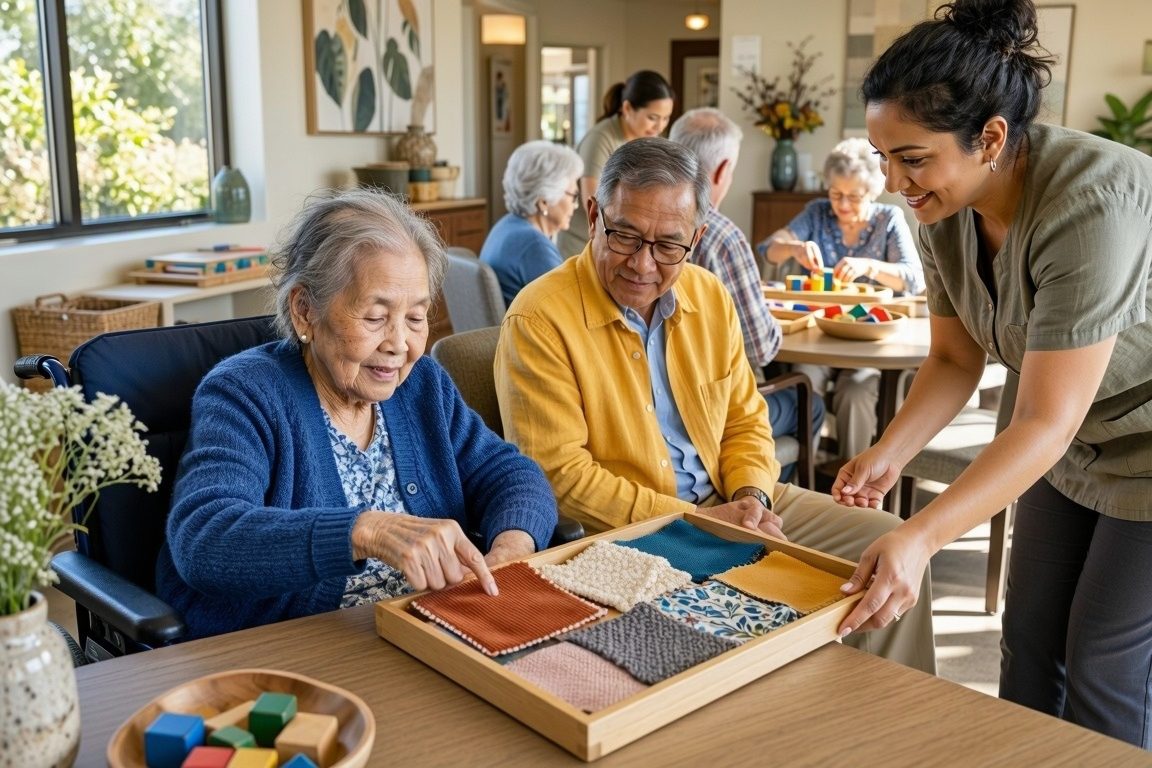
A small basket or box containing:
Rotate items weekly to maintain novelty.
One-Step Job Cards
A set of laminated cards with a single picture and a simple instruction: 'Wipe this tray,' 'Fold this napkin,' 'Roll this ball to me,' 'Hold this cloth.' Use the card as a visual cue while you say the instruction aloud. This reduces the need for verbal processing.
Memory Lane TV or Similar Streaming
A non-pharmacologic digital program that provides multi-sensory stimulation through videos, music, and sounds. It is designed for all stages of dementia and does not rely on plot or character. If not available, use a tablet to play slow nature documentaries or classical music with nature visuals.
The 'Side-by-Side' Setup
Arrange seating so that you are beside the resident, not across from them. This reduces the feeling of being watched or evaluated. Place the activity item on a table or tray in front of both of you. Model the action first, then gently offer the item to the resident.
Daily Mood and Engagement Log
A simple form with columns for: date, time, resident name, activity offered, resident response (e.g., 'smiled,' 'held item for 2 minutes,' 'turned away'), and staff notes. Share this with the care team to identify patterns and adjust approaches.
Different situations
Late-stage Alzheimer's disease (non-verbal, bed-bound)
Focus entirely on passive sensory input: play soft music from their youth, place a warm lavender-scented cloth on their hand, or gently brush their hair. Speak in a calm, low voice, describing what you are doing. Do not expect any response, your presence is the activity.
Lewy body dementia with visual hallucinations or fluctuating alertness
Avoid activities that rely on visual interpretation, like looking at photos or videos, as these may trigger hallucinations. Instead, focus on tactile and auditory engagement: a smooth stone to hold, a drum to tap, or a familiar song. Keep sessions short (5-10 minutes) and stop if the resident becomes agitated.
Frontotemporal dementia (behavioral variant) with disinhibition or apathy
Use activities that involve gross motor movement and a clear 'job', like sweeping with a soft broom, wiping a table, or pushing a cart. Avoid anything that feels like 'play' or 'silly,' as this may be rejected. Frame everything as a task: 'I need your help with this.'
Care partner visiting a loved one in a facility
Bring a personal item from home, a familiar blanket, a photo album with simple images, or a favorite song on a phone. Sit beside them and do the activity together. Do not worry about 'entertaining' them; just being present and touching their hand or arm can be deeply calming.
Activity staff working with multiple residents at once
Set up a 'sensory station' with one activity per resident (e.g., one has a scarf, one has a shaker egg, one has a tray to wipe). Move between them, spending 2-3 minutes with each, modeling the action and then moving on. Use a timer to ensure you rotate equitably.
For the doctor
4
- If a resident consistently refuses all touch or becomes agitated when approached, ask the clinician whether there may be undiagnosed pain, infection, or medication side effects contributing to the behavior.
- If a resident shows signs of distress (crying, yelling, hitting) during sensory activities, discuss with the clinician whether a referral to occupational therapy or a behavioral health specialist is appropriate.
- If you are considering using aromatherapy (e.g., lavender or peppermint oils), ask the clinician first, some essential oils can interact with medications or trigger respiratory issues in sensitive individuals.
- If a resident has a history of seizures or swallowing difficulties, discuss whether certain textures (e.g., small objects, scented sachets) pose a risk and what alternatives are safe.