Step by step
What not to do
- Do NOT correct or argue about the visit. Saying 'But your daughter was here yesterday' will only make the resident feel unheard and more frustrated. They cannot access that memory.Instead, validate the feeling: 'You miss her. I know.'
- Do NOT use logic or long explanations. A person with dementia cannot process complex reasoning in a moment of distress. Keep sentences short and simple. Avoid saying 'She couldn't come because of work', that adds confusion. Stick to emotional comfort.
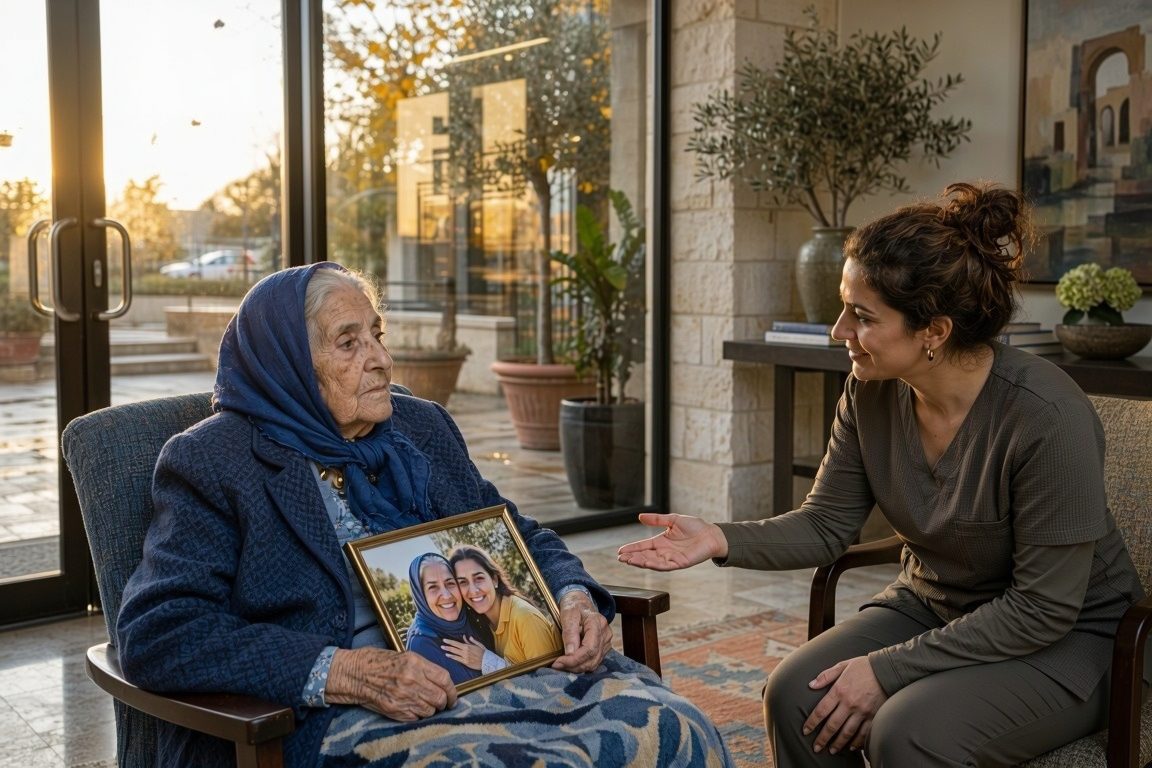
- Do NOT tower over the resident or stand with a tense face. Standing over them feels intimidating. A stressed expression can be read as anger or fear, escalating the situation. Always get to their eye level and soften your face.
- Do NOT say 'Do you remember?' This can cause embarrassment or anger because they likely do not remember. Instead of asking about memory, just state the positive: 'Your daughter loves you very much.'
- Do NOT take the accusations personally. If the resident says 'You never let my family visit,' resist the urge to defend yourself. They are not accusing you, they are expressing a feeling of loss. Respond with empathy: 'That sounds really hard. I'm sorry you're feeling that way.'
- Do NOT force a redirect too quickly. If you jump to a new topic without first validating their emotion, they may feel dismissed. Always acknowledge the feeling first, then gently shift. For example: 'I hear you're sad. Let's go look at the birds outside.'
Key points
- Never argue or correct about family visits, validate the feeling instead.
- Your body language and tone are more important than your words; stay calm, soft, and at eye level.
- Use short, simple sentences and one idea at a time.
- Redirect gently after validating, using a physical change of scene if needed.
- Build a 'family' of staff and other residents to create a sense of community and belonging.
- If the resident becomes angry, give them space and return when calm, do not take it personally.
Videos
 How Do You Calm A Screaming Dementia Patient?This video offers practical, step-by-step techniques for de-escalating a very upset resident, which is directly relevant when family absence triggers a loud or distressed response.
 How to Comfort Someone with DementiaThis video covers the core skill of emotional validation and gentle redirection, which is the foundation of comforting a resident who misses their family.
 How To Convince A Person With Dementia To MoveWhile about moving, this video teaches how to use validation and redirection to handle resistance, skills that transfer directly to comforting a resident upset about family visits.
 Dementia and accusations: How to respond when someone with dementia accuses you of never visitingThis video directly addresses the exact scenario of a resident accusing family of not visiting, offering scripts and strategies to respond without arguing.
2 more videos
 10 Tips For Responding To Anger in DementiaWhen the upset about family visits escalates to anger, these tips help you stay safe and calm while de-escalating the situation.
 Dementia Caregiver AngerThis video helps you manage your own frustration when a resident's accusations feel personal, which is crucial for maintaining a compassionate response.
Background
Why the Upset Happens: It's Not About Logic
When a resident with dementia says 'My family never visits,' they are not lying or being manipulative. Their brain has a disease that makes it hard to hold onto recent memories. Even if you saw their daughter visit yesterday, the resident may have no recollection of it. What they do feel is the raw emotion of missing someone, of feeling abandoned, or of sensing that something important is missing. As one dementia care expert explains, 'They simply do not remember that you were there visiting them.' So when you try to correct them by saying 'But they were just here,' you are arguing against a brain that cannot access that fact. That only makes the resident feel more unheard and more upset.
The Real Need: To Feel Seen and Safe
What the resident truly needs in that moment is not a factual correction, they need emotional comfort. They need to feel that someone sees their distress and cares about it. According to dementia care specialists, the first rule of comforting someone is to never make it sound like they are being unreasonable or overly emotional. To them, the feeling is monumental. When you validate their feeling, 'I can see you're upset. That must be hard', you lower their defenses. They stop fighting to justify their emotion and instead feel understood. This is the foundation for calming the situation.
The Caregiver's Role: Become a Bridge, Not a Barrier
Your body language, tone, and facial expressions matter more than your words. If you approach with a tense face or a rushed voice, the resident will pick up on that and feel more frightened or agitated. As one expert notes, 'They're gonna pick up on your nonverbals, they're gonna pick up on your facial expressions. If you're looking at them like 'I don't know what you want,' that's pretty scary for your loved one with dementia.' Instead, you want to be calm, gentle, and at their eye level. You are not there to solve the problem of the missing family; you are there to be a safe, warm presence. Over time, you can help the resident form new attachments to staff and other residents, creating a sense of community that lessens the pain of family absence.
Practical tools
6
Validation Phrases Cheat Sheet
Print or memorize these phrases: 'I can see you're upset.' 'That must be really hard.' 'You miss them, that's okay.' 'I'm sorry you're feeling this way.' 'How can I help?' 'Let's take a walk together.' Use these instead of corrections or explanations.
The 'Cramp in My Leg' Redirect
When a conversation is stuck on family absence, use a physical excuse to change the scene. Say, 'I have a cramp in my leg, would you mind if we walked a little?' This is a gentle, non-confrontational way to move to a different room or area, which can reset the mood.
Family Connection Kit
Work with the family to create a small box with:
When the resident is upset, bring out one item and use it to start a positive conversation. 'Look, here's a photo of your garden. Tell me about those flowers.'
Staff 'Buddy' System
Assign 2-3 consistent staff members to check in on the resident daily, even for just 2-3 minutes. One expert suggests: 'Get your mom attached to a couple people on the staff so that she feels connected and loved.' The resident will start to form new attachments, reducing the pain of family absence.
Calming Environment Checklist
Before approaching an upset resident, quickly scan the room:
Reduce clutter and noise. Offer a drink of water or a snack without asking, just place it nearby. A calm environment supports a calm mind.
The 'I'm Right Here' Presence Technique
Sometimes the best tool is simply sitting quietly beside the resident, at their eye level, with a gentle hand on their arm (if they welcome touch). Say very little, just 'I'm right here with you.' Your calm presence can be more soothing than any words.
Different situations
Lewy body dementia or Parkinson's dementia
These residents may have more visual hallucinations or fluctuating alertness. When they say family didn't visit, they may also be confusing a dream or hallucination with reality. Validate the feeling, but also check for other causes of distress like pain or medication side effects. Use very slow, gentle movements and avoid sudden noises.
Late-stage dementia (non-verbal or minimal communication)
Focus entirely on non-verbal comfort: soft music, gentle touch (if accepted), a familiar scent, or rocking in a chair. Do not use complex sentences. Your tone and face are everything. Watch for signs of pain (grimacing, moaning) and report to the nurse, pain can look like agitation about family.
Spouse vs. adult child caregiver
If you are a spouse, the resident may have more emotional attachment to you and may be more easily redirected by you. If you are an adult child, the resident may feel more abandoned by you, be extra patient. In both cases, avoid saying 'I'm here, aren't I enough?' Instead, validate: 'You miss your husband. I know.'
In a facility with strict visiting hours or COVID restrictions
Use video calls or recorded messages. Coordinate with staff to schedule a consistent time for a call. If the resident cannot use a phone, staff can hold the device and narrate. Also, encourage family to send letters or small gifts that staff can present as 'a surprise from your daughter.'
Resident has a history of aggression when upset
Prioritize safety. Keep a safe distance, do not corner them, and have a second staff member nearby. Use the 'give space' step early. Do not try to reason or touch them without warning. After they calm, debrief with the team to see if there is a pattern (e.g., always after lunch, or when a certain staff member is off).
For the doctor
4
- If the resident's upset about family visits is accompanied by new or worsening physical symptoms (pain, fever, constipation), discuss with the clinician, physical discomfort can mimic emotional distress.
- If the resident is on medications for anxiety or depression, ask the clinician if a review is needed, especially if the agitation is frequent or severe.
- If the resident has a history of falls, discuss safe ways to redirect them physically (e.g., walking together) without increasing fall risk.
- If the resident is refusing food or fluids because of the distress, discuss with the clinician and dietitian for a plan.