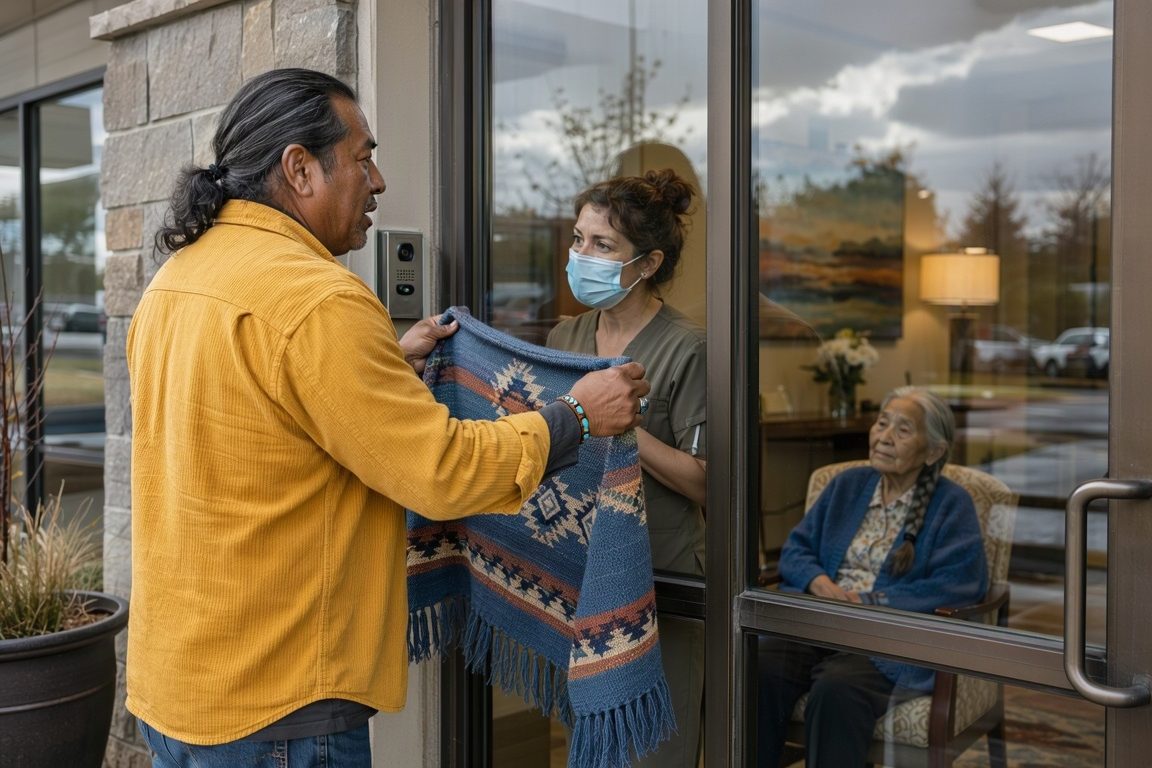
Step by step
What not to do
- Do not demand exceptions without offering a solution. Instead lead with empathy: 'I know you are trying to keep everyone safe. Can we find a safe way for me to see her?'
- Do not argue with staff about rules in front of your loved one. Schedule a private call later instead.
- Do not assume staff know how to connect with your loved one. Offer specific guidance like: 'When she gets upset, say, 'You are safe, I am here,' in a low voice.'
- Do not give up after one 'no.' Ask to speak with the social worker or administrator and try a different framing.
- Do not bypass or break facility rules (climbing through a window, removing a mask, showing up unannounced). Work through channels to change the rule.
- Do not forget to care for yourself. Join a support group, call a friend, or take 10 minutes to breathe deeply.
Key points
- Start with a person-centered care letter that gives staff concrete, usable information about your loved one’s preferences and triggers.
- Always lead with empathy and partnership, not demands. Acknowledge the facility’s challenges while advocating for your loved one’s needs.
- Offer specific, low-burden solutions like a comfort kit, a scripted visit card, or a daily call schedule.
- If you hit a wall, escalate respectfully to the social worker or ombudsman, framing it as a care plan discussion.
- Do not forget to care for yourself. Isolation affects care partners too. Reach out to a support group or take 10 minutes to breathe.
- Persistence, paired with respect, often works. Keep trying different approaches and stay connected.
Videos
 Can't visit your LOWD? 5 tips for staying connected during COVID-19 lockdownThis video offers practical, concrete tips for maintaining connection when you cannot visit in person, directly addressing the lockdown scenario.
 A Special Message From Teepa SnowTeepa Snow’s message validates the emotional struggle of lockdown and provides a compassionate framework for advocating for person-centered care.
 Ian Kremer Executive Director of the LEAD CoalitionThis video gives a policy-level perspective on advocating for systemic changes in dementia care during crises, which can inform your conversations with facility leadership.
 Dementia Care Needs PAC Now, More Than Ever - Go Fund MeThis video reinforces the urgent need for person-centered care (PAC) during the pandemic, which you can reference when making your case to staff.
2 more videos
 Courageous Conversations: Living Alone with DementiaWhile focused on living alone, this video offers insights into the emotional isolation of dementia, which can help you articulate your loved one’s experience during lockdown.
 How To Get Someone With Dementia To Accept HelpThis video provides techniques for reducing resistance, which can be adapted to help staff understand how to approach your loved one during visits or care tasks.
Background
Why Lockdowns Hit People with Dementia So Hard
During a pandemic or outbreak, memory care facilities often lock down to protect residents from infection. But for a person living with dementia, this sudden isolation can be devastating. As Teepa Snow’s Positive Approach to Care team explains, staff in these communities often have very little training on how to deliver compassionate dementia care while also practicing infection control. The result is that residents may be left alone in their rooms, confused and frightened, with no one who understands how to comfort them in a way that respects their personhood. The lockdown is meant to keep bodies safe, but it can unintentionally harm the spirit.
The Danger of a One-Size-Fits-All Approach
As the Dementia Careblazers remind us, a cookie-cutter approach rarely works for dementia care. Every person with dementia is unique. One person may become agitated if they cannot see a familiar face; another may be calmed by a recorded message. When facilities apply blanket rules, like 'no visitors at all' or 'only window visits', they ignore these differences. The person-centered care model, endorsed by the Alzheimer’s Association and NICE guidelines, insists that care must be individualized. You have the right to advocate for your loved one’s specific needs, even during a crisis. The key is to approach the facility as a partner, not an adversary.
Your Role as the Expert on Your Loved One
You know your person better than anyone. You know what calms them, what frightens them, what makes them smile. During lockdown, you become the bridge between your loved one’s inner world and the facility’s rules. The Dementia Careblazers emphasize that the focus must stay on the person, not the disease. When you advocate, you are not just asking for a favor, you are providing essential information that helps staff deliver truly person-centered care. Your voice is a critical tool for ensuring that your loved one is seen as a whole human being, even when the doors are locked.
Practical tools
5
Person-Centered Care Letter Template
One-page letter with:
Give copies to nurse manager and activities director.
Comfort Kit
Box or bag containing:
No training required.
Scripted Window or Video Visit Card
Index card with 3-4 short sentences like: 'Hi Dad, it's me. I love you. Look at this photo of your garden. I'll come back tomorrow.' Hand to staff facilitating the visit so they can read it if your loved one cannot hear well.
Compassionate Exception Request Letter
Short polite email: 'I understand the need for lockdown. I request a compassionate exception for my mother, [name], who has [dementia type]. She becomes severely agitated without seeing my face. Could we arrange a 10-minute masked visit in a ventilated area? I will follow all protocols.'
Daily Connection Schedule
One-page schedule with specific daily time for video call, window visit, or staff-led comfort-kit check-in. Include backup family contacts and a checkbox for staff to mark whether the interaction occurred.
Different situations
Lewy body dementia or Parkinson’s dementia
These individuals are often more sensitive to changes in routine and may have visual hallucinations. When advocating, emphasize the need for consistency and a calm environment. Say: 'My husband becomes very confused if his room is rearranged. Could you please keep his familiar items in the same place?' Also, request that staff avoid using antipsychotic medications unless absolutely necessary, as these can be dangerous for Lewy body patients. Always frame this as a discussion with the clinician.
Late-stage dementia (non-verbal, bed-bound)
Focus on sensory connection. Advocate for staff to play their favorite music softly in the room, use gentle hand massage with familiar lotion, and speak to them even if they cannot respond. Say: 'Even though she cannot talk, she can hear. Please tell her who you are and what you are doing. It comforts her.' Request a daily 'comfort visit' where a staff member sits with them for five minutes, holding their hand.
Spouse vs. adult child caregiver
If you are the spouse, you may have more emotional leverage. Use phrases like: 'I have been married to her for 50 years. I know when she is scared. Please let me help you calm her.' If you are an adult child, you may need to be more diplomatic. Say: 'I know you are doing your best. I want to help you understand what my mother needs. Can we work together?' The goal is the same, but the tone may shift.
Medicaid-funded facility (limited resources)
Acknowledge the facility’s constraints upfront. Say: 'I know you are short-staffed. I am not asking for extra time, just a small change in how you approach her. For example, could you play her favorite radio station during meals?' Offer to provide materials (e.g., a simple CD player, a photo album) to reduce their burden. Be patient and persistent, but realistic about what they can offer.
Facility with a history of poor dementia training
If staff seem unaware of person-centered care, start with education. Offer to share a short video from Teepa Snow’s Positive Approach to Care (the one provided in this guide) with the director. Say: 'I found this resource that might help your team connect with residents during lockdown. Could you share it at your next staff meeting?' This positions you as a helpful partner, not a critic.
For the doctor
4
- Ask your loved one’s doctor: 'Given my loved one’s specific dementia type, are there any medications or interventions that could help reduce agitation during isolation? I want to avoid anything that might cause harm.'
- Discuss with the facility’s medical director: 'If my loved one becomes severely depressed or anxious during lockdown, what is the protocol for a mental health consultation? I want to be proactive.'
- Ask the clinician: 'Are there any specific safety concerns I should be aware of if I request a window visit or a masked indoor visit? I want to balance emotional needs with infection risk.'
- If your loved one has a history of falls or wandering, discuss with the doctor: 'How can we ensure my loved one stays safe if they become more agitated due to isolation? Should we adjust their environment or routine?'